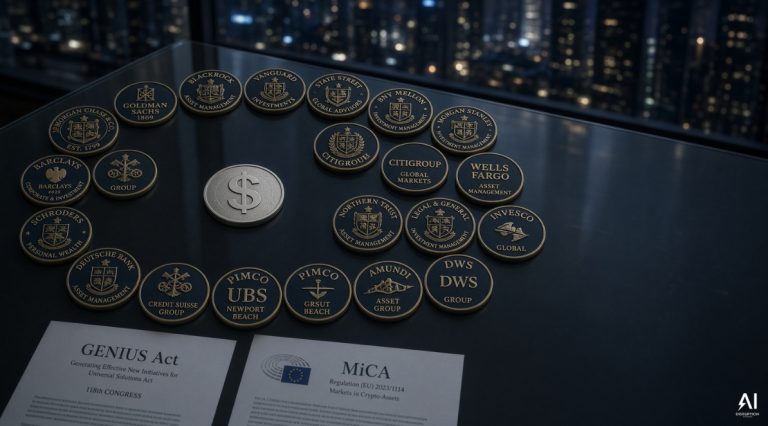

Stablecoins have become a divisive topic between banks and the crypto industry. For the past year banks have warned that yield-bearing stablecoins used by retail customers could pull deposits out of the traditional system. Brian Moynihan, chief executive of Bank of America, raised the issue publicly earlier this year, arguing that the sums involved could run into the billions. The debate fed into the broader fight over the Clarity Act and related legislation, and it has not fully gone away even as parts of the deposit question have been addressed.
At the same time a second question has emerged. Non-bank companies such as Tether and Circle have issued the stablecoins that dominate trading, payments, and on-chain liquidity. Banks have not launched equivalent products. What banks have released so far are tokenized deposits. JPMorgan’s JPM Coin is the clearest example. It is a deposit token that represents U.S. dollar deposits already held at the bank. It is available only to vetted institutional clients on Base and, since October 2026, on Ethereum. JPMorgan has stated that JPM Coin is a bank-issued deposit token, not a cryptocurrency or a stablecoin. Other banks have taken the same route rather than issuing open, fully reserved stablecoins that anyone can hold and freely transfer.
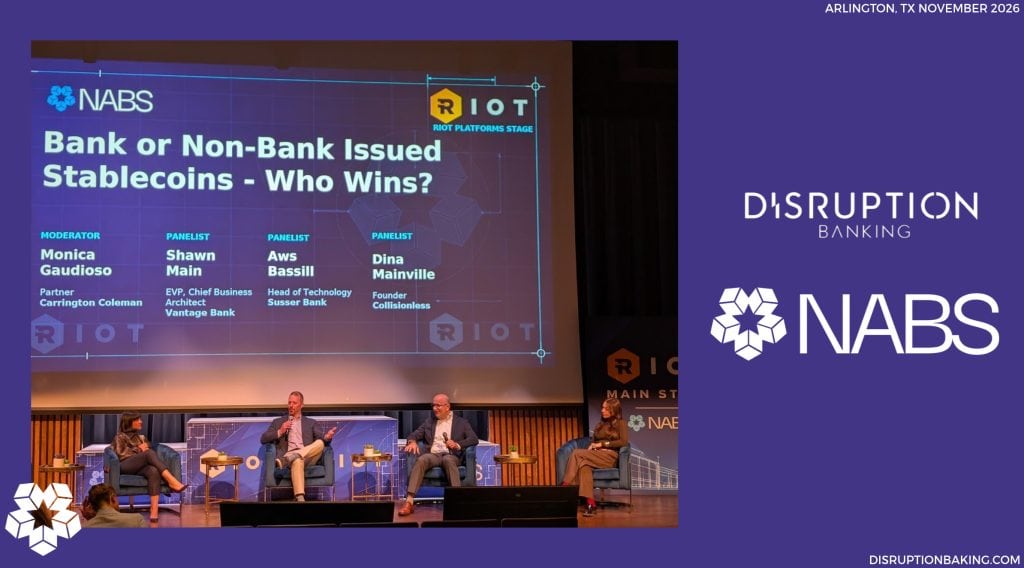
That distinction shaped the discussion at this year’s North American Blockchain Summit. Monica Gaudioso of Carrington Coleman asked the speakers whether the contest between bank-issued and non-bank-issued models has to end in a fatality or whether there is room for both. Shawn Main of Vantage Bank said both must exist and serve different purposes, covering domestic and global money movement as well as cash-like products. Aws Bassill of Susser Bank agreed it is not a winner-takes-all outcome. Dina Mainville of Collisionless said the real winner is the consumer, who benefits from optionality.
Different Use Cases, Different Advantages
Banks bring longstanding relationships, institutional readiness, and regulatory maturity. Non-bank issuers bring deeper liquidity, faster innovation, and easier portability. Mainville said non-bank issuers “work like Silicon Valley, move fast and break things, which provides a certain level of innovation advantage.” She also noted that redemption and movement of assets look different once you leave a single bank’s system.
Bassill said the ability to issue a coin does not mean a bank has to do it. “That’s not a fit for everyone,” he said. “At the end of the day, it comes down to the use case.” Sometimes the better path is using existing products or building on top of layers that already exist.
Main does not treat the technology as just another rail. “If you don’t look at it just like a rail, you look at how we can program and build programmable capabilities,” he said. “It actually opens up a whole new ecosystem of products and capabilities that we don’t have today.” Banks, he argued, need to take the learnings from DeFi and crypto and apply them inside the regulatory guardrails and trust that banking already has.
Obstacles for Banks and the Mindset Shift
Bassill said the barrier is not mainly the technology. “Once we get to a point where the innovation gets technology to disappear into a user experience, that’s where I would see banks and commercial clients and individuals will get better adoption,” he said.
Main called it a mindset shift. Banks run hundreds of technology projects a year, but they now have to decouple what they used to do and learn how to apply the new tools. “Education is a big problem,” he said. He told the audience to start asking their banks about it so the demand is visible. “If we don’t start to get our banks to move, there is going to be some fallout.”
Both he and Bassill rejected the idea of waiting. “Sitting out is not a strategy,” Bassill said. He pointed to the trillions in stablecoin transaction volume already moving outside the traditional system as the reason banks need to engage.
Mainville gave a concrete example from her own firm. “I’ve opened multiple bank accounts, even from my consulting firm, and I’ve been told, ‘Oh, we can’t service you because you work in digital assets,’” she said. Her firm does investigative work and does not take payment in digital assets. She argued the reputational-risk framing needs to be revisited. She also described a non-U.S. bank looking at yield-bearing stablecoin savings accounts as a competitive tool. Those banks, she said, see the lack of clarity or appetite at competitors as an opening for customers who want liquidity and fast access to funds.
Interoperability, Liquidity, and Partnership
Interoperability came up repeatedly. Mainville said a bank-issued instrument that can only be redeemed inside that one bank is less useful than “a globally accepted stablecoin again with deep liquidity and many service providers.” Main agreed that an abstracted experience for the end user requires the systems to work together. “If we just build islands, it’s going to be very hard to build all the boats to make it all work,” he said.
He also flagged liquidity and redemption as a larger future challenge. “The largest liquidity pool in the world is the United States community banking system,” he said. “We’ve got the largest distributed liquidity pool that ever existed. And so, why would we abandon that?” Redemption into trusted cash, he argued, remains essential.
On partnership, Main said banks have the compliance and risk muscle while non-bank issuers and fintechs have more of the innovation muscle. “There’s a good partnership there,” he said. Bassill made a similar point. Fintechs have speed and fewer restrictions; banks are built around risk management. “The best model will be if we combine a financial institution partnering or adopting that execution speed,” he said.
Mainville raised the geopolitical angle. “Stablecoins are a natural extension of the U.S. dollar,” she said. When reserves are held in dollar-denominated stablecoins it can expand dollar influence and affect demand for U.S. Treasuries. At the same time, widespread use in another country “reduces the ability of that foreign government to exercise monetary policy” and weakens the effect of its interest-rate decisions. That layer, she said, is often overlooked.
Advice for the Next Cycle
In the final minutes the moderator asked for any advice the panelists would recommend for non-believers. Main told the audience to talk to their banks and create demand. “Your banks need to be able to participate,” he said. Bassill repeated that sitting out is not a strategy and pointed again to the existing transaction volume. Mainville said the remaining gap is education. “Go talk to people that are doing it. Go talk to stakeholders that are doing it. Talk to consumers,” she said. “Pilots are important. Measuring success is important.”
The panel closed without declaring a winner. The speakers treated bank-issued deposit tokens and non-bank stablecoins as complementary for different use cases rather than as direct substitutes. Whether banks move past tokenized deposits into open stablecoins, or non-bank issuers keep the liquidity, is the open question for the next product cycle.
Author: Andy Samu
See Also:
DBS and JPMorgan Link Tokenized Deposit Networks for 24/7 Dollar Transfers | Disruption Banking
Credit Union of Texas Teams with BankSocial® to Break Crypto Myths | Disruption Banking
Stablecoins are Quietly Rewiring U.S. Banking but are Banks Ready for It? | Disruption Banking

Andrew Samu
Andrew Samu, Editor-at-Large at Disruption Banking, shapes the publication’s global coverage of banking, capital markets and digital assets. Based at London’s Level39, he combines market analysis with a strong commercial perspective, informed in part by his role as Commercial Director at Verita HR.