
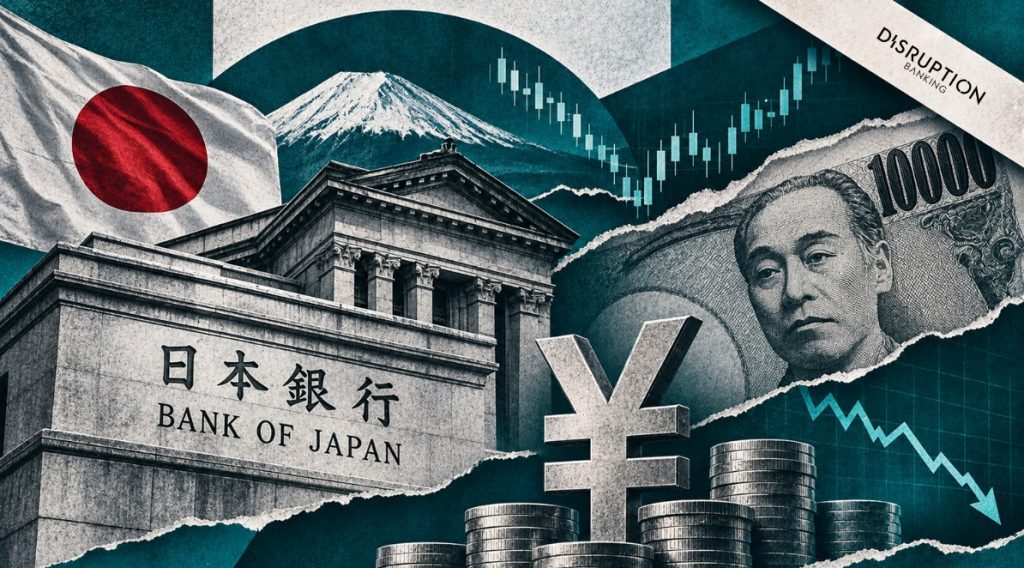
Bank of Japan members are signalling a strong chance of a rate hike at their December meeting. Yet the yen continues to slide.
The BOJ released the Summary of Opinions from its October 29–30 meeting on November 10, 2026. The board decided to hold it’s rate at 1.25% but signalled a willingness to raise in December.
Several members argued that the bank has already reached it’s 2% inflation target and that it needs to bring rates to a neutral level.
The yen was not strengthened on this news however, climbing above ¥158 per dollar in Tokyo trading. Structural factors including interest-rate differentials with the US continue to weigh on the yen.
Data released by Japan’s Ministry of Finance (MOF) on November 9 showed that the BoJ bought ¥15.34 trillion (around $97 billion) over three days in the summer, buying a record amount in order to prop up the currency.
The interventions temporarily lifted the yen, reaching ¥155 per dollar on August 3 and briefly around ¥152–153 in early September. But gains later faded; by November 9 the currency was back to trading around ¥158 per dollar.
Japan’s central bank seems unable to prop up it’s perpetually weak currency.
Japan’s many recent interventions
The BoJ has intervened in the yen market several times over the past few years to support the currency.
In 2022 the bank intervened for the first time since 1998, triggered by the yen reaching multi-decade lows of ¥150 per dollar. According to MOF data, it bought ¥2.84 trillion on September 22 followed by ¥6.35 trillion in total on October 21 and October 24.
Japanese officials have tried to maximise the impact of yen-buying interventions by keeping traders guessing. Most of the moves since late 2022 have been stealth operations; they rarely confirm anything on the day, so the market only finds out later from price spikes or official data.
In 2024, as the yen touched ¥160 per dollar, the BoJ intervened twice in classic ambush style. The MOF said the Bank bought ¥9.79 trillion in total on April 29 and May 1, then another ¥5.53 trillion over July 11-12, again without announcement and outside any obvious scheduled event.
Japan also intervened earlier this year, purchasing a total of ¥11.73 trillion over three days in April and May according to the MOF. This came during the Golden Week holidays in Japan when Tokyo markets are closed and volumes are thin.
They have tended to strike when liquidity is thin, such as during Golden Week or right before a Bank of Japan meeting, so a big order can shove the yen sharply higher and hit stop-losses. The bank also never names a specific level they’re defending, which stops traders from clustering around an obvious line.
The carry trade – Why the interventions don’t work
The BoJ’s interventions have only ever been able to buy temporary relief. They do not change the main forces that have kept the yen weak, so the market repeatedly fades the gains once the immediate pressure is absorbed.
The core driver has been the interest-rate gap. From 2022 onward the Federal Reserve and other major central banks raised rates aggressively while the BoJ stayed near zero or raised very slowly. That gap made carry trades attractive, spurring investors to borrow yen and park the money in higher-yielding currencies or assets, often dollars.
The large carry puts pressure on the Japanese currency as investors sell yen. Even after the BoJ began normalising policy, Japanese rates remained far below US rates for a prolonged period, so the incentive to sell yen never fully disappeared. The BoJ’s policy rate currently sits at 1.25% with the Fed rate at 3.75% – 4.00%.
Japan’s fiscal conditions also weigh on the yen. Japan’s public debt is the highest among major economies, running around 200% of GDP for years. An aging population and rising social-security costs have led to persistent budget deficits for Japan. This has led to eroding investor confidence in the yen.
Furthermore, the deficit has been financed partly through massive purchases by the BoJ of Japanese government bonds. The large-scale buying kept long-term yields near zero for more than a decade under yield-curve control and quantitative easing. The resulting ultra-low interest rates widened the gap with the United States and other economies once they began hiking after 2022.
Interventions can only ever interrupt, not reverse these forces. A sudden multi-trillion-yen purchase can squeeze short positions, trigger stop-losses and produce a sharp bounce, especially when it hits a thin market. But once that one-off buying is finished, the same fundamental sellers reappear.
How the US offers some hope for the yen
The United States’ vested interest in a stronger yen may be a cause for cautious optimism for the yen going forward.
Japan is the largest foreign holder of US Treasuries (around $1.1 trillion). Heavy, prolonged dollar-selling by Japan to buy yen could require the BoJ to liquidate Treasuries, pushing up US yields and raising the cost of financing large US deficits
US officials, including Treasury Secretary Scott Bessent, have framed a stable yen as important for the region and for limiting volatility that could feed back into US markets. Following the joint intervention in July Bessent saidin a post on X that the US “will not hesitate to participate in further joint intervention.”
Japan has also been given access to the Federal Reserve’s Foreign and International Monetary Authorities’ Repo Facility. This allows the BoJ to borrow dollars on a short-term basis by pledging their US Treasury holdings as collateral, rather than selling those Treasuries in the open market.
Bessent publicly pushed to expand or encourage greater use of the facility so Japan could raise the dollars needed for yen-buying without dumping Treasuries and spiking US yields. After the July 2026 joint action, Japanese officials confirmed they planned to use it for future operations.
In practice, the facility’s actual draw by Japan appears to have been limited or unused in the immediate aftermath, but the signalling effect of access has been viewed as important for market confidence.
However, despite public support from the United States, until the interest-rate gap narrows meaningfully, even well-coordinated intervention is likely to remain a temporary brake rather than a lasting turn in the yen’s direction.
Author: Scott Danaher
See Also
Why the U.S. Sold Europe’s Currency to Save Japan’s | Disruption Banking
Has the Japanese Yen Lost Its Safe-Haven Crown in 2026? | Disruption Banking