

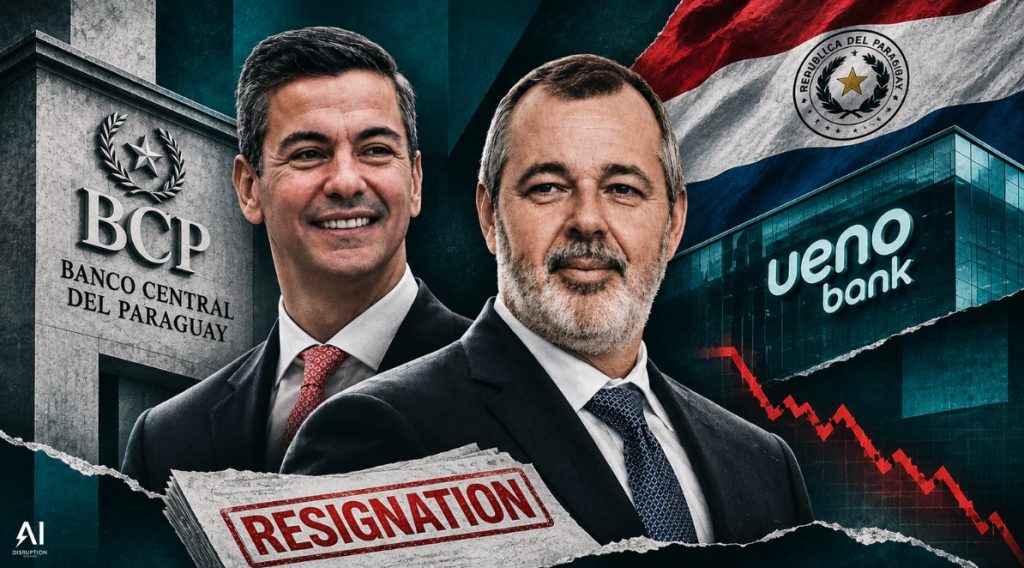
Paraguay’s central bank president Carlos Carvallo resigned on Tuesday, November 3, after the collapse of Ueno Bank amid a series of scandals tied to Carvallo and President Santiago Peña
The Central Bank of Paraguay (BCP) voted unanimously on Monday to take control of Ueno Bank after its solvency ratio fell to below half the legal minimum. The decision leaves the deposits of roughly 3 million customers (roughly 60% of the adult population) and approximately $380 million in pension fund investments at risk.
The intervention was a pure digital freeze: Ueno’s app, cards and transfers went offline overnight, locking out roughly three million customers with no physical branch alternative for most. Prosecutors ordered the arrest of eight senior executives and businessmen linked to the bank, including CEO Federico Miguel Vázquez (also president of Grupo Vázquez) and bank president Juan Manuel Gustale. Courts also froze assets connected to the group. The BCP has repeatedly stated that the problems are confined to Ueno and do not pose a systemic risk to the rest of the Paraguayan financial system.
President Peña requested Carvallo’s resignation amid the crisis. On November 4, opposition lawmakers and some Colorado Party dissidents filed formal impeachment charges (juicio político) against Peña and Vice President Pedro Alliana, citing alleged conflicts of interest and the handling of public and pension funds linked to Ueno.
The BCP has stated Carvallo recused himself from Ueno-related supervision decisions while Ueno says Peña was never a shareholder or investor in the bank.
Who is Carlos Carvallo?
Carvallo’s early career included roles in Paraguay’s Ministry of Finance. He then spent roughly 15 years in international organisations, working as a technical economic advisor in the Mercosur Secretariat, heading a department focused on relatively less-developed countries at the Latin American Integration Association (ALADI), and consulting for bodies such as the Inter-American Development Bank (IDB) and UNDP.
From 2015 to 2020 he was a full member of the BCP Board of Directors. In that role he participated in monetary and financial policy and served as an alternate governor representing Paraguay at the IMF.
After leaving the board in 2020 he moved into the private sector. In June 2021 he became president of Financiera Ueno, the predecessor entity to what became Ueno Bank, a position he held until mid-2023. During this period the institution was still a finance company; its formal conversion to a full bank was approved later in 2023. Under the ownership of Grupo Vázquez it pursued aggressive digital growth, customer acquisition, and later expansion, eventually reaching millions of clients.
He assumed the central bank presidency on September 1, 2023, after being nominated by President Peña. His tenure became increasingly controversial in 2026 as scrutiny of Ueno intensified over related-party lending, solvency issues, and the large volume of public funds held at the bank.
BCP’s supervisor documented that Ueno disbursed roughly US$146 million between September 2025 and May 2026 in loans and credit facilities to three companies (Mowi SA, Grupo Hendy SA, and Grupo M SA) that supervisors treated as related parties linked to Grupo Vázquez, the bank’s controlling shareholder.
These loans were often granted on signature alone, with weak guarantees and preferential terms, and the funds frequently flowed onward to other entities in the group. This occurred while Ueno held large volumes of public and pension money—roughly US$800–855 million in total, including approximately US$345–355 million from the Instituto de Previsión Social (IPS).
Critics questioned the integrity of Carvallo’s move from president of Financiera Ueno (the bank’s predecessor) to president of the Central Bank of Paraguay, the institution responsible for supervising it.
What next?
Initially, Carvallo said he would stay temporarily to help manage the Ueno resolution process, but the board moved quickly. Liana Caballero, a sitting board member with long experience inside the BCP, was designated interim president on the same day Carvallo resigned.
On November 4, Peña nominated Raúl Vera Bogado, a former BCP president from 2001–2002 and longtime banker, as the permanent successor. The nomination still needs Senate confirmation. Vera Bogado was previously fined by the BCP itself in 2022 for regulatory breaches related to asset classification and credit risk—something critics have already highlighted.
As for depositors at Ueno, Paraguay’s Deposit Guarantee Fund covers up to ₲228.3 million (roughly $38,000) per person or company. An initial payout is set for around November 6, prioritising small savers and people with accounts elsewhere; the full guaranteed amount is targeted within the legal 15-day window (extendable once, around November 17).
Author: Scott Danaher
See Also: