

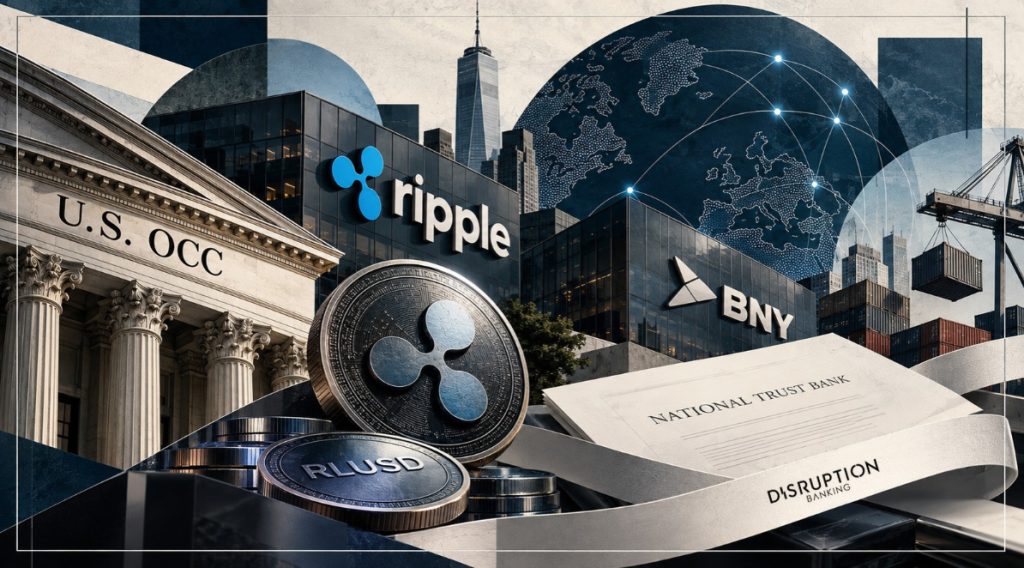
Ripple said on October 26 that the Office of the Comptroller of the Currency (OCC) has granted final approval to charter Ripple National Trust Bank (RNTB), ending an organization process that started when the regulator gave the company conditional approval in December 2025. Bloomberg, which reported the approval a day later, described it as the latest step in Ripple’s push into traditional finance.
The charter was the first of several announcements Ripple timed around its Swell 2026 conference in New York. Within two days, the company also released new Ripple Treasury features and an expanded custody and trade finance arrangement with BNY, and all three place Ripple USD (RLUSD), its dollar-backed stablecoin, at the center of products sold to institutions and corporate finance teams.
Ripple National Trust Bank’s Three Approved Activities
A national trust bank is a narrower institution than a commercial bank. The OCC’s conditional approval letter describes RNTB as a bank that will engage in the operations of a trust company. Under its approved plan, RNTB will manage the segregated reserves supporting RLUSD, act as collateral trustee of those reserves for RLUSD holders, and provide fiduciary digital asset custody services once it opens.
RLUSD issuance does not move to the new bank. Standard Custody & Trust Company, Ripple’s limited purpose trust company regulated by the New York Department of Financial Services (NYDFS), remains the issuer, so the charter adds OCC supervision on top of the state oversight already in place. Ripple said it will keep working with the OCC, NYDFS and other regulators as RNTB begins operations, though its release gives no opening date.
The approved scope differs from Circle’s. Circle received final OCC approval for its own national trust bank in July, and that bank will initially provide custody for Circle’s digital assets, with oversight of USDC reserve management planned for a later stage. RNTB’s approval covers RLUSD reserve management from the outset.
RLUSD Reaches $2.5 Billion as BNY Adds XRP and RLUSD Custody
On October 27, Ripple and BNY expanded their collaboration. BNY was already the primary reserve custodian for RLUSD and a custodian for Ripple Prime, which won a multi-asset brokerage mandate from Brevan Howard earlier this month. It now supports XRP and RLUSD on its Digital Asset Custody platform for eligible institutional clients. BNY reported $63.4 trillion in assets under custody and/or administration as of September 30, 2026.
Corporate treasury is going always-on. 🌐
— Ripple (@Ripple) October 26, 2026
Today, we're introducing new Ripple Treasury capabilities that bring together AI-powered automation, liquidity management, and digital asset infrastructure to help businesses manage and move money around the clock.
More on what's new:…
The two companies also said BNY intends to let its clients mint and redeem RLUSD directly through BNY and to broaden its support for tokenized assets issued on the XRP Ledger (XRPL). On trade finance, they said they intend to advance tokenized trade finance on XRPL, subject to client requirements, and are exploring a supply chain finance initiative with C2FO, a working capital platform, aimed at widening investor access to the asset class. The release gives no launch date for either plan.
The same release puts RLUSD’s market capitalization at approximately $2.5 billion, continuing the growth Disruption Banking examined in March, and says XRPL has processed more than 4.6 billion transactions since launch.
24/7 Returns Targets Corporate Cash Left Idle After Banking Hours
The Ripple Treasury update introduced 24/7 Returns, which lets eligible corporate customers earn returns on qualifying digital assets held in a Ripple wallet, including RLUSD, subject to program requirements. The release names American Airlines, Trax, Christian Louboutin, Subway, Adecco and Kingfisher among the businesses Ripple Treasury serves. The product follows Ripple’s earlier work on tokenized money market funds.
The release does not state what rate 24/7 Returns pays, which Ripple entity pays it, or which assets generate it. Those details determine how the product sits within US stablecoin rules. The GENIUS Act generally bars payment stablecoin issuers from paying interest or yield tied to holding a stablecoin, and an OCC proposal published in February 2026 would treat yield that an issuer funds indirectly through affiliates as inconsistent with that ban.
Ripple’s charter announcement says it will work with regulators as the US implements the GENIUS Act framework. Once RNTB opens, RLUSD’s reserves will sit under both state and federal supervision, while the token itself is already part of BNY’s custody offering and Ripple’s corporate treasury product.
Author: Ayanfe Fakunle
The editorial team at #DisruptionBanking has taken all precautions to ensure that no persons or organizations have been adversely affected or offered any sort of financial advice in this article. This article is most definitely not financial advice.
See Also:
Ripple’s RLUSD Rise: Is This the End for XRP? | Disruption Banking