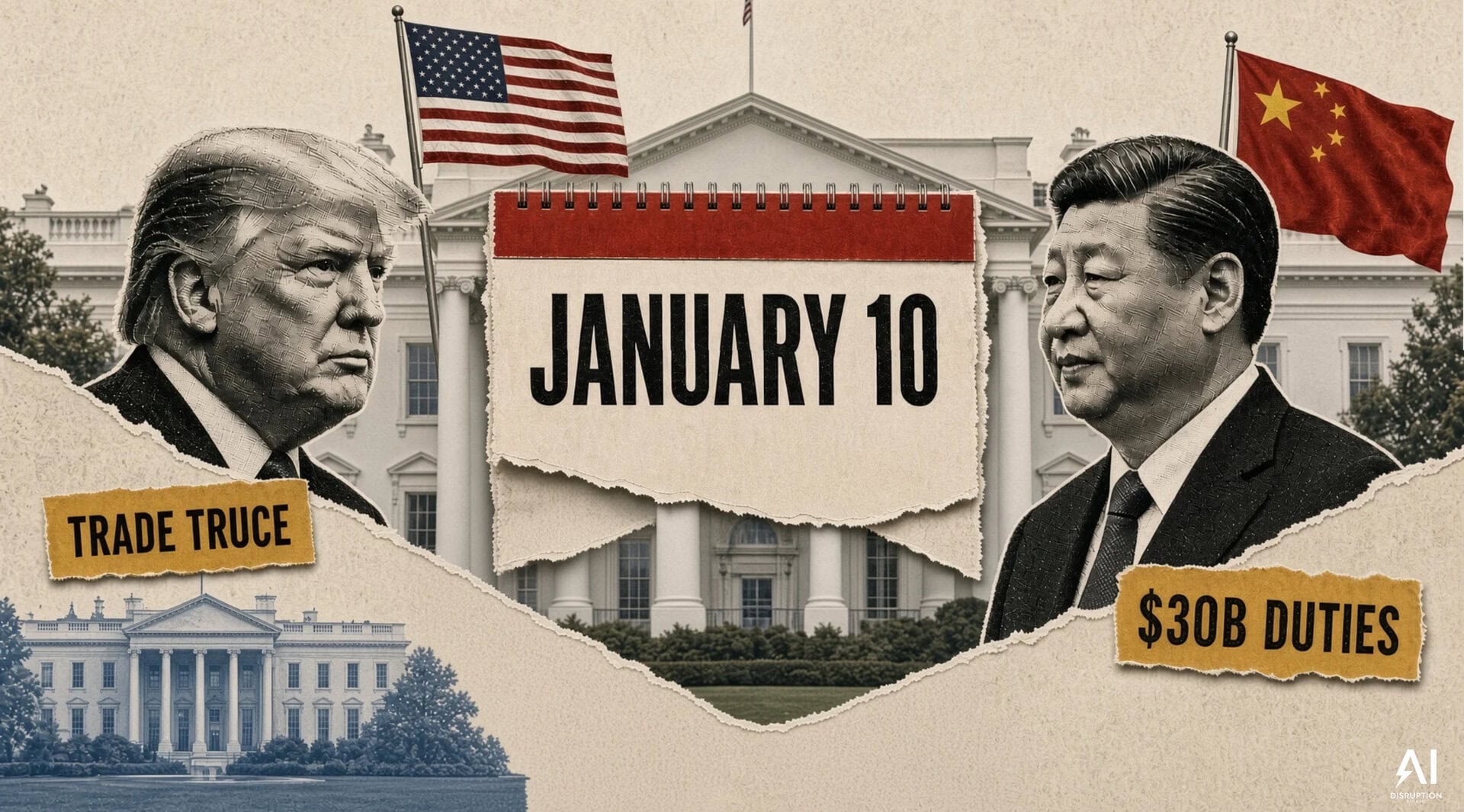
Xi Jinping arrived in Washington this week for his first White House visit in more than a decade. Trump called the talks a great meeting.
Scott Bessent, the US Treasury Secretary, said the trade truce struck in Busan last October would run to January 10, not November 10. That adds two months to a relationship that still carries tariffs, rare earth elements and magnets, farm purchases and an unfinished argument about technology.
Xinhua reported that Xi spoke of a new trade arrangement and called it good news for both industries and the global economy. Bessent’s version was much plainer. The extra weeks were “to give us more time to see what we can do on the economic front.”
US-China Trade Truce Extended to January 10, Not Through 2026
The original pause followed a year in which tariffs went into triple digits and China tightened the flow of rare earth elements and magnets. Washington eased some of the levies. Beijing promised soybeans, a steadier supply of those magnets, and later, in May, Boeing aircraft and a further $17 billion a year of American farm goods. Progress since then has been uneven.
Soybeans have moved. China has been taking cargoes toward the 25 million tonne Busan pledge. Rare earth magnets have not. Shipments to the United States fell to 512 metric tonnes in August, down 20 per cent from July and 13 per cent from a year earlier. Some American buyers are still waiting months for licences. Some Chinese suppliers are still declining US orders.
Two extra months keep the current terms in force. They do not settle what tariffs, rare earth magnet shipments or farm purchases look like after that.
Bessent also flagged work on a cut in duties covering about $30 billion of non-critical goods on each side, and possible announcements on agriculture and financial services.
China’s $1 Trillion Surplus and the $54 Billion Bank Injection
China’s trade surplus is on course to exceed $1 trillion for a second year. Factory output has stayed strong even as domestic demand has not. Disruption Banking set that out in July. The export surplus remains the support under Chinese growth. It is also the point Washington keeps coming back to.
Earlier this month the finance ministry put $54 billion into eight state banks and insurers, including Exim and Sinosure, the policy institutions that stand behind Chinese trade. More capital does not, on its own, produce more borrowers.
Cross-border payments have been shifting at the same time. In April, China’s Cross-Border Interbank Payment System handled record daily volumes. Most invoices still clear in dollars. A growing share of politically sensitive cargoes does not. Deutsche Bank’s role as an RMB clearing bank for Europe in Frankfurt is part of that shift.
Citi’s China Brokerage Licence and Wall Street’s $17.2 Billion in Chinese Tech Deals
Citigroup expects final approval this month for a wholly owned mainland brokerage, a licence it first sought in 2021. JPMorgan, Goldman Sachs and Morgan Stanley are already onshore. Citi would be arriving after them. It would also be in a market where the foreign-owned securities units made more money last year than the politics would suggest.
The other fact is less comfortable, and it is already visible in the deal list. US banks have been bookrunners on 19 Chinese high-tech equity deals worth $17.2 billion this year, nearly 30 per cent of that sector’s issuance, according to LSEG data. The same industry is raising money in America. The pre-summit session between Bessent and Vice Premier He Lifeng was held at JPMorgan’s headquarters in Manhattan.
Goldman Sachs, Anthropic and the Hong Kong AI Split
Artificial intelligence was on the agenda as a possible incident channel and a wider technology talk. The split is already very real.
Goldman Sachs cut Hong Kong staff off Anthropic’s Claude in the spring. Mainland China already keeps American models behind the firewall. Hong Kong used to be the exception. It is becoming the test of where a US contract ends, and a China risk committee begins.
What Happens if There Is No Deal Before January 10
January 10 is not a settlement date. It is a tariff renegotiation date.
If the $30 billion cut in duties on ordinary goods appears, the first prices to move will be in consumer cargoes, energy and agriculture. If a financial services concession appears, the onshore licences and the offshore yuan map will be back in focus. However, if neither appears, existing facilities stay in place until the first week of January, when the current terms run out.
Trump and Xi can call the week what they like. The terms run to January 10.
Author: Andy Samu
The editorial team at #DisruptionBanking has taken all precautions to ensure that no persons or organisations have been adversely affected or offered any sort of financial advice in this article. This article is most definitely not financial advice.
See Also:
Why Goldman Sachs Blocked Hong Kong Bankers from Anthropic’s Claude AI | Disruption Banking