Hyperliquid’s HYPE token price touched an all-time high of $83.53 on August 26, pushing its market capitalization to roughly $19.5 billion and putting the exchange’s native token into crypto’s top ten by market cap. Trading volume topped $1 billion for the day.
The rally has been building for a week, but the token’s next move may depend less on trading charts and more on what happens in Washington.
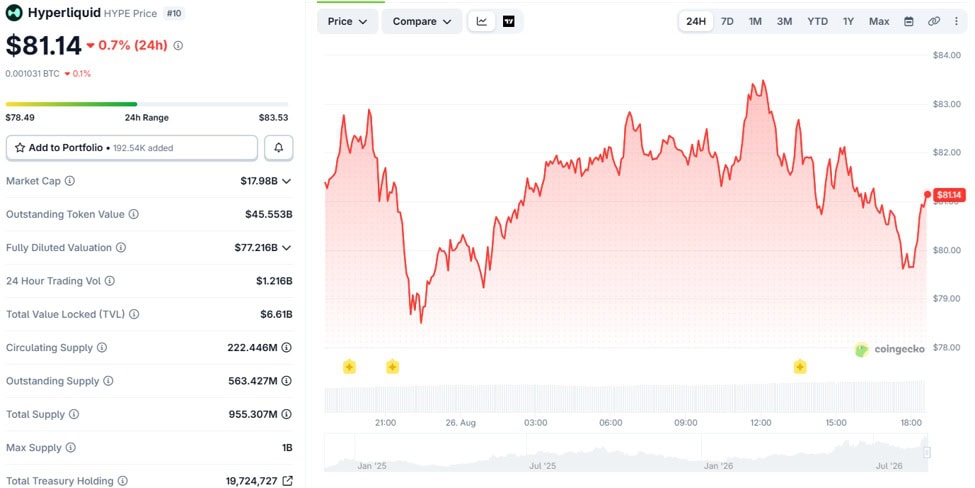
HYPE Climbs as Trump Puts Hyperliquid on the CFTC’s Desk
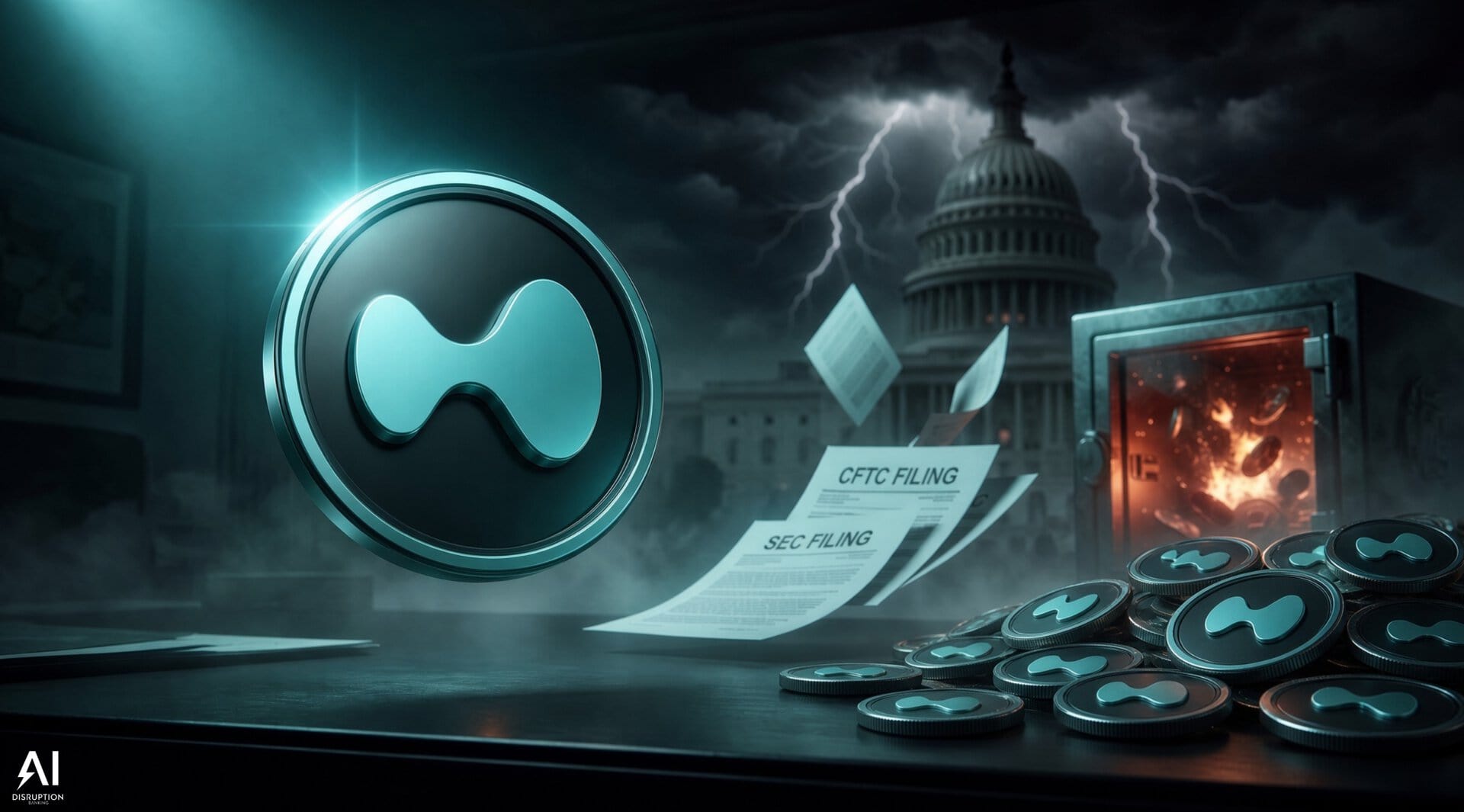
The most immediate catalyst came from the White House. President Trump told a gathering of crypto executives, including Coinbase’s Brian Armstrong, Ripple’s Brad Garlinghouse, and Robinhood’s Vlad Tenev, that the Commodity Futures Trading Commission was “working very hard” to bring Hyperliquid into the United States in a “fully compliant and legal fashion.”
HYPE jumped 16% after Trump’s comments. The remarks fall short of formal approval or a timeline, and bringing an offshore derivatives platform onshore would still require meeting the same customer-protection and market-oversight standards that govern any U.S. futures venue.
Hyperliquid’s CFTC and SEC Push for U.S. Approval
Hyperliquid isn’t waiting for Congress to settle the broader question of crypto market structure, a fight Disruption Banking has tracked as the CLARITY Act stalls in the Senate. Instead, the exchange is working with regulators directly, on two fronts at once.
The Hyperliquid Policy Center, alongside wallet provider Phantom, filed with the CFTC asking regulators to confirm that blockchain developers running self-custodial markets shouldn’t automatically trigger exchange or clearinghouse registration requirements. Jake Chervinsky, the Policy Center’s chief executive, said the goal is for regulators to interpret existing rules in Hyperliquid’s favor, or write new ones that better fit how self-custodial platforms actually operate. The stakes are clear: about 32% of Hyperliquid’s second-quarter trading volume came from stocks and other real-world assets, a business line with no clear path to U.S. users today.
Separately, Hyperliquid Policy Center and trading partner trade[XYZ] asked the SEC to consider a framework for pre-IPO perpetual contracts, instruments that let traders take a position on a company’s expected valuation before it lists publicly, without conferring ownership or voting rights. The filing cited past pricing accuracy, noting that actual IPO prices have landed 10.8% to 38.4% below the prior-day price for these contracts.
Not every established player is convinced the model is safe at scale. CME Group and ICE have separately raised manipulation concerns with U.S. regulators about how these markets are priced, a reminder that Hyperliquid’s ambitions are colliding with incumbents who have their own lobbying weight. FalconX strategist Martin Gaspar told CoinDesk that the platform’s real edge is letting traders combine positions across asset types in one place, pairing, for instance, a stock-linked perpetual on a company like Nvidia with an outcome-market bet on its earnings, something no single traditional venue currently offers.
The Buyback Machine Behind the Price
Much of HYPE’s price support comes from mechanics rather than sentiment. Hyperliquid routes nearly all of its net trading fees into an Assistance Fund that continuously buys HYPE on the open market, a structure that has produced more than $1.16 billion in cumulative buybacks since launch. The fund’s design has no private key and no withdrawal mechanism, which is why validators voted in December 2025 to formally treat roughly 37 million HYPE tokens sitting in the fund, worth close to $1 billion at the time, as permanently burned rather than merely idle.
On top of that structural buyback, a new mechanism called AQAv2 went live on August 26, directing yield earned on the platform’s USDC reserves into additional repurchases and burns. Institutional demand is arriving through a separate channel: spot HYPE exchange-traded funds from 21Shares and Bitwise pulled in a combined $53 million within their first few trading sessions, giving traditional investors a regulated wrapper around a token that still trades mostly on offshore, self-custodial rails.
Fee Revenue Fell 43% From Its Peak
The harder question is whether the fees feeding that machine can keep up with Hyperliquid’s growth. Gross protocol revenue fell 43% from its 2025 peak, dropping from $357 million to $202 million in the second quarter of 2026, even as trading volume and open interest reached record highs. The culprit is HIP-3, a program that lets outside builders launch their own markets on Hyperliquid’s infrastructure and keep up to half the trading fees for themselves.
Real-world-asset perpetuals built through trade[XYZ] now account for a substantial piece (not more than half) of the trading volume on the platform, up from just 2% earlier in the year, and Hyperliquid passes those builder fees through as a cost rather than keeping them. The result: the Assistance Fund’s HYPE purchases dropped 49% quarter over quarter, from $290 million to $149 million.
A $1.2 Billion HYPE Token Unlock Arrives August 29
Roughly $1.2 billion worth of HYPE tokens unlock on August 29, about 14.18 million tokens, split nearly evenly between early investors and the community, with a small share to the Hyper Foundation. The insider slice alone is worth about $560 million.
It’s the largest monthly unlock since Hyperliquid launched in November 2024. Past unlocks have produced mixed results, with the token falling 14.1% after May’s release, rising 1% in June, and dropping 7% in July. Traders are watching insider allocations most closely, since early backers hold tokens acquired at a fraction of current prices.
Whether HYPE holds its record depends on which force wins out first: a regulatory green light that expands its addressable market, or a fee structure that has to prove it can fund a billion-dollar buyback program while giving away half its edge to the builders driving its growth. The same institutional adoption dynamics have already reshaped how Wall Street firms treat crypto tokens more broadly, as Disruption Banking examined in its look at Goldman Sachs’ shifting XRP ETF position.
Author: Ayanfe Fakunle
The editorial team at #DisruptionBanking has taken all precautions to ensure that no persons or organizations have been adversely affected or offered any sort of financial advice in this article. This article is most definitely not financial advice.
See Also:
Zcash’s Rally Gets an ETF Behind It, and Privacy Coins Are Back on the Table | Disruption Banking