Summer makes networking harder for fintech startups. Events like Money 20/20 or Fintech Connect are in the rear-view mirror for many companies, while Singapore Fintech Festival becomes the focus for many going into the second half of the year.
It’s during these events that the editorial team at DisruptionBanking often meet some of the most promising startups like Permutable, Quai Network, BankSocial, and more recently R34DY from Hungary.
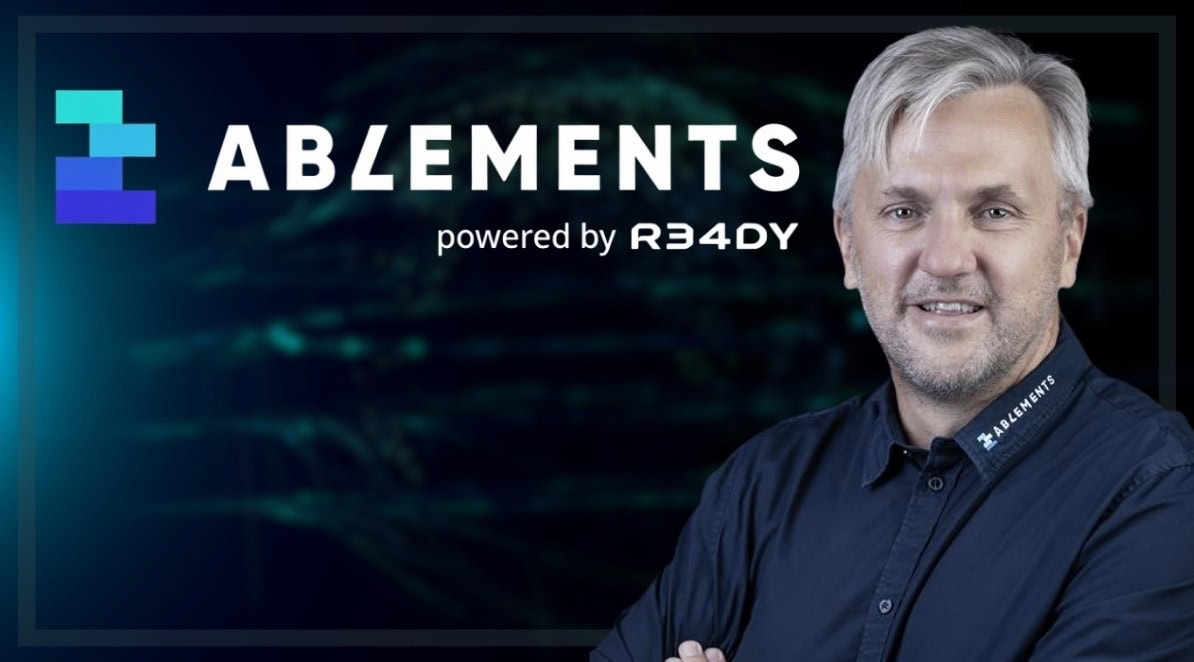
Led by the charismatic Mark Hetenyi, R34DY’s team was at Innovate Finance in London in 2025, as well as a host of other events. A quick look at the Ablements site shows a packed calendar: Fintech Connect in London, the BIAN Banking Summit in Chicago, Money20/20 in Las Vegas and Amsterdam, SIBOS in Frankfurt, MoneyLive North America, FinovateFall in New York, TechMeeting GenAI Exploration in Paris, and the MEA Finance Banking Technology Summit in Dubai. Few Hungarian fintechs have matched that level of consistent international presence.
Whilst on a discovery trip to Budapest, we sat down to talk about legacy modernization, AI reliability, and what comes next for the platform.
The Hungarian Startup building from Budapest
Mark Hetenyi is the co-founder, and co-CEO of R34DY. Previously he worked as Chief Digital, Retail and Strategy Officer at leading Hungarian bank, MKB Bank. Importantly, he has also worked and studied in Silicon Valley where he finished his MSc in Computer Engineering.
One distinction worth clarifying is how the company positions itself. R34DY was founded in October 2019, the Ablements brand you will often see mentioned by the company is its platform focused on “context engineering” for banking IT transformation. This platform can create structured digital twins of a bank’s legacy systems, data, processes, and architecture so AI can reason about and modernize them more reliably.
Speed Dating in Las Vegas
The team’s recent US trips included Fintech Meetup in Las Vegas, MoneyLive, Money20/20 and Finovate in New York. Fintech Meetup stood out.
“They focus more on speed dating. You go in and you have thousands of tables. I found a genuine amount of real interest at this conference to solve acute problems,” Hetenyi said.
Conversations with the largest banks took place, but the stronger pull came from the middle market. Credit unions in particular. Many already share capabilities through Credit Union Service Organisations. The risk is that those shared entities themselves become the next legacy layer if they stay on outdated technology.
There is also a consolidation angle. The US credit union sector is active in mergers and acquisitions. Transparent, well-mapped IT makes an institution more attractive – from both the buyer and seller angle. For now, the company remains focused on Central and Eastern Europe while building presence in Western Europe and the US middle market. Asia is later on the roadmap.
Trust, token costs and scaffolding
Hetenyi is careful about the current wave of AI tools. Many large providers promised to map entire architectures. In practice that has sometimes increased mistrust.
“There’s a trust question. A lot of companies have offered solutions and said they can build the scaffolding around your systems. That has led to mistrust in AI more than it used to.”
Token costs add another barrier. Mapping a complex architecture with general-purpose models can run into hundreds of thousands or even millions. CFOs notice.
Ablements takes a narrower path. It works on enterprise architecture only. It does not need customer data. And it reads documentation, source code and database schemas. Deployments are usually on-prem and often use smaller open-source models. The aim is a reliable, low-cost scaffolding that makes every later AI step smarter and more deterministic.
From systems integration to context engineering
R34DY began as a systems integration firm. Hetenyi and his original partners had lived through the internal friction of banking transformations. The name “Ready” came from that experience: they felt ready to take a different approach to market.
Ablements evolved from an earlier iPaaS (Integration Platform as a Service) idea once the practical value of AI for architecture mapping became clear. The platform is deliberately not a coding engine, and not a full digital banking front-end in the style of Backbase or Temenos.
“The entire software development lifecycle is not about coding. It’s about people understanding each other. Our software tries to take the heavy lifting out of that inflated process.”
Hetenyi is frank about the current state of AI-generated code. Without a clear map of the existing estate, banks risk simply accelerating the next generation of legacy. Ablements is designed to give architects a structured view of what already exists before new work begins.
The team behind the scaffolding
The technical side of R34DY has a strong DevOps legacy. Hetenyi values that background. “DevOps people are good because they have a real breadth of view of systems. Coders just like the code. DevOps people know where it can go wrong, performance, efficiency, security.”
That technical backbone helps the entire organization. There is also a mix of strong frontend and backend engineers plus people deep in AI. The core stack is focused: Java for the backend, Angular for the frontend, Python for the AI work. The platform has already proven it can read .NET environments and older languages such as COBOL by translating them into a universal architectural model. The ideal customer remains the enterprise architect who sees the full web of interconnections, including the systems no one has touched for decades.
Hungarian roots and competitive spirit
When the conversation turns to national identity, Hetenyi is measured but clear. He is half American and half Hungarian and spent most of his formative years in the United States. What he chooses to put forward is a culture of innovation and competitive drive.
He points to John von Neumann’s foundational work on computing and neural networks, the Rubik’s Cube, and Hungary’s strong per-capita record in the Olympics. “There’s a huge competitive spirit in Hungary that I am proud of. That’s what I share with others about my Hungarian heritage.”
The company is still early. Customers are being won primarily in Central and Eastern Europe. The US middle market and Western Europe are the next priorities. The product thesis, low-cost, on-prem, architecture-first scaffolding that makes AI usable inside complex banks, is being tested in real conversations every week.
Whether that thesis becomes a lasting answer to banking’s legacy problem will depend on execution. For now, the team is doing what the name suggests. They are ready.
Author: Andy Samu
See Also:
Credit Union of Texas Teams with BankSocial® to Break Crypto Myths | Disruption Banking
Future Digital Finance Focus On Customer Experience | Disruption Banking
Why Banks and Fintechs need Sprints as a Service with András Berczeli | Disruption Banking