
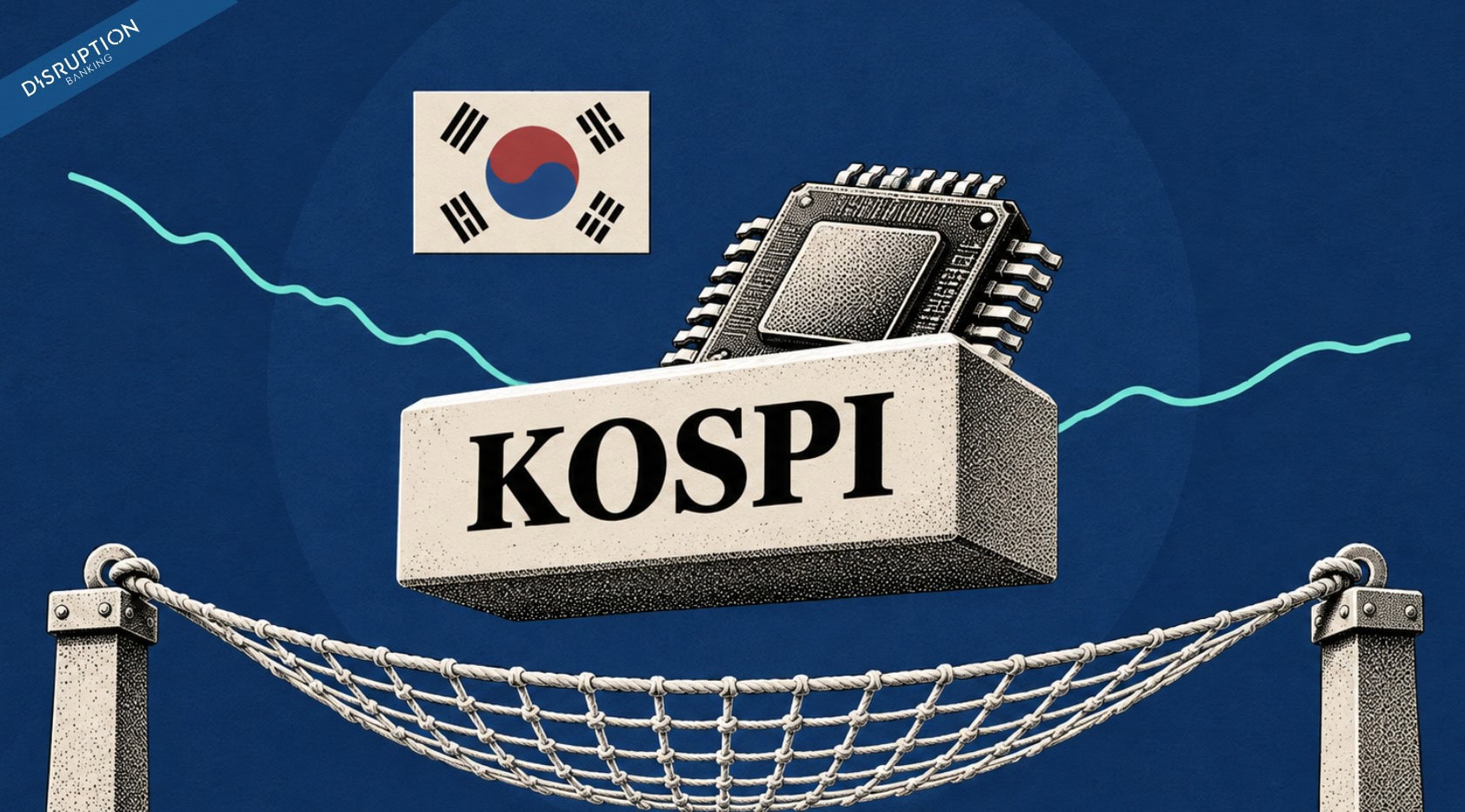
South Korea’s KOSPI closed 4.34% higher at 4,916 on November 27, a gain of 204 points that marked the largest point rise since August 10 and the biggest percentage advance since July 31.
The move was driven primarily by rising expectations that authorities would enlarge the roughly 10.76 trillion won Securities Market Stabilisation Fund, reinforced by firm U.S. futures and a sharp turn in foreign flows.
The rebound also followed low-price buying after excessive declines, with US markets closed on November 26 for Thanksgiving.
This comes after a sharp rout: the KOSPI fell 5.2% on November 20 and closed around 46% below its June 22 peak amid AI-related concerns
What is South Korea’s Market Stabilisation Fund?
The Market Stabilisation Fund is a standing liquidity backstop created in 2020 with committed capital of about 10.76 trillion won from 25 financial institutions and related bodies, including the Korea Exchange.
It operates on a capital-call basis: participants pledge money that is drawn only when authorities decide to buy stocks, typically through broad vehicles such as KOSPI 200 ETFs. It has never been activated since its creation; the last comparable intervention occurred in 2008.
On November 22 top policymakers, including Finance Minister Lee Hyoung-il, Bank of Korea Governor Shin Hyun-song, Financial Services Commission Chairman Lee Eog-weon and Financial Supervisory Service Governor Lee Chan-jin, agreed to prepare for immediate activation if conditions required it.
Subsequent reports that the Korea Development Bank had contacted banks and brokers to gauge additional capital contributions, combined with plans for an emergency market-stability meeting on November 30, lifted investor confidence.
No new size or activation date has been announced, but the prospect of a larger official backstop was enough to reverse selling pressure.
Foreign Investors Return on the Improved Outlook
The fund-related optimism drew foreign investors back into the market. They bought a net 1.13 trillion won of KOSPI shares on November 27, their largest single-day net purchase since September 7, when they bought roughly 2.5–2.6 trillion won.
Institutional investors added a net 237 billion won, including 288 billion won from pension funds, while retail investors sold a net 1.77 trillion won.
Foreign investor flows have amplified KOSPI swings for months. Through the recent sell-off foreigners were consistent net sellers, particularly of major chip stocks, with net outflows frequently exceeding 1 trillion won on the steepest down days. Domestic retail buying was rarely large enough to offset those outflows.
The return of foreign buying on November 27 marked a clear break from the pattern that had driven the index lower.
The Rebound Reverses Recent Tech Selling
The same day the tech-heavy Kosdaq closed at 709 up 8.13%, its first finish above 700 since November 11. On the KOSPI, Samsung Electronics rose 4.55% and SK hynix rose 5.41%.
The gains followed a series of sharp declines tied to doubts over the durability of global AI infrastructure spending. This included a 5.2% drop in the KOSPI on November 20 and a 6.16% fall on November 25 that left the index near 10-month lows and roughly 46% below its June 22 closing peak of 9,114.
Foreign net buying concentrated in the two chipmakers, which together have accounted for a large share of the index’s weight and of its recent volatility.
Strength in US futures and reports of new solid-state-drive technology from NVIDIA and Kioxia that expands GPU memory capacity further supported memory-chip sentiment on a day when US cash markets were closed for Thanksgiving.
A Backstop That Leaves AI Exposure Intact
The stabilisation fund remains only a contingent liquidity backstop. Its current committed size equals roughly 0.28% of KOSPI market capitalisation, and authorities have not yet called any capital or made purchases.
While an expansion could reduce the risk of disorderly selling in a further downturn, it does not alter the index’s heavy concentration in semiconductor and AI-related names. Samsung Electronics and SK hynix continue to dominate both market weight and daily swings, leaving the KOSPI highly sensitive to shifts in global technology sentiment.
Analysts noted that the rebound could stay limited until fresh capital is actually deployed or until clearer evidence emerges that AI capital expenditure remains robust.
Upcoming events, including a US congressional hearing involving NVIDIA’s leadership and earnings from Broadcom and Micron, will likely set the next tone for Korean chip stocks.
For now the fund has restored a measure of confidence and drawn foreign buyers back, but the index’s direction still appears more closely tied to the outlook for the AI trade than to the size of any official safety net.
Author: Scott Danaher
See Also:
Why Did Anthropic’s IPO Fail To Rescue The KOSPI? | Disruption Banking
Will Huang’s Return Outweigh Capex Doubts for Asian AI Stocks? | Disruption Banking
Is the AI Boom Over for KOSPI and Asian Tech Stocks? | Disruption Banking