
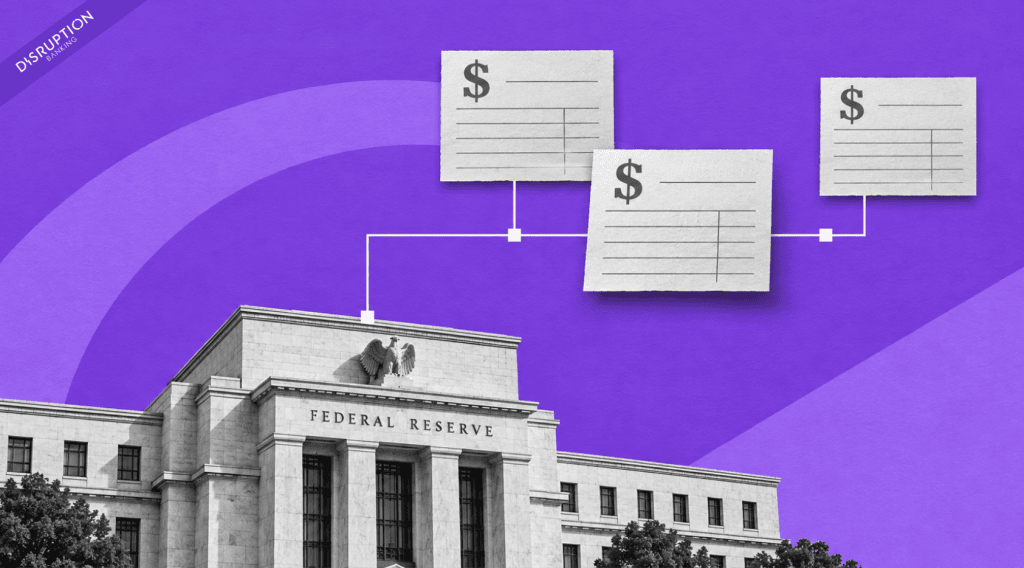
Federal Reserve Governor Christopher Waller has set out how the US central bank sees its place in a payment system that blockchain and tokenization are reshaping.
In a speech to The Clearing House Annual Conference in New York on November 17, Waller said the private sector should lead on building tokenized payment products. The Fed, he added, should supply the settlement infrastructure underneath them and steps in only where markets cannot solve a problem alone.
Waller, who chairs the Fed’s payments committee, said a convergence between blockchain technology and established markets is “clearly under way.” Stocks, bonds and commodities are now being tokenized for use on blockchain networks, and established payment providers, banks and market infrastructures are using those networks to improve existing services and launch new ones.
Open Blockchains Running 24/7/365 are Forcing Banks to Compete
Journalist Eleanor Terrett summarized the remarks as Waller saying the bank monopoly in payments is “breaking down,” although that phrase does not appear in the speech text published by the Fed.
In the published text, Waller said “tokenization is changing the nature of competition in payments.” Because open blockchain networks operate 24/7/365, he said, they offer a new model of competition with traditional payment rails. Smart contract code is often open source, which he said lowers the barrier for new entrants.
He described three ways established firms are responding: building their own blockchains where they keep control of the ledger, pooling resources in consortium-owned networks, and partnering with blockchain-native firms. Waller said he expects several models to survive rather than one winning outright, because different customers and use cases need different trade-offs between control and scale.
His host is one example. The Clearing House, owned by large US banks, is building an On-Chain Money Initiative to clear and settle tokenized deposits between banks around the clock. The network is expected to open to participants in the first half of 2027.
Trust and Legal Clarity Will Decide Which Tokenized Services Scale
Waller argued that technical capability alone will not be enough. New tokenized services must earn trust through reliable operation and clear governance, he said, and that trust in payments is measured in years and decades rather than quarters.
He raised a set of unresolved accountability questions: who is responsible when fraudsters exploit automatically executing smart contracts, how operators will handle lost keys and erroneous transfers, and what happens to assets stranded on failed “zombie chains.” He added that recent events around Binance have highlighted some of the issues that can arise from programmable blockchains.
He added that clear legal treatment of tokenized claims, custody, insolvency and resolution will be critical before mainstream institutions adopt these products, especially in complex smart contract arrangements.
Central Bank Money Stays at the Foundation of the System
On the Fed’s own role, Waller’s position was that traditional infrastructure is not being replaced. He said traditional rails and the forms of money exchanged on them will continue to play an important role in underpinning trust. “Central bank money need not be used in every transaction or on every platform, but its presence at the foundation of the system is essential,” he said.
Waller pointed out that this layering is already happening, since traditional rails are used to move money into and out of stablecoins and to settle tokenized deposit transactions. He also cautioned against treating atomic settlement as the only model for tokenized markets, noting that market participants told him net and batch settlement will remain useful in high-volume capital markets where saving liquidity matters.
The Fed, he said, will keep engaging with industry, providing core payment and settlement infrastructure and monitoring financial stability risks. He said it will act as “a connector and convener” where market forces fall short, and that the issue sits within its mandate.
A Light-Touch US Approach Built on Private Stablecoins, Not a Digital Dollar
Waller’s speech fits the light-touch approach the US has taken to digital payments and tokenization, which leaves digital money to the private sector.
President Donald Trump’s January 2025 executive order barred federal agencies from pursuing a central bank digital currency while backing stablecoins. In July 2026 the 21st Century ROAD to Housing Act put a statutory ban on a Fed-issued CBDC in place through December 31, 2030.
Within those limits, the Fed has been widening access to its own rails. It formally proposed “payment accounts” in May 2026; a limited form of master account that Waller first floated in October 2025. He has said the Fed aims to finalize them by the end of 2026.
Congress, meanwhile, is still working through the CLARITY Act, which would draw the lines between the SEC and CFTC on digital assets, after tokenization took center stage on Capitol Hill earlier this year.
Can Traditional Banking Coexist With Tokenized Finance?
Waller’s answer is yes, on the condition that new and old systems connect. He said he sees a range of payment solutions coexisting, with corporate treasurers, banks and asset managers likely to use several tokenized instruments at once, much as they use multiple rails today.
The open question, in his view, is how participants will flexibly and safely move between different forms of money, which he said will require continued dialogue between the industry and the Fed.
Author: Ayanfe Fakunle
The editorial team at #DisruptionBanking has taken all precautions to ensure that no persons or organizations have been adversely affected or offered any sort of financial advice in this article. This article is most definitely not financial advice.
See Also:
DBS and JPMorgan Link Tokenized Deposit Networks for 24/7 Dollar Transfers | Disruption Banking
Why Did 21 Banks Need a Dollar That Is Not Their Deposit? | Disruption Banking
Can Pontes Give Banks Tokenised Settlement in Central Bank Money? | Disruption Banking