
- Denmark’s economy remains strong despite a challenging external environment. Elevated geopolitical and trade tensions and heightened uncertainty continue to cloud the outlook.
- Denmark’s main policy challenge is to leverage its strong fundamentals to boost medium-term growth. The priority is to calibrate fiscal policy to reflect full employment and rising spending needs, to uphold financial stability, and to advance structural reforms to sustain high incomes and preserve fiscal space.
Washington, DC: The Executive Board of the International Monetary Fund (IMF) completed the Article IV Consultation for Denmark.[1] The authorities have consented to the publication of the Staff Report prepared for this consultation.[2]
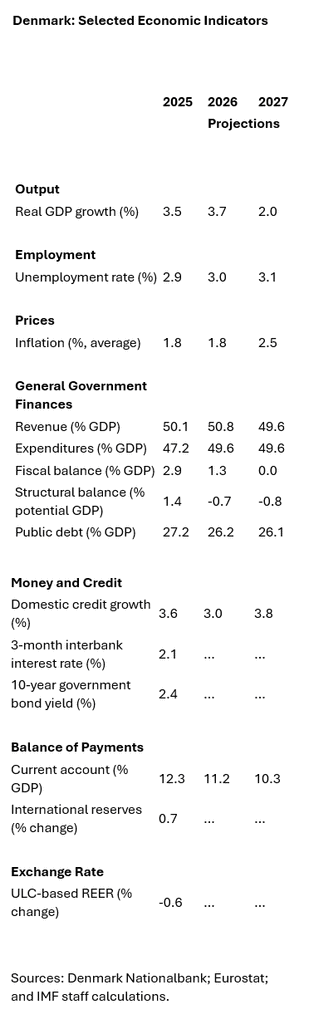
Denmark’s economy has continued to expand despite shocks from the war in the Middle East. Strong pharmaceutical exports have been an important driver of growth, while the rest of the economy has expanded at a more moderate pace. Expansionary fiscal policy has also supported aggregate demand. Public finances, external positions, and the financial system remain robust.
Output growth is projected to strengthen from 3.5 percent in 2025 to 3.7 percent in 2026, reflecting strong pharmaceutical exports alongside moderate expansion in the rest of the economy. Beyond 2026, growth is projected to moderate to around 2 percent in 2027 and further to 1.5 percent annually by 2030, below the 2.2 percent average in 2010–25. This reflects weaker global growth prospects—due to greater geoeconomic fragmentation and a more volatile global environment—as well as a declining working-age population. Labor market pressures have eased, although the economy remains at full employment. After falling sharply to below 1 percent in early 2026, due to cuts in electricity taxes, inflation is expected to rise to around 2.5 percent by end-2026, reflecting higher energy and services prices.
Risks to growth are tilted to the downside, while risks to inflation are tilted to the upside. Geopolitical tensions and intensification of conflicts, including in the Middle East, could weaken global growth, raise energy prices, disrupt supply chains, and tighten financial conditions. Higher trade barriers and geoeconomic fragmentation could also weigh on the outlook. Domestic demand could prove weaker if uncertainty remains elevated. Conversely, a faster-than-expected easing of geopolitical tensions and recovery in global energy supply could strengthen confidence and support growth.
Executive Board Assessment[3]
Directors commended Denmark’s prudent economic management and resilience, despite a challenging external environment, with robust fiscal and external positions and a sound financial system. Noting that elevated geopolitical and trade tensions and demographic pressures cloud the medium‑term outlook, Directors emphasized policies to strengthen the economy’s resilience to future shocks, broaden growth drivers, and raise productivity.
Directors commended Denmark’s strong fiscal position and framework, which underpin fiscal sustainability. Noting the possible lagged effects from the fiscal stimulus and that the economy is already at full employment, Directors generally agreed to a broadly neutral fiscal stance in 2027, to avoid adding to capacity and inflationary pressures. Cost‑of‑living measures should be temporary, targeted to vulnerable households, and preserve price signals. Given medium‑term spending pressures from demographics, energy transition, and defense spending, Directors encouraged continued expenditure prioritization and improvements in public‑sector efficiency and underscored maintaining the link between retirement age and life expectancy to support labor supply and safeguard long‑term fiscal sustainability.
Directors welcomed the financial system’s resilience. They recommended maintaining the current capital‑based macroprudential stance, further strengthening operational and cyber resilience, and closely monitoring vulnerabilities from nonbank financial institutions and their linkages with banks. Directors considered that the existing borrower‑based measures should be recalibrated if housing‑related credit vulnerabilities continue to increase. They looked forward to the 2027 FSAP as an opportunity to assess remaining macroprudential gaps.
Directors emphasized that structural reforms are critical to sustaining high incomes and preserving fiscal space. They encouraged further measures to expand labor supply, improve health and elderly care efficiency, enhance public‑sector digitalization, while continuing to review skilled‑immigration policies. Channeling Denmark’s savings toward domestic investment would raise potential growth and support rebalancing. Directors also recommended accelerating digitalization and artificial intelligence diffusion, particularly among SMEs, increasing housing supply, and continuing to advance energy security and climate adaptation.
[1] Under Article IV of the IMF’s Articles of Agreement, the IMF holds bilateral discussions with members, usually every year. A staff team visits the country, collects economic and financial information, and discusses with officials the country’s economic developments and policies. On return to headquarters, the staff prepares a report, which forms the basis for discussion by the Executive Board.
[2] Under the IMF’s Articles of Agreement, publication of documents that pertain to member countries is voluntary and requires the member consent. The staff report will be shortly published on the www.imf.org/en/countries/dnk page.
[3] At the conclusion of the discussion, the Managing Director, as Chair of the Board, summarizes the views of Executive Directors, and this summary is transmitted to the country’s authorities. An explanation of any qualifiers used in summings up can be found here: http://www.IMF.org/external/np/sec/misc/qualifiers.htm.
See also:
IMF signs Establishment Agreement with Spain | Disruption Banking