
Spread betting has a reputation for being inscrutable, which is a little unfair. Strip away the flashing prices and the jargon, and every position rests on two numbers: one, how far a market moves, measured in points, and two, how much money is attached to each of those points. Once both numbers are clear, the profit or loss on any trade becomes straightforward arithmetic. Misjudge either one, and an modest-looking position can turn out very differently from what you expected.
What Counts as One Point Across Different Markets
This is where newcomers tend to trip up, because a point does not cover the same distance on every chart.
On stock indices, one point usually equals one whole index point, so the UK’s FTSE 100 moving from 9,000 to 9,050 is a 50-point move. Major currency pairs are quoted to four decimal places, and a point is normally the fourth. GBP/USD edging from 1.3400 to 1.3401 is one point, the increment forex traders call a pip. Yen pairs use the second decimal place instead. Commodities and metals follow their own conventions, so it pays to check each instrument’s specification first.
Points, Stakes and Why Spread Betting Works Differently
Most investors think in shares or units. Buy 500 shares at £4 and you own £2,000 of a company. With spread betting, ownership is replaced by a view on direction. You never hold the underlying asset. Instead, you choose a stake in pounds per point, then go long if you expect the price to rise or short if you expect it to fall.
The point is the unit that measures the price, and the stake is the multiplier. A £2 per point bet on a market that climbs 40 points returns £80. Put £20 per point on the same move and the result is £800, even though the market did exactly the same thing.
The Formula Behind Every Trade
The calculation itself is plain and simple. For a long position, profit or loss equals the closing price minus the opening price, multiplied by the stake per point. A short works the other way around, and you gain when the market closes below where you sold.
Take a £5 per point long on the FTSE 100, opened at 9,000 and closed at 9,060. The market moved 60 points your way, giving a gross profit of £300. Now picture a £10 per point short on GBP/USD at 1.3400. If sterling strengthens and you close at 1.3440, the market has travelled 40 points against you, and the loss is £400.
The size of the trading account plays no part in that formula, which is exactly why stake sizing deserves so much attention.
Where the Spread Fits In
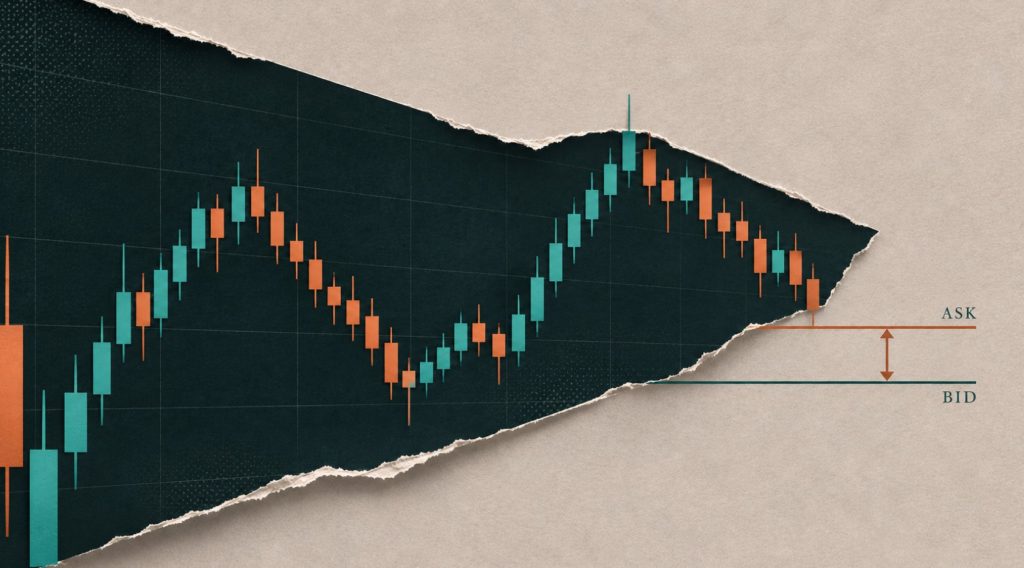
The product takes its name from the gap between the buy and sell prices quoted on every market. Long positions open at the higher buy price and close at the lower sell price, so each trade begins slightly behind. If the FTSE 100 is quoted at 9,100/9,101, a £5 per point buyer effectively gives up one point, or £5, before the market has moved.
For most retail spread bets, the spread is the main dealing cost, with no separate commission. Positions held overnight usually attract a financing charge too, which belongs in any honest tally for longer trades.
A Lesson From Sterling’s Turbulent Autumn
The pound’s slide in September 2022 shows how quickly points can pile up.
After then-Chancellor Kwasi Kwarteng’s mini-budget, sterling dropped more than 3% against the dollar. The following Monday it briefly fell almost 5% further, touching a record low just above $1.03 in early Asian trading, as Bloomberg reported at the time. On GBP/USD, that second leg alone was worth several hundred points in a matter of hours.
For a £10 per point short, the move produced a gain running into thousands of pounds. An equivalent long suffered an identical loss. The formula didn’t change, but the speed at which the market changed did. Moves of that size also explain why standard stop-loss orders can be filled at a worse level than requested when prices gap, and why some traders pay a premium for guaranteed stops around major events.
Margin, Leverage and the FCA’s Guard Rails
Spread bets are leveraged, so only a fraction of the full position value is needed as a deposit. Exposure is the stake multiplied by the price, meaning £5 per point on the FTSE 100 at 9,000 equates to £45,000.
Since 2019, FCA rules have capped retail leverage on CFDs and financial spread bets at between 30:1 and 2:1, depending on the asset’s volatility. Providers must close positions once a client’s funds fall to 50% of the required margin, and negative balance protection stops retail clients losing more than the money in their account. Major indices sit at 20:1, so that £45,000 exposure needs £2,250 of margin.
Profit and loss, however, is calculated on the full exposure. A 100-point move on that index bet is worth £500 either way, more than a fifth of the margin posted.
How Returns are Taxed
For UK residents, the final figure has an unusual feature. HMRC generally treats financial spread betting as betting rather than trading, so profits are typically free of Capital Gains Tax and stamp duty. Its Business Income Manual explains that winnings only become taxable where they arise from actually carrying on a trade, rather than from an opportunity a trade presents.
The trade-off is that losses cannot be set against other capital gains. Tax rules can change and individual circumstances differ, so anyone trading at a meaningful scale should take professional advice.
Final Note
Spread betting isn’t some form of wizardry or alchemy, but rather a straightforward equation that anyone can learn.
Points measure the move, the stake sets its value, and the spread; financing and margin decide what is left at the end.
Investors who can run those numbers before opening a position, and who size stakes against the full exposure rather than the deposit, usually find spread betting far less mysterious than its reputation suggests.