
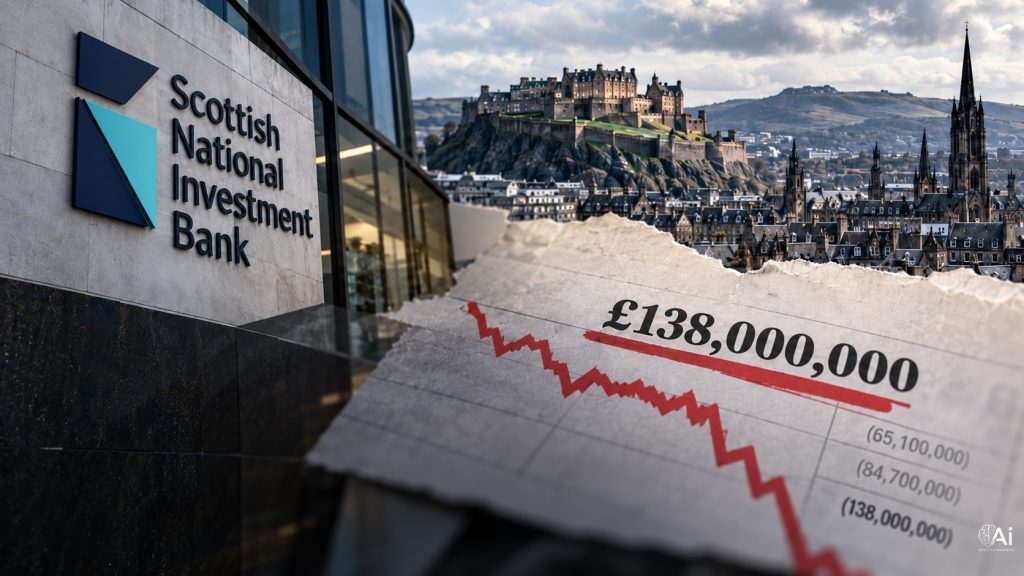
In August 2026 the Scottish National Investment Bank reported a net loss of £138 million for the 2025/26 financial year. According to its Annual Report and Accounts, the figure comprises realised losses of £65.1 million on three early investments that have failed and unrealised losses of £84.7 million, largely from two further companies still in administration.
It is the fifth consecutive year the bank, wholly owned and funded by the Scottish Government, has recorded a deficit. Chairman Willie Watt said investment losses “will always be present in a development bank portfolio, with a mandate to take on higher risk,” while chief executive David Ritchie described the outcome as “regrettable and disappointing” yet consistent with the risk the bank’s mandate requires it to accept.
Failed Investments but “positive impact”
The first portfolio company to fail was Glasgow photonics pioneer M Squared Lasers, the bank’s flagship first investment after launch in November 2020. SNIB ultimately committed £37.5m, of which roughly £34m was outstanding when the company collapsed into administration in August 2025. Administrators from Interpath later reported that the company’s intellectual property was sold for £75,000 and its remaining physical assets for a further £90,000 — a total of £165,000. In their progress report they stated that, given the scale of preferential creditor claims and the negligible realisations, “no returns are anticipated to become available to either Santander or SNIB.” SNIB had lodged claims of £15.2m in loan funding and £22.3m in equity; the taxpayer recovery is expected to be zero.
In February 2026 Trojan Energy, the Aberdeen-based EV charging firm, was also sold out of administration in a pre-packaged deal to a subsidiary of Connected Kerb. Before the administration the company had drawn down £26m of the £28m SNIB had committed. Interpath, again the administrators, noted that while the pre-pack preserved all 63 jobs, the bank’s substantial debt and equity exposure left it facing a significant loss.
From these two investments, together with a further £4.6m sunk into the spacetech company Krucial (R3 IoT), the Annual Report and Accounts record realised losses of £65.1m. The unrealised losses are larger still, at £84.7m, principally from the ongoing administrations of rocket company Orbex and medtech firm Pneumowave.
The accounts show an operating profit of £12.3m this year: a total income of £32.3m (setting aside the above losses) against roughly £20m in operating costs, lower than what was budgeted. However, approximately £13.5m of the £32.3m income figure is accounted for by capitalised income – not cash flow – meaning a significant part of the profit is still subject to the same risk as other investments.
Impact claims versus the £138m loss
The £138 million taxpayer loss sits next to the bank’s own published figures for the same period. In its Annual Report and Accounts it states that, since launch, it has committed £1.2 billion to 53 businesses and projects and crowded in a further £1.9 billion of private capital. In 2025/26 alone it committed a record £374 million and crowded in £445 million.
These totals are set against the impact metrics published in the June 2026 Impact Report (covering the portfolio to 31 December 2025): 325,739 people positively impacted, 3,330 jobs supported, 983 new homes, and 235,429 tCO₂e avoided or reduced — the equivalent of taking 125,106 cars off UK roads for a year. CEO David Ritchie said there would be a “continued focus on deepening impact.”
The contrast is sharp. The £1.2 billion of commitments and £1.9 billion of crowded-in capital are presented as evidence of scale and leverage, while the same accounts record a £138 million net loss, of which £65.1 million has already crystallised on three early investments. The impact numbers are not adjusted for the failed investments, nor do they quantify the cost to the taxpayer of the losses.
Offsetting this summer’s impact report against the ARA is like mixing chalk and cheese. The impact details are not quantifiable by margin – it’s not possible to evaluate gains against losses – whilst the account figures are. The impact report does not, for instance, make any claims about the total number of Scottish taxpayers negatively impacted by the bank’s investments.
This fact highlights a tension, ever growing as the bank continues to lose capital, between its broader “missions” and commercial success. The bank holds itself to three missions, explicit in both the impact report and the ARA: the delivery of Net Zero, Place (essentially housing), and Innovation. The impact report illustrates the bank’s success with regard to its missions. The accounts tell a story of commercial failure.
Sir John Elvidge, author of a recent independent report reviewing the bank’s performance, highlighted the “tensions between seeking a commercial return and the broader goal of unlocking additional economic activity which would not otherwise have taken place.” However, he is quick to rule out any criticism of the operation, adding that the bank has “sought to navigate the tensions thoughtfully”.
He doesn’t express any personal opinions about the CEO’s line that losses are a natural consequence of the bank’s pursuit of impact, though vaguely implies in his report that the losses are not out of the ordinary: “I heard views from external investment professionals that the [level of losses was not higher than expected]”.
Outcomes from the 2026 reports
In the bank’s first communication after the release of the ARA, a letter from David Ritchie to the Public Audit Committee, the CEO attributed the losses in part to the “challenging trading and fundraising conditions” in the innovation-led and net zero sectors over recent years. He also points out that the failed investments were made in the bank’s first three years. Since 2023 they have “enhanced investment governance”, and generally tightened up their processes.
It’s hard not to apply scrutiny when the bank continued to invest in M Squared Lasers – £7.7 further equity in September 2023, and an additional £2m sum of loan notes in December 2024 – after this period. Nevertheless, according to Sir John Elvidge’s report, the bank have recently undergone further “lessons learned” exercises.
Equally, there is the notion mentioned above that the losses are to be expected from a young bank with a focus on impact. Willie Watt, chair of the bank piled in that “Investment losses will always be present in a development bank portfolio, with a mandate to take on higher risk” in a press statement attached to the ARA.
Meanwhile, the ARA figures received heavy political criticism from the Scottish Conservative party, whose spokeswoman alleged “a spectacular failure of financial leadership by the SNP’s flagship national investment bank.” Craig Hoy, another conservative spokesperson, emphasised that “taxpayers are now paying the price for the failures [of an] SNP vanity project.”
Taking stock
The SNIB are explicit about the fact that their pursuit of impact leads them to a risk environment where they have lost large amounts of capital: £138m in 2025/26. Yet the acknowledgement remains an explaining factor, rather than a lesson learned. In fact, the CEO speaks openly about a “continued focus on deepening impact”. The impact figures are resoundingly positive, and no doubt the bank will continue to publish them. However, due to the underlying tension, between pursuit of impact and commercial success, the SNIB remains liable to big losses and public scrutiny.
Author: Remy Rushbrooke
See Also:
SNIB Fireside: New CEO David Ritchie Defends Bank’s Record Amid Mounting Losses | Disruption Banking