
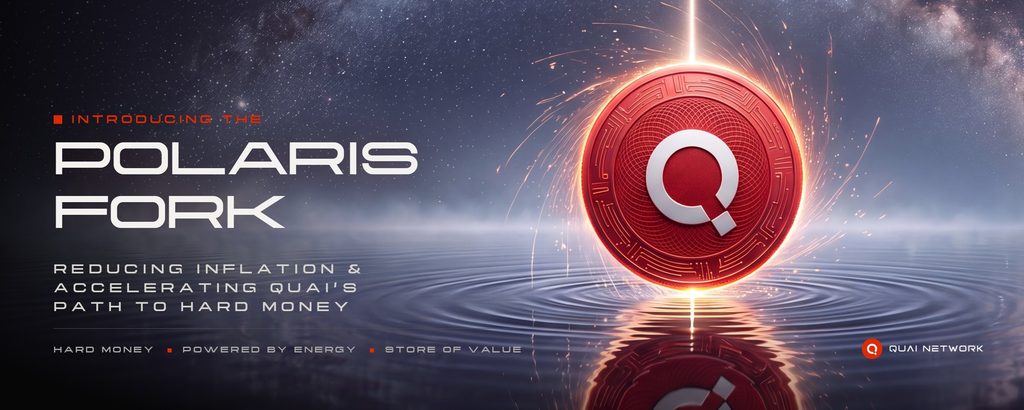
Quai Network announced the Polaris Fork on 13 October. The upgrade permanently burns 236,456,538 QUAI from the remaining genesis allocations held by the founders and the Dominant Strategies team. This means that genesis inflation falls from 13 percent to under 4 percent a year immediately. Monthly unlocks drop from roughly 13 million QUAI to about 3.7 million. After the fork, circulating supply rises from 77 percent to 93 percent of the total.
The network has already burned 1.9 billion of the original genesis QUAI between the Singularity and Polaris upgrades. Combined with the Subsidized Open-market Acquisition Protocol (SOAP), which currently burns more than 300 million newly mined QUAI a year, total inflation is projected to fall from 18 percent to under 9 percent in the twelve months after the fork. Genesis unlocks reach finality in early 2029. The remaining unlocks after the burn stand at 90 million.
The effect is less future dilution for existing holders and a shorter period during which new tokens enter the market from the original allocation. For a Proof-of-Work network that also burns the majority of new mining rewards through SOAP, the higher circulating percentage and lower ongoing unlock rate reduce the overhang that typically weighs on younger chains.
Disruption Banking covered the earlier Singularity Fork in July. That upgrade permanently removed approximately 1.67 billion QUAI from future unlocks through a multilateral agreement and protocol-level enforcement. Polaris continues the same direction. The founders and Dominant Strategies team are forgoing their remaining allocations so that QUAI reaches a higher circulating supply and lower ongoing dilution sooner than the original schedule allowed.
What the burn changes
The Polaris change is enforced in the open-source go-quai repository. After the activation block, the addresses that previously received the burned unlocks simply stop receiving them. No off-chain promise is required. The network’s supply tracker at supply.qu.ai publishes live figures for circulating supply, remaining genesis unlocks and SOAP burns.
SOAP itself converts external block rewards from merge-mined chains into QUAI buy pressure that is then burned. The protocol currently supports SHA-256 and Scrypt hardware and is already securing Bitcoin Cash, Litecoin and Dogecoin. Bitcoin support is in active development. At the present burn rate, SOAP destroys more than 75 percent of newly mined QUAI. The combination of the founder burn and the SOAP mechanism is what produces the single-digit total inflation figure. Disruption Banking reported earlier on the revenue SOAP has already generated from that activity.
By Year 3 (February 2027 to February 2028) the network expects supply growth of roughly 8.7 percent. By Year 5 the figure falls to about 4 percent. Quai’s own comparison places that Year-3 rate below Bitcoin, Litecoin, Monero and Kaspa at the same age, and roughly in line with Ethereum’s mature issuance.
The same emission profile on other Proof-of-Work networks has reduced dilution for holders without, by itself, determining price.
Why the numbers matter
Most layer-1 token reductions in recent years have been discretionary treasury burns or community votes. Polaris is a protocol-level skip of scheduled unlocks that the founders themselves held. The circulating supply figure jumps immediately, and the remaining unlock schedule is shorter and smaller. For any desk that treats token inflation as a dilution input, the change is measurable on the public supply tracker rather than dependent on future governance.
Quai’s architecture remains a hierarchy of merged-mined Proof-of-Work chains under Proof-of-Entropy-Minima consensus. QUAI sits on the account-based ledger and is positioned as the store-of-value asset. QI, the UTXO token whose issuance tracks mining difficulty, is intended as energy-priced cash. The Polaris changes affect only the QUAI emission path. They do not alter the dual-ledger design or the merge-mining security model.
The practical question for readers is whether a Proof-of-Work network that has already burned the large majority of its original founder allocation, and that continues to burn the bulk of new mining rewards through merge-mining, can maintain that emission path under live hash-rate conditions. The supply tracker is public. The fork logic is open source. Both can be checked independently of the announcement.
Author: Andy Samu
See Also:
How Quai’s Singularity Fork Reframed Proof-of-Work Tokenomics | Disruption Banking
Quai Network Reports $6.177 Million in Chain Revenue via SOAP Protocol | Disruption Banking

Andrew Samu
Andrew Samu, Editor-at-Large at Disruption Banking, shapes the publication’s global coverage of banking, capital markets and digital assets. Based at London’s Level39, he combines market analysis with a strong commercial perspective, informed in part by his role as Commercial Director at Verita HR.