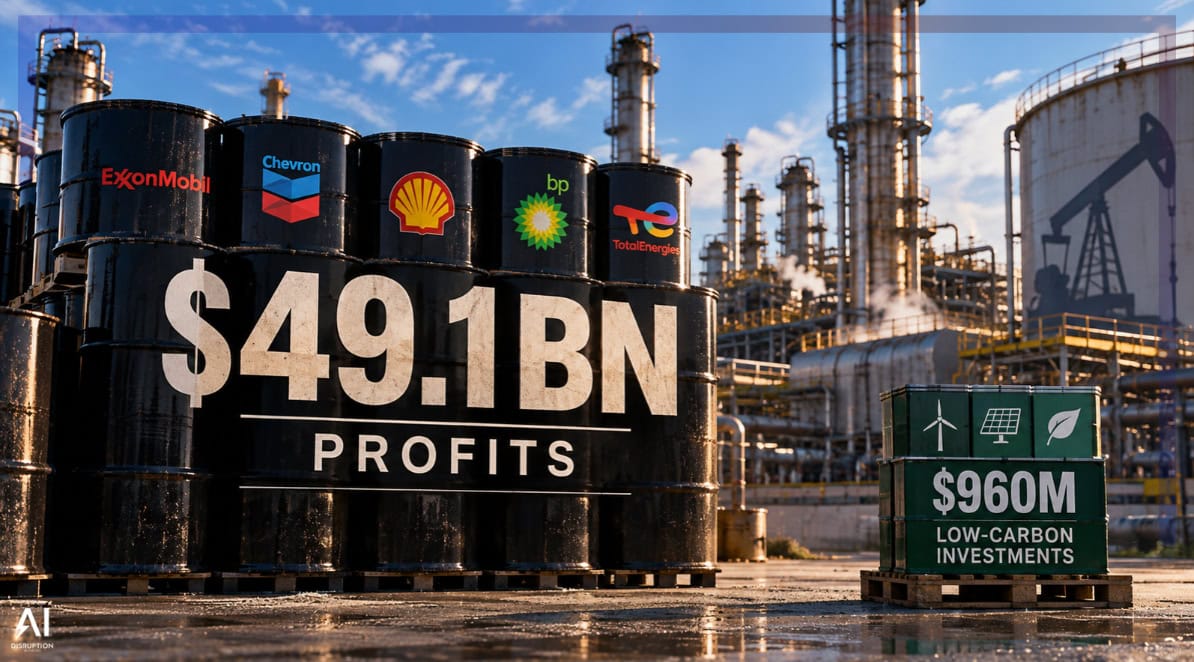
Big Oil booked a roughly $50bn quarter in Q2 2026, meanwhile the sector’s ESG transition budget stayed flat. The five Western supermajors (ExxonMobil, Chevron, Shell, BP and TotalEnergies) reported a combined haul of about $49.1bn after the shock of the Iran/ Hormuz conflict, according to both company filings and Bloomberg tallies.
Despite nearly $50bn in profits, ESG transitions did not rise. The listed oil majors did not use a windfall to reopen the transition plans they sold to ESG investors in 2020–23. In Q2, companies’ distributions and upstream spending absorbed cash, with low-carbon and ESG transition spending not rising. In the same quarter that filled buyback programmes we also saw the weakest set of new low-carbon deal announcements in over eight years.
Table 1: Q2 2026 headline profits vs Q2 2025
Headline figures used for the $49.1bn total: ExxonMobil GAAP net income; Chevron reported earnings; Shell income attributable to shareholders; BP underlying replacement-cost profit; TotalEnergies adjusted net income (TotalEnergies share). Sources: company filings.
| Q2 2026 ($ bn) | Q2 2025 ($ bn) | Profit Increase ($ bn) | % increase from Q2 2025 to Q2 2026 | |
| ExxonMobil (GAAP) | 14.5 | 7.1 | 7.4 | 104.23 |
| Chevron (reported) | 12.1 | 2.5 | 9.6 | 384 |
| Shell (IFRS income) | 10.8 | 3.6 | 7.2 | 200 |
| BP (underlying RC) | 5.7 | 2.4 | 3.3 | 137.5 |
| TotalEnergies (adj.) | 6 | 3.6 | 2.4 | 66.67 |
| Big Oil Total | 49.1 | 19.2 | 29.9 | 155.73 |
Energy Intelligence’s Low-Carbon Investment Tracker stated that low-carbon investments by 50 oil and gas firms fell to $960m in Q2 2026, dipping by 70% from Q1, despite occurring in the same quarter as the profit spike. This is the lowest level since Q4 2017. Global clean-energy investment has reached a record of about $2.2tn according to the IEA World Energy Investment 2026. Despite investment from oil and gas firms falling, it proves that green capital has not vanished; major oil and gas companies did not reopen or uphold the transition plans they sold to ESG investors earlier in the decade.
Global energy spending is on track to reach $3.4 trillion in 2026
— International Energy Agency (@IEA) August 28, 2026
Around $2.2 trillion of this is set to go to grids, storage, low-emissions fuels, nuclear, renewables, efficiency & electrification
And about $1.2 trillion goes to oil, natural gas & coal: https://t.co/8IajZj1gIL pic.twitter.com/jqNnFGHZxZ
IEA data show oil and gas companies invested roughly $23bn in low-emissions technologies in 2025 and are looking to invest $22–24bn for 2026, or close to 4% of sector capex. That ratio sits against a global clean-energy total of about $2.2tn. Many of these firms had already cut ESG targets which were set at the start of the decade. Alongside this, many bank and asset managers have diluted net-zero alliances, yet continue to invest in and lend to these big oil companies. (See our earlier article on Morgan Stanley’s exit from the Net-Zero Banking Alliance.). These oil companies are spending more of their money producing gas and oil, while making huge profits and decreasing spending in ESG.
Table 2: Company Detail on profits, guided low-carbon spending and distributions
Source: company Q2 2026 results releases and investor presentations. Longer explanations of strategy shifts appear in table and text below.
| Company | Q2 2026 profit | H1 2026 profit | Guided low-carbon/ Integrated Power/ RES | Last published target context | Distributions (div+ buybacks) |
| ExxonMobil | $14.5 bn GAAP, $14.7bn adj, | $18.7bn GAAP | Lower-emissions envelope of $20bn for 2025-2030 (CCS, hydrogen, lithium, materials not wind/solar) H1 cash capex overall~ $13bn | Cut from ~$30 bn earlier envelope. Baytown low-carbon hydrogen paused | Q2 $9.4 bn ($4.3 bn div + $5.1 bn buybacks) |
| Chevron | $12.1bn ($12.0 bn adj.) | $14.3bn | Published lower-carbon plan removed | $10 bn plan (2021–28) dropped. | Q2 $6.5 bn ($3.5 bn dividends + $3.0bn buybacks) |
| Shell | $10.8bn IFRS income; $9.8bn adj. earning | $16.5 bn income; $16.8 bn adj. | Drop in planned and active renewables; RES segment loss-making after impairments; European onshore renewables being sold | Selective retreat from renewable power generation; hydrogen and offshore wind scaled back | Q2 $5.2 bn ($2.2 bn div + $3.0 bn buybacks) |
| BP | $5.7bn underlying RC, $3.91bn IFRS net | $8.93 bn underlying RC; $7.75 bn IFRS | Transition spend guided $1.5–2 bn a year | 2025 reset still binding; 2020 production-cut pledge dropped. US onshore wind sold | Dividend raised 4% in Q2; ongoing cash returns under the reset |
| TotalEnergies | $6.0 adjusted net income, $5.4bn net income | $11.4 bn adj.; $11.2 bn net income (TE share) | Integrated Power organic investments continue; share of total capex guided down to ~26% | From ~33% earlier. $3.5 bn power + $0.5bn low-carbon molecules on ~$15 bn annual budget. | Buybacks increased to $1.5 bn in Q2; net investments H1 ~$7.9 bn (annual guidance $15 bn) |
Capex is planned years ahead, so the point is not that boards “refused” to spend one quarter’s profit on wind farms or other alternative low-carbon technology. The point is that guided low-carbon, Integrated Power or RES envelopes did not rise with the windfall, and several firms had already cut the targets set in 2020–23. “Renewable power” (utility-scale wind, solar, batteries) is not the same as broader low-carbon / ESG transition spend (CCS, hydrogen, biofuels). US majors never promised large utility-scale renewables portfolios. Europe did. Much of the confusion lies in the difference between US and European low-carbon strategies. The US majors have aimed for lower-carbon solutions, whilst European firms have focused more heavily on renewable-power.
BP
BP executed the sharpest U-turn on its low-carbon plans. The company’s 2020 plan pledged a 40% cut to oil and gas output by 2030 and a large renewable book. The February 2025 reset raised oil and gas investment, limits transition spend to $1.5–2bn a year, sold US onshore wind, placed remaining offshore wind in a capital-light JERA JV, and booked a $4–5bn write-down on gas and low-carbon assets around Q4 2025. 2026 cash is being used to prove the reset, not revive the earlier pledge.
Shell
Shell, however, has been more selective. It is selling its European onshore renewables unit (roughly 500 MW operating/under construction plus a 3.5 GW pipeline) to TotalEnergies. Hydrogen and some offshore wind projects have been scaled back. The RES segment was loss-making in Q2 once impairments on renewable generation in Asia and Europe are included.
TotalEnergies
TotalEnergies remains the outlier. Gross installed renewable capacity stood at 37.4GW at end-Q2. It continues organic Integrated Power investment and is acquiring Shell’s European onshore book. Yet the guided share of capex allocated to Integrated Power plus low-carbon molecules has been cut from 33% to about 26% ($3.5 bn power + $0.5 bn molecules on a $15 bn annual budget). Oil and gas still receive the majority.
ExxonMobil
ExxonMobil never ran a utility-scale renewables business. Its lower-emission portfolio for 2025–30 was reduced from about $30 bn to about $20 bn; the money is aimed at CCS, hydrogen, lithium and new materials. Baytown low-carbon hydrogen has been paused for lack of customers. Rose CCS permits in Texas (September 2026) are the concrete progress item. Q2 free cash flow reached $17.2 bn and distributions alone hit $9.4 bn which is far larger than a typical quarter of lower-emissions spending.
Chevron
Chevron has the thinnest ESG strategy of the five. The published $10bn lower-carbon plan (2021–28) was dropped. Record US production after the Hess acquisition and a strong downstream swing drove the $12.1 bn Q2 net income. Gorgon CCS in Australia has stored far less CO₂ than designed.
There are questions to raise about the combined Q2 profit of roughly $50bn for the five majors and only $960m of new low-carbon announcements in the same quarter (Energy Intelligence tracker states it is the lowest since Q4 2017). Europe made loud renewable-power commitments but has since scaled them back. But this should not be flattened into “all oil companies abandoned ESG.”
Outcome
Have the 2026 profits restarted the ESG transition budget? No. Sector low-emissions spend is guided essentially flat at $22–24 bn. Several firms had already cut the published target and either reduced funding to ESG spending or reduced it over several years compared with their targets for 2030. Q2 announcements were the weakest in eight years.
Is corporate ESG culture aligned with the 2020–23 slide decks? This is mixed, but that is the point: every company has different strategies and plans for the future. TotalEnergies is still building a power business. BP and Shell have told investors their earlier plans destroyed returns. Exxon and Chevron never sold a large utility-renewables story. ESG language remains on the websites, but the capex allocation has shifted.
What percentage of the windfall is going into transition spend? That is the question the above tables answer. Profits are not the same as capex. Compare distributions and upstream spending with the low-carbon line. For Exxon, Q2 distributions alone of $9.4 bn dwarf a typical quarter of lower-emission outlays. The same pattern holds across the five: cash returned to shareholders and spent upstream far exceeds the guided low-carbon envelopes that did not rise with earnings.
Who is still in the ESG / transition-finance chain? Banks that left or diluted net-zero alliances continue to lend to these names. Proxy advisers still face climate votes on the same five. Transition-finance desks and remaining ESG holders must live with the boards’ choice of distributions and upstream over any reopening of the 2020–23 portfolios.
Summary
Greater oil profits in 2026 did not reopen the renewable or ESG capex path set earlier in the decade. Europe has retreated from renewable power. The US doubled down on CCS and cash returns. TotalEnergies is the exception that continues to invest in renewable power, albeit at a lower share of capex than previously declared.
If the ESG transition budget does not move in a $50bn quarter, when does it move?
Author: Alice Hitchens
The editorial team at #DisruptionBanking has taken all precautions to ensure that no persons or organizations have been adversely affected or offered any sort of financial advice in this article. This article is most definitely not financial advice.
See Also:
How Did Chevron Crush Q1 2026 Earnings Estimates? | Disruption Banking
This Oil Company Is The Biggest Winner of The War in Iran | Disruption Banking
Should ExxonMobil’s Move to Texas Worry Shareholders? | Disruption Banking