- The IMF Executive Board today approved a new 48-month extended arrangement under the Extended Fund Facility (EFF) of SDR 5.9 billion (about US$8.1 billion or 295 percent of quota); with an immediate disbursement of about US$1.5 billion. This financing forms part of a US$136.5 billion international support package for Ukraine.
- Ukraine’s EFF-supported program aims to build on the achievements of the 2023 EFF while anchoring continued macroeconomic and financial stability and advancing structural reforms, including governance, to secure a robust post-war recovery and support Ukraine’s EU accession goal.
- The approval of the EFF is expected to mobilize large-scale concessional financing from Ukraine’s international donors and partners, to help resolve Ukraine’s balance of payments problem, attain medium-term external viability, and restore debt sustainability on a forward-looking basis.
Washington, DC—February 26, 2026: The Executive Board of the International Monetary Fund (IMF) approved today a 48-month extended arrangement under the Extended Fund Facility (EFF) with an amount of SDR 5.9353 billion (about US$8.1 billion or 295 percent of quota). This arrangement is part of a US$136.5 billion total international support package for Ukraine. The Executive Board’s decision allows the immediate disbursement of SDR 1.1 billion (about US$ 1.5 billion).
With Russia’s war on Ukraine still ongoing and insufficient time remaining under the 2023 EFF arrangement to restore external viability, the Ukrainian authorities have requested a new IMF-supported extended arrangement under the Extended Fund Facility (EFF) to resolve Ukraine’s balance of payments problem and restore medium-term external viability under the Fund’s policy on UCT lending under exceptionally high uncertainty (EHU). The 2023 EFF has, accordingly, been cancelled.
The overarching goals of the authorities’ new program are to continue anchoring economic and financial stability, restore debt sustainability on a forward-looking basis under both the baseline and downside scenarios, and advance reforms that will lay the foundation for a robust post-war recovery and support Ukraine’s EU accession goal.
The new program will build on achievements under the 2023 EFF while addressing the challenges arising from a longer war. Macroeconomic priorities under the program include (i) implementing prudent fiscal policy, including a sound 2026 budget, with measures to boost revenue mobilization by leveling the playing field and reducing tax evasion and avoidance; (ii) anchoring price stability and guarding against external imbalances, including through increased exchange rate flexibility; and (iii) safeguarding financial sector stability.
The authorities are also committed to implementing ambitious structural reforms to secure robust post-war recovery and reconstruction and their EU accession goal. These include strengthening fiscal institutions and tax administration, enhancing governance and anti-corruption frameworks, developing the financial and capital market infrastructure for post-war reconstruction supported by private credit growth, and promoting a market-based economy.
The US$136.5 billion financing gap over the 4-year program period is expected to be closed through committed donor support and flow relief from debt operations. In 2026, the US$52 billion gap is expected to be filled through disbursements under EU facilities, the G7’s ERA financing, bilateral support, as well as the newly approved IMF-supported program. The Group of Creditors of Ukraine, which holds the majority of Ukraine’s official bilateral debt has committed to extend the current debt standstill and complete a definitive debt treatment after the resolution of exceptionally high uncertainty (EHU).
At the conclusion of the Executive Board’s discussion, Ms. Kristalina Georgieva, Managing Director of the IMF, issued the following statement:
“Ukraine and its people have weathered a long and devastating war for over four years with remarkable resilience. Through skillful policymaking, supported by the 2023 EFF and exceptional financial assistance from international partners, the authorities have maintained overall macroeconomic and financial stability, achieved progress on domestic revenue mobilization, and advanced some critical reforms. In addition to the large-scale external financing, the authorities also secured external debt relief, including a debt restructuring by the private sector. The economy recovered, inflation was contained, and reserve buffers rebuilt. Nevertheless, the war has taken a toll on economic and social conditions, with slowing growth and the outlook remaining subject to exceptionally high uncertainty.
“The new EFF arrangement aims to preserve the hard-won macroeconomic and financial stability as well as to extend and deepen structural reforms as the war continues. This will resolve Ukraine’s balance of payments problem and restore medium-term external viability, ensure strong prospects for reconstruction and growth in the post-war period, and facilitate Ukraine’s path to EU accession. Under the program, the authorities are committed to tackling longstanding bottlenecks to growth, including through combatting corruption, promoting the formalization of economic activities, addressing tax avoidance and evasion, reforming energy markets, and strengthening financial market infrastructure. The program will be promptly recalibrated in the case of successful peace negotiations.
“A significant group of Fund shareholders reaffirm their recognition of the Fund’s preferred creditor status in respect of the amounts currently outstanding to the Fund by Ukraine, plus any purchases under the new extended arrangement. These shareholders comprise the following countries: Austria, Belgium, Canada, Denmark, Estonia, Finland, France, Germany, Greece, Iceland, Ireland, Italy, Japan, Lithuania, Luxembourg, the Netherlands, Norway, Poland, Portugal, Spain, Sweden, the United Kingdom, and the United States. They further undertake to provide adequate financial support to secure Ukraine’s ability to service all of its obligations to the Fund, in accordance with the Fund’s preferred creditor status and complementing the Fund’s multilayered risk management framework.
“Risks to the EFF arrangement are exceptionally high. The success of the program will depend not only on continued support by the international community to help close fiscal and external financing gaps and restore debt sustainability, but also the authorities’ steadfast determination in implementing ambitious structural reforms and readiness to undertake additional measures if needed.”
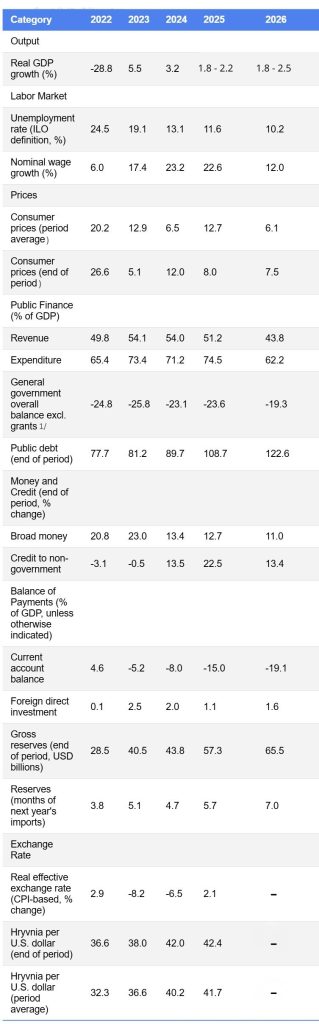
Sources: State Statistics Committee of Ukraine; Ministry of Finance; National Bank of Ukraine; World Bank; World Development Indicators; and IMF staff estimates and projections.
1/ The general government includes the central and local governments and social funds.