




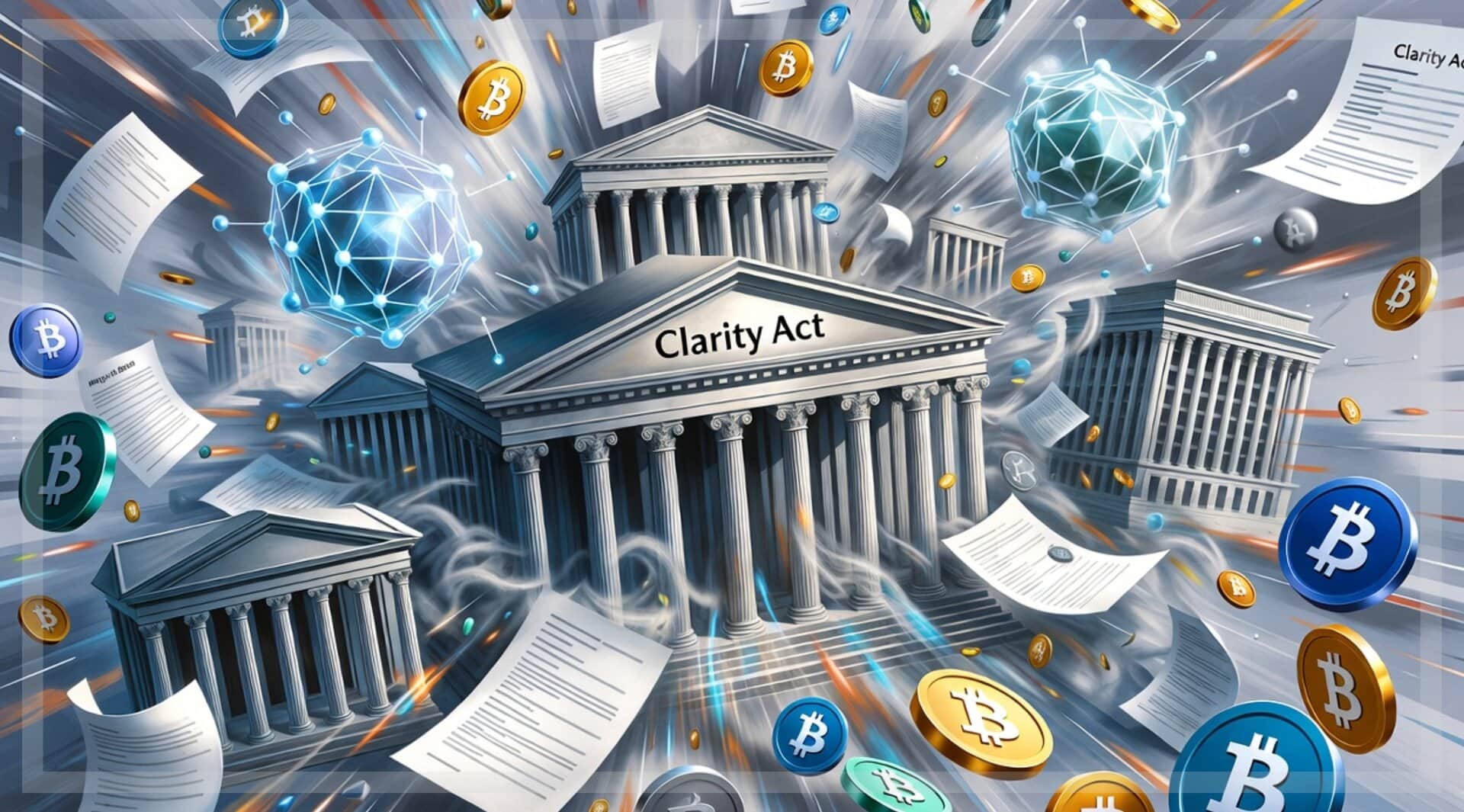
A food fight is happening between crypto founders over the terms of the Clarity Act, a new bill that will divvy up cryptocurrencies between the Securities & Exchange Commission (SEC) and the Commodities Futures Trading Commission (CFTC). Ripple stands to win big, and Ripple founder, Brad Garlinghouse, is advocating for congress to pass the bill.
Charles Hoskinson, co-founder of Ethereum and founder of Cardano, criticized Garlinghouse for supporting the current version of the bill, unlike Coinbase’s Brian Armstrong, who has criticized the bill itself.
“Clarity” Versus Control
“Ripple and I know firsthand that clarity beats chaos, and this bill’s success is crypto’s success,” Garlinghouse wrote on X, adding, “I remain optimistic that issues can be resolved through the mark-up process.”
Armstrong, among others, says the bill favors banks, and Hoskinson has warned that it hands too much power to the SEC and locks crypto into flawed regulation that favors banks over innovation.
In a video, Hoskinson declared, “I didn’t sign up to hand the revolution to 15 banks to live in a world where everything is a custodial wallet, every transaction is KYC, everything is mutable and reversible, and can be frozen at a whim when that number comes stamped on my forehead. I signed up for freedom.”
The next day, Cardano saw a 7% drop in price, despite bullish sentiment.
📊 There was a massive spike in bullish sentiment toward Cardano yesterday, followed by an immediate price drop. This was related to founder Charles Hoskinson's interview where he, among other topics:
— Santiment (@santimentfeed) January 19, 2026
📌 Expressed his concerns over the CLARITY Act
📌 Criticized Ripple CEO Brad… pic.twitter.com/7xVFbTcdtf
Hoskinson Draws a Line in the Sand
Hoskinson compared people like Garlinghouse to Judas and his trade of Jesus Christ for silver and warned of extensive surveillance by the government.
The irony of handing control back to an agency that relentlessly sued crypto companies, sending subpoenas, and confiscated crypto mining equipment is not lost on Hoskinson.
In his January 18 Live feed, he said, “You know what the current [Clarity Act] bill has in it, 137 amendments later? It hands the entire keys to the cryptocurrency kingdom to the Securities & Exchange Commission, and you have to go beg and plead for them to make it not a security. All new projects are securities by default. How is that any better than what Scary Gary [Gensler] gave us under Biden? Did you vote for that? The hundreds of millions in donations and lobbying to pay for everything from the inauguration to the East Wing of the White House and all the stuff in between, the [Trump] family’s crypto assets, and all these things, and one year later and what we got is Elizabeth Warren wrote the bill!”
Crypto, Power, and Political Contamination
He rails against Biden’s Scary Gary in the same breath as he calls out the embrace of crypto titans of Donald Trump’s venality, funding the president’s pet projects to the tune of nine-figure donations.
A week before his much-reported Live on X, Hoskinson unloaded on President Trump’s crypto policy, criticizing the Trump memecoin as “extractive” and saying Trump’s politicization of cryptocurrency puts the industry in a worse position than it was under Trump’s predecessor, a heresy crypto professionals wouldn’t dare whisper only a year ago.
Hoskinson made a deft point, saying, “I think it would have been extremely different because we would have probably passed not only the GENIUS Act but also the Clarity Act, and there was a window of time where crypto legislation could have been intrinsically bipartisan.”
The Crypto President
He may be right. Most of the snags the Clarity Act has hit among Democrats are due to the President’s involvement in the industry.
Senator Cory Booker (D-NJ), the lead Democratic negotiator, said, “This is ridiculous that the President of the United States and his family have made billions of dollars off of this industry and are still trying to create a framework here without the kind of ethics that would prevent this kind of gross corruption in our country.”
Meanwhile, Ripple hasn’t voiced concerns because the firm is deeply entrenched in Wall Street and trying to become a bank itself, which Disruption Banking wrote about here.
According to Hoskinson, the bill predisposes institutional TradFi at the direct expense of DeFi, which he says gets “decimated” by the language of the legislation, as written.
🚨 HOSKINSON SAYS CLARITY ACT DECIMATES DEFI
— CryptosRus (@CryptosR_Us) January 23, 2026
According Input Output Founder Charles Hoskinson, the current draft of the market structure bill only offers clarity for big banks — NOT the crypto industry.
⚔️ @IOHK_Charles publicly clashed with @Ripple CEO Brad Garlinghouse, who… pic.twitter.com/74dL0OrlRY
Crypto as Punk Rock
Cardano is positioning itself as a political bet, seeming to prioritize sentiment and ethos.
On January 31, Hoskinson explained his thinking in a Live on X, “What does it mean to be in crypto? Crypto is the punk rock of finance. We’re supposed to be the outsiders. We’re supposed to be the cool kids. We’re supposed to be the nonconformists. We’re supposed to be the rebels! We’re supposed to be different from the rest. What happened is that all that changed in 2021. We all got rich. We all got accepted. We all basically became part of the system, and you know what the system does when you become part of it. It makes it not cool. It takes the life out of it.”
Cardano’s strategy and positioning are basically the opposite of Garlinghouse’s vision for Ripple, which is seeking to become part of TradFi, rather than trying to stand against it.
For Cardano, there is a cost to a punk rock approach as is evident in its infrastructure play with Circle’s USDCx, which represents Cardano effectively importing liquidity and rejecting regulatory capture.
Hoskinson said, of the deal, “We [now] have access to Circle’s network, Circle’s protocol, Circle’s technology, and the great liquidity of the Circle network as a whole, and the added privacy benefits of USDCx and all the technologies therein.”
Clarity on the Clarity Act?
Ten days after Hoskinson’s tirade, the Senate Ag Committee advanced the “Digital Commodity Intermediaries Act” on a party-line vote. Republicans all voted yes and Democrats all voted no, citing missing DeFi provisions and inadequate safeguards against public officials (read: President Trump) from engaging in the crypto industry.
After pulling support for a previous version, Brian Armstrong threw his support behind this version.
Really important step forward today on market structure legislation with the Senate Ag Committee passing its portion of the bill.
— Brian Armstrong (@brian_armstrong) January 29, 2026
Thanks to Chairman @JohnBoozman for your leadership, and Sen. @CoryBooker for ultimately helping America get a comprehensive bipartisan crypto bill… https://t.co/1eKh7MwqSj
Garlinghouse echoed this view.
The last couple of weeks have been an absolute firestorm of action to get the Market Structure bill passed. While @BankingGOP clears its logjam (thank you @SenatorTimScott!), congrats are in order to @SenateAgGOP and Chairman @JohnBoozman for advancing the Senate Agriculture… https://t.co/aPaDzwplG6
— Brad Garlinghouse (@bgarlinghouse) January 29, 2026
In contrast to Hoskinson’s warnings, the bill does not hand everything to the SEC. It is actually focused on the CFTC, requiring joint SEC-CFTC rulemaking. Digital asset exchanges would still be required to make disclosures to the SEC before having the opportunity to permit trading in a digital commodity, so the SEC remains the main gatekeeper for projects hoping to move from the securities lane to the commodities lane.
Davis Wright Tremaine, a corporate law firm, wrote in a blog post, “The updated Senate Ag legislative text, while not bipartisan like the discussion draft, takes on much of Senate Ag’s earlier discussion draft and focuses more squarely on digital asset intermediaries, but still leaves open the treatment of DeFi protocols.”
Bad Law Is Forever
Hoskinson may be early, or he may be isolated. But history suggests that bad financial law outlives its authors. In that light, chaos may be less dangerous than surrender.
As Washington hesitates and markets fragment, crypto’s future is being shaped not just by lawmakers, but by the founders who are willing to live with chaos and who are willing to own the consequences of clarity forever.
The fight over the Clarity Act is a referendum on what crypto is allowed to become. Right now, that’s really unclear, and it seems like Senate Ag just needed to push something out, even if the bill eludes many of the most substantial issues, so the effort didn’t stall entirely.
While Garlinghouse and his allies argue that imperfect clarity is better than regulatory limbo, Hoskinson is making a rarer and riskier claim: that some laws, once passed, cannot be unwound, and that surrendering to institutional capture in exchange for acceptance may cost the industry its reason for existing.
Author: Tim Tolka, Senior Reporter
#Crypto #Blockchain #DigitalAssets #DeFi
The editorial team at #DisruptionBanking has taken all precautions to ensure that no persons or organizations have been adversely affected or offered any sort of financial advice in this article. This article is most definitely not financial advice.
See Also:
Clarity Act: Ripple Says Yes, Coinbase Walks Away | Disruption Banking
Clarity Act Blow-Up: Armstrong Optimistic, Bitcoin Slumps | Disruption Banking










One Response
Banks shouldn’t have any say in crypto clarity bull. It’s not there money , the people should get to vote this bill in not banks! It’s time to give control to the people. Without the people there is no banks. If the politicians that were voted in by the people are controlled by banks then even the politicians should have no vote either. Let us, the people with the money be the deciding factor. We should be able to vote on our future , not those that have ruined all trust and only care about there own pockets! The banks will just need to be bailed out again so the ceo’s can take there hundreds of millions in retirement bonuses again! It’s a joke and we the people always pay the price! So let us individually vote on our monies future not those who can’t even control the crooks in the banking system. The politicians are bribed and bought off to vote the banks way. We the people aren’t paid for! It’s our money not crooks and they have always been crooks and they always will be when it comes to money and there greed!