
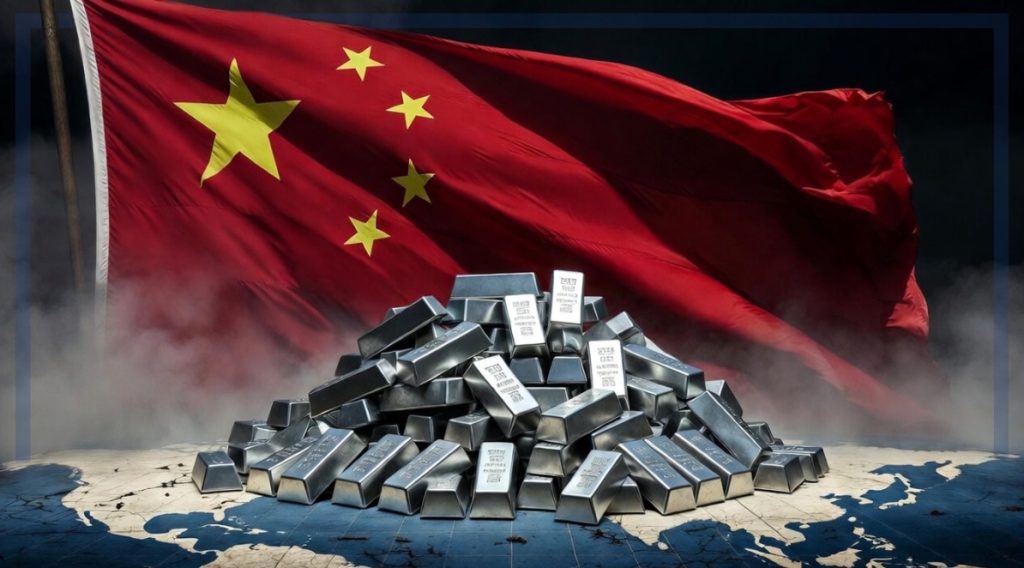
China’s appetite for silver lifted overseas purchases to an eight-year high at the start of 2026. The world’s biggest buyer pulled in over 790 tons in the first two months, including nearly 470 tons in February, the highest ever for that month, according to Chinese customs data. These are not speculative numbers. They are customs records. And they tell a story the silver market cannot afford to ignore.
790 Tons in 2 Months: China’s Massive Physical Grab
Strong demand has pushed local prices well above international benchmarks, whittling down already low exchange stockpiles and pulling metal in from abroad.
Much of it moved through Hong Kong. During the first two months, prices there for large silver bars attracted a premium of as much as $8 an ounce, when they normally trade at a discount to the London benchmark, according to Stanley Cheung, managing director of AC Precious Metals Refinery Ltd. That is not a market quirk. That is arbitrage under acute stress.
Simone Knobloch, Chief Operating Officer of Swiss refinery Valcambi SA, was direct: “The feedback we receive from the market indicates strong interest in physical products.” When the world’s major refiners describe conditions in those terms, the signal is clear.
China imported 790 tons of silver in two months.
— PeerMetals (@peer_metals) March 20, 2026
470 tons in February alone.
Highest in eight years.
Silver dropped 10% yesterday. China kept buying anyway.
Chinese warehouses emptying fast. Solar companies stockpiling.
Regular people buying bars.
Silver falls in the West.… pic.twitter.com/5L2W94OgOH
Solar Boom + Retail Rush: Dual Demand Engines
Demand is coming from two distinct and powerful fronts. Demand stems from retail investors acquiring bars as an alternative to gold, and from solar manufacturers accelerating production ahead of the removal of an export tax rebate on April 1.
Rhona O’Connell, head of market analysis for EMEA and Asia at StoneX Group, described the industrial side plainly: solar cell manufacturers are “going gangbusters.”
On the retail side, the growing appetite for silver as a cheaper alternative to gold has made investment bars ranging from 20 grams to 1 kilogram common in the Shuibei market in Shenzhen, the center of China’s retail bullion trade. With gold now fluctuating around $4,600 per ounce and silver trading near $68 as of March 21, 2026, the gap makes the trade obvious to millions of Chinese savers.
Song Jiangzhen, a researcher at Guangdong Southern Gold Market Academy, described the psychological shift: “Silver has been a hit among retail investors and sellers,” adding that consumers increasingly view gold as simply out of reach.
Goldman Warns: Export Curbs Risk Fracturing Global Silver Market
China’s new 2026 export restrictions, which now require official approval for outbound silver shipments, could fragment the global silver market, reducing liquidity while amplifying price swings, Goldman Sachs analysts warned in January.
“Disruption risk may prompt participants to secure their own stockpiles rather than share buffers globally,” the analysts said. “This shift from a pooled global system to isolated regional inventories would create an inefficient structure, transforming a smooth, integrated market into one prone to sharp, localized price swings.”
As we covered previously in Silver Price Surges as Precious Metals Become Scarcer and Market Crash Looms, COMEX registered inventories, the metal actually available for futures delivery in the U.S., have plunged roughly 75% since 2020.
Sixth Straight Deficit: 67 Moz Shortfall in 2026
The Silver Institute’s forecast, based on analysis by London-based consultancy Metals Focus, points to a 67-million-ounce shortfall in 2026, with total demand once again outstripping total supply. That makes six straight years of deficit. Including last year’s shortfall, the five-year cumulative deficit will climb above 800 million ounces, an entire year of global mining output.
Physical investment demand is set to strengthen considerably, with the Institute projecting a 20-percent rise to a three-year high of 227 million ounces. Industrial demand, though easing slightly from record highs, remains structurally locked in by the energy transition. Solar manufacturers can thrift and substitute where possible, but the conductivity requirements for photovoltaics do not disappear simply because silver is expensive.
China Controls Both Ends: Top Consumer + Export Gatekeeper
China controls this market from both ends: the world’s largest silver consumer and, through its new export licensing regime, the dominant gatekeeper of global silver refining output.
As of March 21, 2026, silver is trading around $68 per ounce, down sharply from its January all-time high of $121.62, but still more than double its level a year ago. Yuan Zheng, an analyst at the Shanghai-based trading arm of Henan Jinli Gold and Lead Group, noted that the premium has softened and solar demand has slowed as the April 1 rebate deadline nears: “We’ve moved into a situation of more supply than demand in the near term.”
But near-term easing is not a structural resolution. As Song Jiangzhen warned, “All it takes is just another surge in prices. Retail investors tend to follow rising trends rather than buy dips.”
The deficit persists. The export controls remain. And the global silver pipeline increasingly runs through Beijing.
Author: Ayanfe Fakunle
The editorial team at #DisruptionBanking has taken all precautions to ensure that no persons or organizations have been adversely affected or offered any sort of financial advice in this article. This article is most definitely not financial advice.
See Also:
Iran War Sparks Gold Surge Past $5,400, Silver to $96 | Disruption Banking
The Great Silver Crash 2026 and the Alleged Paper Reset | Disruption Banking