The Digital Assets Forum is now in full swing. The exhibition area and the stages are both full of people, it is really bustling here. Frederick Gregaard, CEO of the Cardano Foundation, has just finished his keynote speech. The energy levels remain very high.
We had not met Stuart MacDonald from Level III Capital before. Stuart was the moderator at the next panel at the Forum. A panel which touched upon a key challenge for everyone involved with digital assets today. He certainly is someone we would recommend you follow.
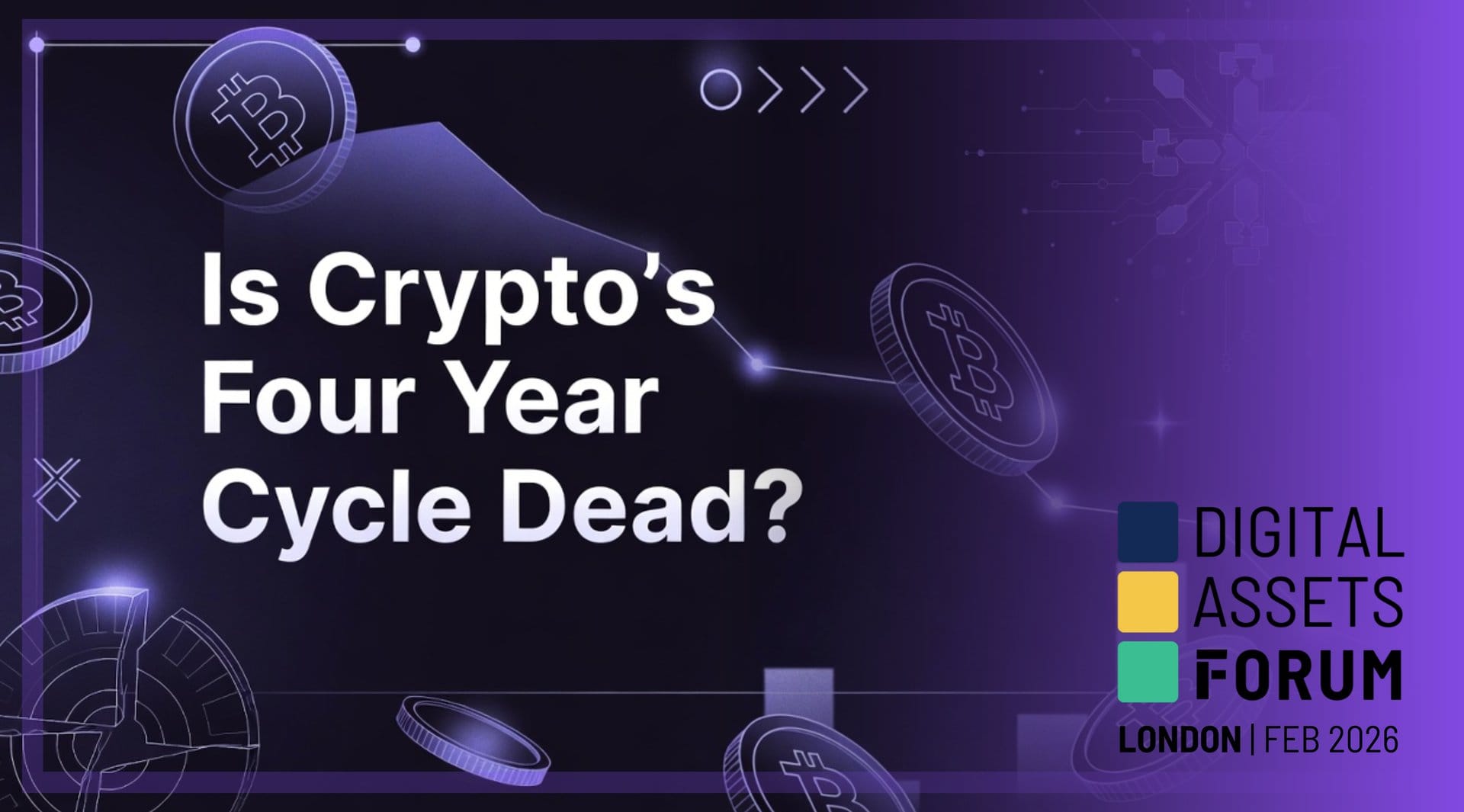
Crypto’s Four-Year Cycle – Is It Dead?
Stuart was joined on stage by Francesco Filia, Founder & CEO of Fasanara, Anatoly Crachilov, CEO & Founding Partner of Nickel Digital Asset Management, Matthew Le Merle, Partner & CEO of Fifth Era, Bradley Duke, Managing Director & Head of Europe at Bitwise, and Yves Choueifaty, President and CIO of TOBAM.
Is #Crypto's Four Year Cycle Dead? At the Digital Assets Forum here in London. Speakers from Nickel Digital and Fasanara share their insights with delegates #DAF3 pic.twitter.com/zzUbeDtwmw
— Digital Startup (@digitalstartup5) February 5, 2026
Stuart introduced Bitwise as the leading ETF provider on “this side of the Atlantic”. He was also very complimentary of the other speakers whom he spent time emphasizing the experience of to delegates at the event. Yves spoke first as he has often discussed the four-year cycle of bitcoin in the past. His company, TOBAM, is a French quantitative asset management company and pioneer in bitcoin investing.
“I think this narrative (the four-year cycle) is an artifact of an early market structure,” Yves shared. “The narrative emerged from the early days when the market was dominated by one single asset, and the whole market was retail driven with limited institutional balance sheet participation. There was no proper derivative market which generally drives well established markets.”
“The market has changed dramatically,” Yves continued. He shared how the market has become a multi-asset asset class rather than being driven by one dominant asset. More importantly, he highlighted, there is now a “very substantial derivative market.”
Francesco, whose firm Fasanara Capital has been a stalwart at most hedge fund and digital assets events we attend in London, added his thoughts. He commented how we have seen a big drop in crypto prices in the last month, at the same time as gold is reaching new highs. He raised the question “what happened to the cycle?” Is it still there?
“It has happened multiple times that the big rallies of bitcoin have been preceded by decreases in prices of anywhere between 50 and 80 percent,” Francesco shared.
Halving vs ETF Flows
Anatoly, of Nickel, commented on how halving incidents are largely irrelevant today compared to the early days of bitcoin. He pointed to how ETF flows now dominate, and how treasury acquisitions have changed things.
Yves added how the four-year cycle has been linked to halving in the past. He shared how mining during the first four years of bitcoin was responsible for releasing 10.5 million bitcoins into circulation. Today the impact of mining is much less.
Francesco mentioned October 2025 when the current downward trend for crypto started. At the time bitcoin’s price was above $126,000, today it is trading at just $69,000. Francesco explained how liquidity is the driver in moments like this. He shared that in October the market experienced extreme liquidations, not dissimilar to what we have seen over the last few days.
Matthew is a leader in the crypto community. His firm, an early stage investor in Coinbase, Tether, and Bitwise amongst others, is investing in companies that can be the next generation of FAANGs. He felt it important to share three key things with delegates.
“We are about to reach an inflection point in adoption,” Matthew explained. “We have about 500 million digital wallets and are expecting another 3 billion or so to be added to this group in the next 2 to 3 years. Any delay in this adoption will hurt companies like Kraken and Coinbase.”
Matthew also highlighted the role of the developer community in supporting the crypto industry. He questioned how these people are feeling right now and where they are putting their energy to use? The issue Matthew sees is that there are only a few top blockchain developers in the world. Maybe 1,000. These developers also make great AI developers, though, he explained. This mirrors the shift in bitcoin mining to data center infrastructure that we have seen over the last twelve months.
Finally, Matthew sees the existing establishment and regulators as standing in the way of change. Current volatility is another great excuse for them to use fear to lower the legitimization of the sector. This may hinder innovation, he shared.
The Future of Bitcoin
The discussions continued. Anatoly explained his alternative scenario for bitcoin. The only adverse scenario he sees for bitcoin is if central bankers were “orthodox”. He argued that central bankers have NEVER been orthodox, and there is little chance that this will change. They have continuously failed to protect the purchasing power of fiat currencies.
Anatoly shared how bitcoin is paying the price for central bankers’ behaviour. The recent tightening of monetary policy has affected prices, not to mention how central bankers have been buying huge amounts of gold.
Matthew summarized the discussions. He explained how the FAANGs were our benchmark in the last decade. In the next decade he believes it is the companies digitalizing the world’s financial infrastructure alongside digital assets who will be the winners of this race.
“We love bitcoin, we love Satoshi and the core developer team,” Matthew concluded. “We need 8 billion people to have digital wallets.” That is the future. We all hope.
Author: Andy Samu
#DAF3 #DigitalAssetsForum
See Also:
London’s Digital Assets Forum Kicks Off Amid Stablecoin Surge | Disruption Banking