In today’s feature, “How strong will BTC be in 2026?” Disruption Banking looks at the potential trajectory of Bitcoin (BTC) in 2026, focusing on ETF-driven institutional demand that continues to absorb supply amid subdued speculative activity, the maturing regulatory environment facilitating greater capital access, and the dynamics of whale accumulation contrasted with limited retail engagement.
Furthermore, we investigate mining economics amid post-halving cost pressures and the broader macroeconomic factors that could propel Bitcoin to new highs, sustain range-bound trading, or trigger a retracement.
ETFs Are Absorbing Supply Without Igniting Speculation
U.S. spot Bitcoin ETFs have drawn substantial inflows since their January 2024 debut, amassing approximately $57 billion net as of early January 2026. Even in late 2025, the flows remained robust, around $471 million on January 2 and $697 million on January 5. Yet Bitcoin’s price has barely budged.
The coin flirted with $90,000 in December 2025 in late 2025 before recovering into the low $90,000s in early 2026. In other words, ETF buyers are hoarding BTC without triggering a speculative stampede.
So far, it looks like steady accumulation is happening quietly. Institutions are snagging coins even as spot volatility remains muted.
Evolving Bitcoin Regulation: Enhanced Clarity Paired with Increased Oversight
2025 brought some big rule changes that matter for Bitcoin. The EU’s Markets-in-Crypto-Assets (MiCA) framework became fully operational, while the U.S. enacted the stablecoin-focused GENIUS Act, both providing clearer legal footing. In the U.S., regulators took a mixed path: the Securities and Exchange Commission (SEC) approved spot BTC and ETH ETFs and even allowed traditional in-kind creation/redemption, but it also paused or slowed a few conversions (e.g., it delayed Grayscale’s plan).
This balanced approach provides institutional participants with a more robust operational framework, albeit under heightened scrutiny. Banks now have greater confidence in holding or tokenizing crypto assets, yet unresolved issues around taxation, custody standards, and enforcement persist.
In essence, Bitcoin’s legitimacy as an institutional asset class has strengthened in 2026, though each advancement invites additional regulatory safeguards.
Corporate and Whale Bitcoin Holdings Surge as Retail Participation Wanes
Right now, big holders are driving demand. In Q2 2025, corporate treasuries bought roughly 131,000 BTC, more than the ~111,000 BTC that U.S. ETFs bought in the same quarter. Meanwhile, the total Bitcoin held on exchanges plunged to ~2.45 million (a seven-year low) by October 2025.
As of early 2026, public companies collectively hold over 1 million BTC, with Strategy alone at approximately 674,000 BTC.
In plain terms, whales and institutions are hoarding Bitcoin, while retail interest is relatively muted. This flips the old narrative: Bitcoin’s price dynamics are increasingly influenced by strategic institutional and corporate acquisitions rather than retail-driven hype or meme-fueled rallies.
Post-Halving Bitcoin Mining Dynamics: Navigating Cost Pressures and Breakeven Thresholds
The economics of mining were very tight in 2025. The network’s hashrate climbed to about 1 exahash (ZH/s), pushing mining difficulty to all-time highs (~156 T). Following the April 2024 halving, miners’ revenues rely predominantly on BTC price appreciation, as transaction fees contribute minimally. Public miner data revealed average cash costs of ~$74,600 per BTC in Q2 2025, with higher figures including depreciation. Hashprice (BTC earned per PH/s) fell from ~$64 in July 2025 to ~$35 by December, roughly the breakeven for even the most efficient farms.
In other words, many miners were barely breaking even, even when Bitcoin was near its highs. Industry analysts now say BTC likely needs to climb well above $100K just to restore robust miner profitability. Without that rally, smaller or higher-cost mining operations will shut down or sell holdings, which could exert downward pressure on price.
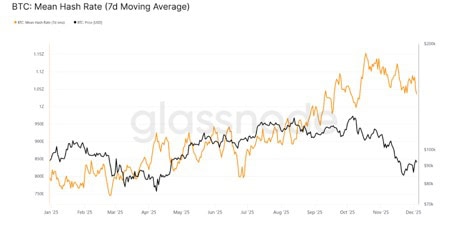
Bitcoin Mining in 2025: Mean Hash Rate (7-day Moving Average). Source: ForkLog
Drivers of Bitcoin Performance in 2026: Liquidity Tailwinds or Policy Headwinds?
Bitcoin’s fortunes in 2026 will hinge on macroeconomic conditions. Elevated sovereign debt and inflation uncertainty should elevate demand for a hard-capped asset. Indeed, Grayscale projects a new all-time high in H1 2026 on those macro grounds. If inflation continues to cool and central banks eventually cut rates, significant pools of capital could flow into risk assets, including Bitcoin.
Historical patterns hint at this dynamic. For example, when U.S. political turmoil hit in October last year, BTC briefly rallied as investors sought a hedge. Similarly, a $2 billion USDT issuance early in the same month coincided with a Bitcoin up-move. In each case, external liquidity and risk appetite drove flows into BTC.
Conversely, resurgent inflation or prolonged tight monetary policy could align BTC with equities, capping gains. Ultimately, Federal Reserve decisions, inflation metrics, and geopolitical stability will determine whether macro forces provide uplift or restraint.
Bitcoin Scenarios for 2026: Institutional Breakout, Range Trading, or Liquidity-Driven Reset
Analysts outline three plausible paths for Bitcoin in 2026:
● Upside Case: Institutional Momentum and Supply Constraints Propel BTC Higher
Everything clicks. Supportive macro conditions, such as accommodative Fed policy, catalyze a breakout. In this case, BTC could surpass its prior $125,000 peak, with projections from Standard Chartered reaching ~$150,000 by year-end if demand persists. The milestone of the 20-millionth Bitcoin issuance in March 2026 would reinforce its scarcity narrative, fostering a virtuous cycle of adoption and price appreciation.
● Base Case: Range-Bound Bitcoin in a Risk-Managed World:
Steady progress, no fireworks. Policy clarity improves gradually, and adoption grows piece by piece, but nothing triggers a parabolic surge. Bitcoin then trades in a wide $80,000–100,000 range. Institutional investors remain engaged (buying dip after dip), but a wary Fed and periodic macro jitters keep rallies in check.
In practice, Bitcoin ends up largely moving with equity markets: it rises when liquidity is ample and dips on bad news. The net result is moderate upside on the year, with each rally tempered by traditional profit-taking.
● Downside Case: Liquidity Shocks Override the Halving:
Shock or stalemate. Suppose central banks hold higher rates, or a major crypto/stablecoin crisis spooks investors. Then institutional flows dry up, and miners, already squeezed, start dumping Bitcoin. The price could then falter sharply.
Bitcoin was already down ~24% in Q4 2025; in this scenario, it could test its prior lows again (near $60,000–70,000).
Here, 2026 is a consolidation year or mild correction. The old four-year “halving” cycle takes a back seat to macro and liquidity shocks.
In 2026, Bitcoin’s Strength Will Be Measured, Not Promised
In every case, fundamentals win. Bitcoin’s strength in 2026 will be determined by actual data, ETF inflows, corporate treasury reports, mining costs, and Fed signals, not by folklore. Institutional investors should watch those gauges closely, as they will reveal whether Bitcoin’s next move is a sprint, a stroll, or a stumble.
Ultimately, regulation, capital flows, and macro policy will write the script for BTC’s performance in 2026.
Author: Ayanfe Fakunle
The editorial team at #DisruptionBanking has taken all precautions to ensure that no persons or organizations have been adversely affected or offered any sort of financial advice in this article. This article is most definitely not financial advice.
See Also:
Can XRP Rally in 2026? ETFs, Utility, and Outlook
XRP ETF Boom: $1.4B Inflows in Early 2026
Bitcoin News: How Quai Network’s Christmas Fork Brings Renewed Confidence to Bitcoin Miners