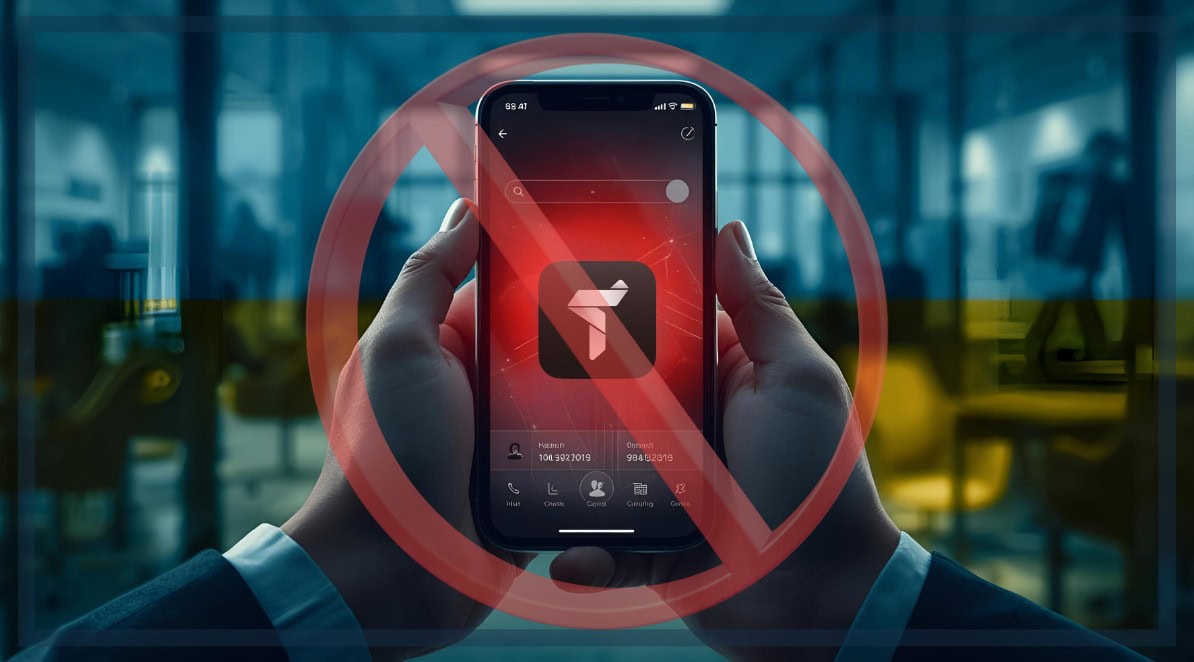
Our first story explained what Trustee Global UAB built, how it operated, and why the National Bank of Ukraine (NBU) moved against it.
In this second part, DisruptionBanking picks up from there. We examine the deeper political and regulatory context, the cross-border tensions, the proof-of-reserve compliance blind spots, and the broader warning this case sends to crypto-fintech companies operating across jurisdictions.
A Rare Enforcement Move in Ukraine’s Transitional Crypto Framework
For context on enforcement: the NBU’s ban is unusual. The country is only now moving to formally legalize crypto and improve fintech rules. Apart from targeting fintech fraudsters, the NBU seldom identifies specific crypto services by name. Its public advisories list a few foreign unlicensed players (mostly loan apps or exchanges), but never before had it singled out a crypto wallet from Lithuania.
In response, Trustee’s CEO pointed out that the NBU backed off most accusations and only objected to P2P and euro features. He downplayed the ban as “a negative precedent” because it effectively “bans P2P interactions between users.” Trustee insisted customer assets remained safe and that in practice Ukrainian users could still hold crypto and do ordinary exchange, just without the peer-to-peer hryvnia bridge.
The company even claimed it halted new Ukraine sign-ups earlier in 2025precisely because of such legal uncertainty. In essence, Trustee argues it has operated under EU oversight and had no intent to violate Ukraine’s laws. The NBU disagreed, declaring the specific wallet features illegal without local licensing.
Building Legitimacy: Web Summit, Kyiv Talks, and the Pivot
At industry events, Trustee Global has courted legitimacy. In November 2023 the company exhibited at Europe’s Web Summit, with Vadym Hrusha listed as CEO and boasting “100K app installations” and active trading volume. This was presented as a mainstream success story in cryptocurrency innovation. Hrusha also spoke on crypto payments at Kyiv’s U Tomorrow Summit in 2023. In interviews around that time he cited Ukraine’s fast-growing crypto scene and the need for legal clarity.
Trustee Plus achieves 500K+ downloads and nears 100K crypto card users. Key features like P2P trading and zero-commission deposits drive growth, solidifying its impact in Ukraine's cryptocurrency market. https://t.co/TY4iKBC1px
— Voted.News (@VotedNews) September 11, 2024
After the NBU move, Trustee issued statements claiming it always meant to work within the EU’s legal framework and portrayed the ban as an overreach. For example, Hrusha publicly pressed the NBU for dialogue on licensing, only to be told Ukraine lacks a law authorizing any crypto services. In crypto media, he stressed that the firm shifted focus to Europe’s markets, emphasizing that Trustee Plus in the EU has full compliance and that Ukrainian users legally residing abroad can still use the app freely.
Why This Ban Hits Harder Than It Looks
To understand why this ban landed hard, you need to know what usually doesn’t happen in Ukraine.
Corruption in Ukraine doesn’t just exist as a problem, it’s structural. The country scored 35 out of 100 on Transparency International’s 2024 Corruption Perceptions Index, down from 36 in 2023. The Joe Biden administration warned years ago that Moscow could use rampant corruption to destroy Ukraine from within after failing militarily. The US has withheld aid over corruption concerns. Most recently, a $100 million corruption probe announced this November has already prompted resignations of senior officials.
Against this backdrop, banning a foreign company, especially one operating in fintech, where regulatory capture risks are elevated, isn’t simple politics. It’s more than just enforcement. It’s enforcement with teeth.
Ukraine’s EU accession report showed continuous corruption pressure across ministries. The NBU’s anti-corruption program remains intact despite external pressure. When regulators in this environment enforce, it signals that something has changed.
Lithuania’s “Fintech Paradise” and the Arbitrage That Backfired
Behind the scenes, Lithuania’s role looms large. For years Lithuania has aggressively courted fintech firms, especially crypto startups, by offering fast licensing and a friendly regulatory sandbox. By 2025 some 285 fintech companies (including 42 crypto firms) were licensed there. This has given Lithuania an outsized fintech “launchpad” reputation. Indeed, BlockSoftLab and Trustee Global were able to set up in Vilnius with minimal delay, gaining permission to issue crypto services Europe-wide.
Until MiCA took effect local fintech regulators often approved foreign founders’ applications quickly, sometimes inviting even early-stage projects to Lithuania for access to EU banking and card schemes. This facilitation helped Trustee Global market to Ukraine by advertising a “fully licensed” EU service.
But as the NBU case shows, that licensing does not extend outside the EU. Ukrainian regulators do not consider an EU crypto license as permitting domestic hryvnia or hryvnia transfers. This regulatory arbitrage, one regulator’s permissiveness vs. another’s strict controls, is exactly the loophole Trustee exploited. Its strategy relied on the assumption that being legal in Lithuania/EU meant being safe in Ukraine too. That assumption has proven false.
The New Rule: Market Targeting = Jurisdiction
The Trustee Global case exposes something deeper than one company’s missteps: It clarifies that in Ukraine’s regulatory view, active market targeting + user data collection + systematic service provision = jurisdiction, regardless of where the corporate entity is registered.
Ukraine has generally welcomed crypto innovation with open arms (until MiCA, it had no law to specifically ban or allow crypto). But it also has stringent FX controls as a wartime measure. Firms like Trustee can promise to bridge these worlds yet lack clear authorization.
The NBU’s ban reveals that, in Ukraine, foreign fintech services must explicitly comply with local payment laws or stay out entirely. It also suggests Ukrainian authorities are now alert to the risks of “crypto-cards” enabling capital flight. For emerging market customers, the lesson is harsh: a wallet app with a shiny EU license can suddenly have key features switched off if local regulators object.
That’s not unique to Ukraine. That’s the direction all regulators are moving.
The Proof-of-Reserves Blind Spot: A Global Red Flag
Internationally, the incident is a warning. Lithuania’s model attracts global crypto ventures, but without tight follow-up, it can mask problems. The Bank of Lithuania claims it enforces strong AML/CFT and transparency (requiring licensees to meet MiCA standards and robust governance), but the Trustee case suggests enforcement can lag.
Trustee Global UAB did secure its Lithuanian VASP license, yet users now ask whether the company demonstrated any proof-of-reserves or published audits, measures now seen as best practice in crypto. The answer is that the company has no such data available to the public.
Proof of reserves, a concept most crypto companies still fumble, became mandatory for CASPs applying for licenses by June 30, 2025. Audits must cover at least 10 crypto assets representing 80% of customer-held balances. The infrastructure for rigorous oversight exists. That’s the operating environment Trustee Global claims to operate in.
But Trustee Global hasn’t published public proof of reserves. Major platforms like Kraken release monthly or quarterly attestations covering Bitcoin, Ethereum, Solana, and stablecoins. Trustee doesn’t. The Lithuanian regulator hasn’t forced it too yet either. MiCA doesn’t mandate proof of reserves as a standalone requirement for all CASPs, though it’s moving in that direction in other jurisdictions like Turkey.
This is a critical risk vector. In an environment where user deposits matter but transparency remains optional, regulators face a choice: trust the structure or audit it to death. The NBU chose the latter, or so it seems for now.
In general, customers in Ukraine were largely unaware of the backend corporate structure and assumed Trustee Plus was just another mobile wallet. Now they face a partial shutdown due to rules they didn’t even know applied.
What the Lawyers and Analysts Are Saying
Industry lawyers say the NBU move sends a strong signal. As ASA Group’s managing partner Ihor Mlechko put it, “the NBU is closely monitoring non-bank financial applications and reacts harshly if such entities provide payment services without licenses.”
Winner Law Firm’s Ihor Yasko echoed that foreign crypto services must obey Ukrainian licensing or face bans: “Any foreign services that work with payment or crypto transactions for Ukrainian citizens must comply with Ukrainian regulatory requirements and obtain a license, otherwise they risk being banned,” he warned.
Another compliance lawyer, Ella Nelha, stressed that the NBU’s action is not a ban on P2P crypto per se, but on “unlicensed activity:” the law requires any payment provider (or foreign branch) to have a permit and to safeguard users’ funds (separate accounts, insurance/guarantees, risk systems, etc.).
In short, the consensus is that any crypto wallet serving Ukrainians must fit into Ukraine’s legal framework. Experts note that Ukraine still has no full-fledged virtual assets regulation, so firms are stuck between foreign licensing and domestic law ambiguity.
Trustee’s ordeal highlights this gap: without valid crypto regulation, the NBU defaulted to older payments rules. As one commentator pointed out, Ukraine only passed a preliminary crypto bill in September (first reading), but that still awaits significant amendments. Meanwhile, foreign wallets like Trustee Plus are on thin ice, the NBU could treat this case as a precedent, restricting other non-authorized fintechs targeting Ukrainian users.
Despite these concerns, observers note that Ukraine is moving toward a transparent regime. MEXC analyst Shawn Young says Kyiv is “forming a full-fledged regulatory framework” to bring crypto into the system. He sees short-term coordination gaps (possible temporary P2P restrictions or stricter user rules) but calls the process “the building of rules…rather than a threat to business.” In his view, aligning with EU standards will ultimately protect users and investors as Ukraine’s crypto ecosystem evolves.
Where Are the Users Now? Reddit, Trustpilot, and the Exodus
Many fintech startups lack a good opinion online. Trustee Global is no different. Reddit has been busy in the first half of 2025 with multiple posts from disgruntled users. One of them even called Trustee a “scam”. Others just recommend that users “avoid” the Lithuanian company.
On Trustpilot the story isn’t much better. Trustee Global has a score of 2.9/5.0 with 170 reviews. One user posted this week about “unreasonably long AML verifications.” After being advised that the AML review would take 3 – 7 days it has been much longer. There are multiple further negative reviews from last week. Trustee Global does seem to be proactive in its response, however these complaints warning users off Trustee Global shouldn’t be happening in the first place.
The Bottom Line
The Trustee Global ban is real enforcement in a system where real enforcement is rare. It happened because the company made targeting visibility in Ukraine through active marketing, Ukrainian influencers, deliberate market penetration, high traffic, while it structured itself to avoid licensing in Ukraine. Sophisticated? Sure, but not sufficient.
For other fintech companies operating regionally: this is the clarification. Regulatory jurisdiction in 2025 has moved from corporate registration to systematic market targeting. Ukraine’s NBU proved it can enforce that view, even though corruption remains systemic and institutional capacity remains strained. That’s the actual story. Not a quirky regulatory quirk. A signal that the EU’s regulatory intensity, expressed through MiCA and coordinated enforcement, is reaching across borders into markets like Ukraine.
Trustee Global hasn’t been destroyed. Its EU operations continue, especially at this year’s Web Summit a few weeks ago. But the Ukrainian narrative just shifted from “wild west crypto” to “regulated boundaries matter.” That is a level of friction that other companies will face.
Our editorial team reached out to Trustee Global and specifically asked the company about Proof of Reserves, Compliance, who the Chief Risk Officer of the company is, and other questions. Trustee Global were unable to provide a response to ANY of our questions even though the company was given over 2 full weeks.
#TrusteeGlobal #TrusteePlus #NBU #Ukraine #Lithuania #Regulation #Corruption
Author: Richardson Chinonyerem
The editorial team at #DisruptionBanking has taken all precautions to ensure that no persons or organizations have been adversely affected or offered any sort of financial advice in this article. This article is most definitely not financial advice.
See Also:
Trustee Plus: The Crypto App Ukraine Had to Partially Ban | Disruption Banking
The Rise in Popularity of Crypto in Lithuania | Disruption Banking