
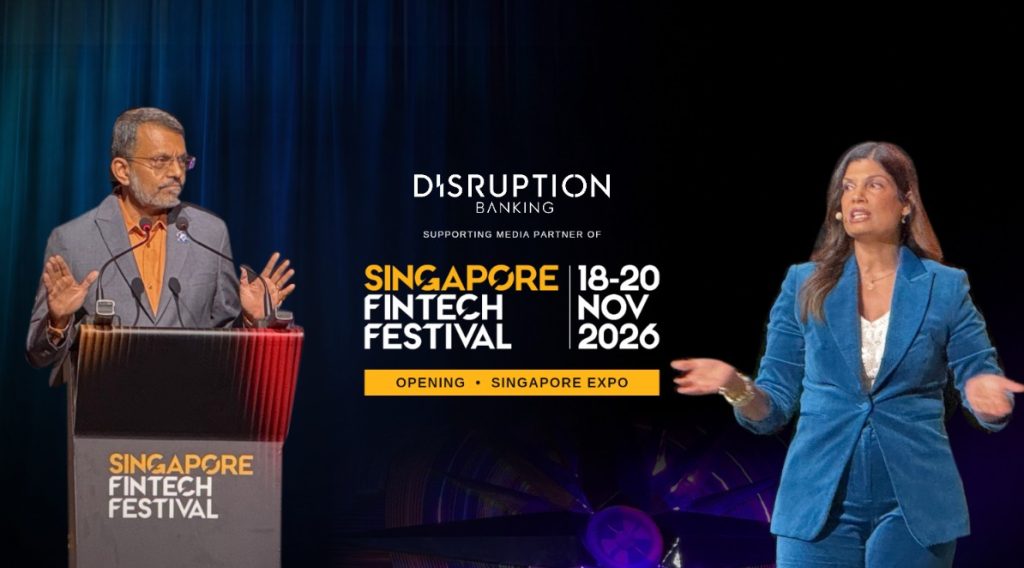
It was an early start for the Disruption Banking team on the opening day of the Singapore FinTech Festival 2026 at Singapore EXPO. Signs for the festival lined the route into the venue, and by the time the Festival Stage opened, the hall was already busy with delegates arriving from across the financial and technology sectors.
Running from November 18-20, the festival is organised by the Monetary Authority of Singapore (MAS) and the Global Finance & Technology Network (GFTN), in collaboration with the Association of Banks in Singapore. Last year’s edition attracted more than 70,000 participants from 142 countries, establishing the festival as one of the largest international gatherings dedicated to financial technology.
Manisha Tank, the broadcaster and long-standing host of the festival’s main stage, kicked off the week. With more than two decades of broadcasting experience at CNN, the BBC and now CNBC Asia, Tank has become a familiar presence at the event. This year she welcomed the audience in the hall, as well as the festival’s live-stream viewers for the first time.
Singapore FinTech Festival 2026 kicks off today at Singapore EXPO.
— Digital Startup (@digitalstartup5) November 18, 2026
CNBC Asia presenter Manisha Tank gets Day 1 under way. AI agents are making payments and assets are trading on-chain, putting existing rules to the test.
Global Finance & Technology Network (GFTN) #MAS_sg… pic.twitter.com/bM9KyG4tQk
Her introduction set out the broad themes for the coming days. Technology, policy, geo-economics, capital and talent are all undergoing significant changes, with new risks and regulatory questions emerging alongside opportunities for growth.
Tank was then joined on stage by Ravi Menon, Chairman of the Board of Directors of GFTN, Singapore’s Ambassador for Climate Action and former Managing Director of MAS.
The changing geography of global finance
Menon’s opening talk focused on how the relationship between finance and geopolitics is changing. Trade, investment, supply chains, technology and financial infrastructure are increasingly shaped by strategic considerations, with governments using tariffs, sanctions, export controls and investment screening alongside more traditional economic policies.
For financial institutions, these developments have consequences extending well beyond technology investment. As we have seen, changes in trade relationships can affect capital flows, supply-chain financing and the markets in which businesses choose to operate. Financial infrastructure itself is also becoming an increasingly important part of geopolitical competition.
Menon specifically highlighted the growing significance of the US dollar and the financial leverage that comes with its international position. While dollar dominance remains firmly established, he pointed to the development of alternative payment systems and regional financial connections as signs of targeted diversification.
He explained that the alternatives do not need to replace the dollar to have an effect. Their existence alone can give countries and institutions additional options when faced with financial restrictions.
“It is not just about allocating capital; it is also about exercising power.”
For banks and institutional investors, this is a significant change. Capital allocation does not take place in isolation from government policy or international relations. Sanctions, investment restrictions and changes in access to financial infrastructure can affect where money moves, which markets remain accessible and how institutions assess geopolitical exposure.
What comes next at SFF26
Tank and Menon’s opening addresses set out the wider geopolitical and economic questions facing the financial sector.
The discussions over the coming days will turn to how these challenges are being approached in practice, from the resilience of cross-border payment infrastructure to the place of regulated digital money and the early applications of technologies such as quantum. Disruption Banking will follow selected sessions across the festival.
Author: Grace Sharp
See Also: