
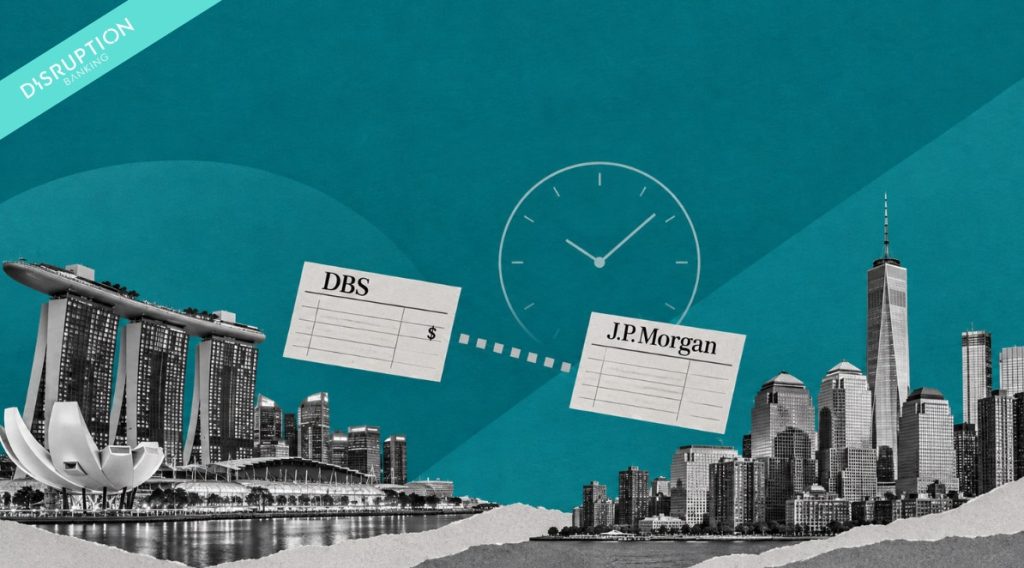
DBS and Kinexys by J.P. Morgan said on November 16 that institutional clients can now move US dollars between blockchain-based accounts in Singapore and the United States at any hour, including weekends.
The service connects DBS Token Services with Kinexys’ Blockchain Deposit Account network, and Ant International is the first client, using it for treasury and liquidity management across its entities in both markets.
What does DBS Means by an “Industry-First” for Tokenized Deposits?
DBS describes the launch as an “industry-first interoperability solution.” The release does not define the term further. Weekend dollar transfers between the two countries had already been done; DBS and Citi completed a Singapore-to-New York payment on Saturday, September 5, using tokenized deposits on the Swift Digital Ledger.
The DBS and JPMorgan service differs in structure. It joins the two banks’ own permissioned deposit networks directly with Partior handling settlement orchestration. DBS says it is commercially ready for clients of both banks. The launch puts the interoperability framework the two banks announced in November 2025 into operation.
Dollar Transfers Outside Fedwire’s Monday-to-Friday Schedule
A tokenized deposit is a bank deposit recorded on a blockchain, so the money remains a claim on the bank and does not become a stablecoin. Recording it this way lets a company with accounts at both banks shift dollars when conventional payment systems are closed.
The Federal Reserve’s Fedwire Funds Service does not operate on weekends, and the Fed expects to add Sundays and weekday holidays in 2028 or 2029, which would still leave Saturdays closed. DBS said in September that a dollar payment between Singapore and the US can take up to two business days because of time-zone and weekend gaps.
The new service does carry one limit of its own. Transfers on Kinexys’ network complete around the clock, but moving funds between that network and legacy demand deposit accounts is unavailable from 3 p.m. to 6 p.m. Eastern Time every Saturday. The release says an enhancement is in development.
Kinexys Brings $7 Billion in Daily Volume, DBS a 19-Market Network
JPMorgan supplies the US dollar side of the link. The bank said in June that Kinexys had processed more than $4 trillion in transactions since inception, with average daily volume above $7 billion. It also said that it added five Asia-Pacific currencies that month, including the Singapore dollar, to its Blockchain Deposit Account network.
DBS supplies the Asian side through DBS Token Services, which it launched in October 2024 on its own permissioned blockchain. The bank operates in 19 markets. Both banks are founding shareholders of Partior, and they co-lead the token interoperability workgroup of BLOOM, the Monetary Authority of Singapore’s initiative for settlement in tokenized bank liabilities and regulated stablecoins.
A US-Singapore Corridor Open Only to Institutions
The service is available to institutional clients of the two banks, so individual investors cannot use it directly. For companies and funds that hold dollars with both banks, cash held in the US can reach a Singapore account during Asian business hours, when US payment systems are shut, and the same applies in the other direction.
DBS cites a Money20/20 and FXC Intelligence forecast that Asian outbound cross-border payments will reach $24 trillion by 2033, up from $13.5 trillion in 2025. Its own survey, also cited in the release, found that 88% of corporations are deploying or piloting tokenized money and that more than half have adopted or plan to adopt tokenized deposits. The release gives no fees, transaction volumes, or client numbers beyond Ant International.
What One Live Service Shows About Tokenized Dollars
With this launch, a framework announced a year ago has become a live service that moves tokenized dollars between two large banks’ networks. The evidence it offers on wider viability is limited because Ant International is the only client named and the link covers two banks and one currency.
That currency is the dollar, as it was in the DBS and Citi payment, and the Federal Reserve has linked its own longer Fedwire hours to the dollar’s role in global commerce and finance.
The service does not use a publicly traded crypto token. The release mentions no stablecoins or public blockchains, although the 2025 framework was meant to cover both public and permissioned networks. The closer comparison is with dollar stablecoins, and JPMorgan has stuck to deposit tokens while 21 other banks and asset managers plan a dollar stablecoin.
Author: Ayanfe Fakunle
The editorial team at #DisruptionBanking has taken all precautions to ensure that no persons or organizations have been adversely affected or offered any sort of financial advice in this article. This article is most definitely not financial advice.
See Also: