
In June 2025 the Luxembourg State Treasury sold €50 million of digital treasury certificates on HSBC’s Orion platform. Luxembourg described the sale as the largest issuance of treasury certificates using blockchain. A year earlier Slovenia had issued a €30 million short-dated digital bond on the BNP Paribas Neobonds platform. The Philippines and Thailand have also issued tokenized government bonds, although the one to watch has been Hong Kong.
The Hong Kong government has run a digital green-bond programme since 2023, and on September 28, 2026, priced a fourth sale of about HK$20 billion, in four currencies, on HSBC’s Orion platform.
None of those issues is collateralized. Luxembourg and Hong Kong borrow on their own credit, with proceeds used for budgetary purposes. Buyers price the default risk. The Marshall Islands issued USDM1 for a different reason. It is sovereign debt of a dollarized country with one correspondent bank, and the proceeds are used to purchase US Treasury Bills that are pledged to a collateral agent before the bond is issued. That is the difference.
This model was popularized by the Brady bonds. In March 1989 Nicholas Brady, then US Treasury secretary, offered a way out of the Latin American debt crisis: bank loans that were not being paid were exchanged for bonds, and the principal was backed by US Treasury zeros pledged to a collateral agent outside the debtor. A zero pays nothing until maturity, then pays its face value, so a creditor could be confident that they could collect the principal even if the country itself defaulted. Over $160 billion Brady Bonds were issued. The exchanges ran from Mexico in 1990 to Côte d’Ivoire in 1998, and were used to help Nigeria, Vietnam, Poland and Bulgaria as well as Latin America.
USDM1 uses that structure for a different problem. The Marshall Islands is a USD-based economy with one correspondent bank, and its domestic banks cannot reliably transfer funds in or out of the country. Because the population is spread over hundreds of islands, it’s even difficult to transfer funds within the country. A bank can hold USDM1 because Brady Bonds are treated as equivalent to US Treasuries, because they are backed by US Treasuries and are themselves sovereign bonds – precisely what banks are encouraged to hold as reserves. And in the case of USDM1, both the principal and the interest are fully collateralized by T-bills, not zeros. In November 2025, the Marshall Islands banking commissioner confirmed in a letter that firms may keep USDM1 in the ordinary course as sovereign debt, not as a virtual asset. That enables use as reserves, which reduces the need for domestic banks to transfer in and out.
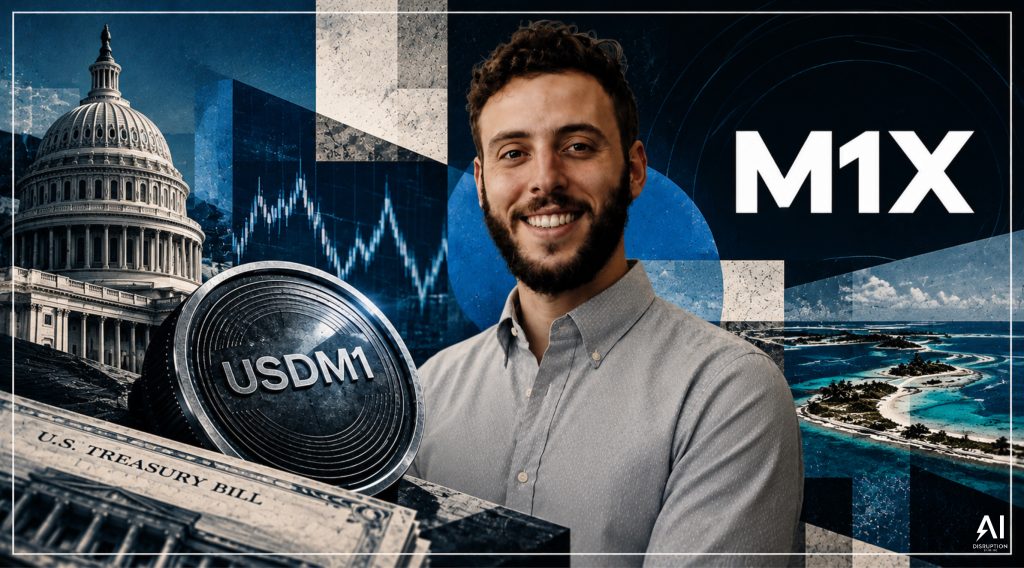
Disruption Banking sat down with Mark Lurie, Chief Executive Officer of M1X Global, who shared more about USDM1 and the problem it solves.
The correspondent banking hole USDM1 is built for
The first problem we discussed was how one bond can do two jobs. One is moving a government payment across atolls the banks no longer reach. The other is sitting in a repo between institutions. They do not look like the same problem. Lurie said they have the same root.
Money in and out of the Marshall Islands goes through the banks, and the banks go through a correspondent. The Pacific has lost about 60 per cent of those relationships since 2011, twice the global rate, on the World Bank’s count. The Ministry of Finance says the republic is down to one. The islands had already tried stablecoins. In a cash economy the on-ramp and the off-ramp are still the bank, which cannot themselves hold stablecoins as reserves, and so need to on/off ramp themselves through a correspondent. But a correspondent that has already left is not going to accommodate transfers originating from stablecoin holders.
What a domestic bank will book is a Treasury bill, or something built to be held as one. USDM1 is the second. Because it is collateralized sovereign debt, a Marshallese bank can keep it as a reserve asset and, if a customer wants a stablecoin, swap on-chain. The correspondent never has to book the token. That is the settlement rail. It is also why a repo desk can take it. The banks that hold it as a bill are also banks that can repo it.
Why USDM1 is a Brady bond on a blockchain
The next thing we discussed was why M1X does not simply say it is putting Brady bonds on a blockchain. Lurie said that is what it is. “USDM1 is a Brady bond that is issued natively on chain. The transfer agent uses the blockchain as the ledger. That’s it.”
The reason the name is not clearly defined, he said, is that the last Brady bond was issued over twenty years ago and most buyers would need to understand the history just to understand the analogy.
But for us, Lurie explained the history in more detail. He shared how Brady bonds were built so banks could repair their balance sheets. The banks then repoed them for liquidity. “I think about $10 trillion were traded in secondary markets from Brady bonds,” he said, as he explains that market as part of the growth of repo.
Lurie supplied the figure, but the mechanism was the point he was making. Different markets, same reason for holding the paper: a bank can book it as if it were a US Treasury.
He also gave the reason the United States posted the collateral for other countries in 1989 and then stopped. “When you owe the bank $1, it’s your problem. When you owe the bank a billion dollars, it’s the bank’s problem. But when you owe the US banking sector $100 billion, it’s the US government’s problem.”
Once the banks were clear of the loans, Washington stopped putting up the bills, and the reason to issue bonds disappeared. The Marshall Islands has a different reason for using Brady bonds. It cannot transfer funds to its own citizens through the bank that they use at the moment.
The United States, Taiwan and Japan have put about $1 billion into a trust fund for the islands, largely reparation for nuclear tests. The interest is in part used to pay a quarterly transfer or “ENRA” to every citizen. USDM1 has been used as a mechanism, not the funding. He said another large domestic use now is a national utility: people paying for power. The Ministry’s own account of the Compact Trust Fund is above $1.3 billion in mid-2025, with further contributions committed, on its note on financial access.
The IMF’s Article IV, concluded on October 29, 2025, was more cautious. Directors said the authorities should not proceed with a global launch of the digital sovereign bond, and that USDM1 and the universal income scheme could carry macro-fiscal and financial-integrity risk, in the staff report. Lurie explained that an Article IV visit comes on a two-year clock, not when asked, and that the project was still an initial pilot at the time. “I think the report would be very different now.” He also separated the instrument from the Fund’s inflation worry, which the IMF warned could result from the breadth of the ENRA program. The islands import almost everything from the United States. A transfer spent on those goods, he said, is another shipment, nowhere near sufficient to drive a price rise in America.
How banks repo USDM1 as if it were a Treasury
Outside the islands, the use Lurie talks about is collateral. Repo, derivatives, margin. “There is no way for them to do that now,” he said of banks that want to net, cross-margin and repo on a chain with an asset that gets Treasury-like capital treatment. “I can’t think of a single way.” He puts sovereign debt at 80 per cent of collateral in traditional finance, and he expects the on-chain mix to end up in the same proportions. Gold, corporate debt, bank deposits, and other assets can be the rest. However, these are not, in his view, the asset a dollar repo desk is missing.
The Virtu, Tradeweb and M1X trade in August was the demonstration: the bond as the securities leg, cash and return on the Canton network, no prime broker in the middle. The bottleneck he described is not speed. It is an instrument a bank is allowed to hold that was missing. In November 2025 the banking commissioner confirmed, in a letter reported by The Banker, that firms may keep USDM1 in the ordinary course as sovereign debt, not as a virtual asset.
Why the bond indenture is safer than a stablecoin
The US Treasury bills pledged against USDM1 sit in New York. The bond obligation is the Republic’s. Lurie shared that USDM1 is a bond indenture, and that it has dual recourse to the Government of the Marshall Islands, which guarantees it, as well as to the T-bills that are pledged to a collateral agent with a first-priority security interest. If the issuer defaults, the agent liquidates the Treasuries and still pays the holders. A bankruptcy court, he said, has no jurisdiction over a government, so there is no stay of the kind that can freeze a stablecoin issuer or a tokenized fund and prevent payment. A trustee represents the bondholders and can instruct the agent to repay the funds. The Ministry’s description of that pledge is on its USDM1 page.
A tokenized money-market fund and a stablecoin can both hold Treasuries. However, neither is itself a sovereign obligation, and neither puts the holder first in a bankruptcy repayment. Sovereign debt is safer here because the pledge cannot be trapped in a private insolvency like a corporate exposure or a fund share. USDM1’s structure provides collateral look-through to the credit of pledged US Treasuries – i.e., the United States.
Stellar for the islands, Canton for the banks
M1X does not have its own blockchain, Lurie explained. The issuer is the Republic. Lurie’s firm is a service provider. The bond is on Stellar, Solana, Canton and Ethereum. Inside the islands, the choice is Stellar, which he called mission-driven and an obvious fit. Canton is the obvious fit for many institutional books.
Lurie shared how he does not claim to know where the institutional flow will settle. “The mandate is to make USDM1 a useful asset wherever holders want them, and so in that sense it’s chain agnostic.”
The dollar is a fact about the islands. They use the US dollar, so there is no foreign-exchange risk on this issue. Asked about Argentina or Ethiopia, he said a country that wanted the same thing would likely want it in its own currency. But insofar as they already have their own currency, they have less correspondent bank reliance for domestic needs.
Stablecoins, tokenized funds and USDM1 are not the same job
Lurie does not think the bond replaces other tokens. “I expect it to coexist with stablecoins. Stablecoins are payments. That’s really what they were designed for.” Collateral and institutional settlement are a different job, and he does not think a stablecoin or a tokenized deposit scales into it. A bank does not hold another bank’s deposit as its reserve. It holds central-bank money, sovereign debt, or coinage – all direct issuances/liabilities of a government. A tokenized deposit still has a counterparty, and deposit insurance does not cover an institutional balance.
Off-chain, deposits, money-market funds and sovereign debt already sit side by side and get used for different things. He expects the same split on a chain. The piece used as collateral, he said, is likely to be the sovereign. Lurie closed the interview on the same point. “I can’t think of a single way” institutions do 24/7 settlement without an asset like USDM1.
Author: Andy Samu
See Also:
What a Canton Network Super Validator Does, and Why Shinhan Wants the Role | Disruption Banking

Andrew Samu
Andrew Samu, Editor-at-Large at Disruption Banking, shapes the publication’s global coverage of banking, capital markets and digital assets. Based at London’s Level39, he combines market analysis with a strong commercial perspective, informed in part by his role as Commercial Director at Verita HR.