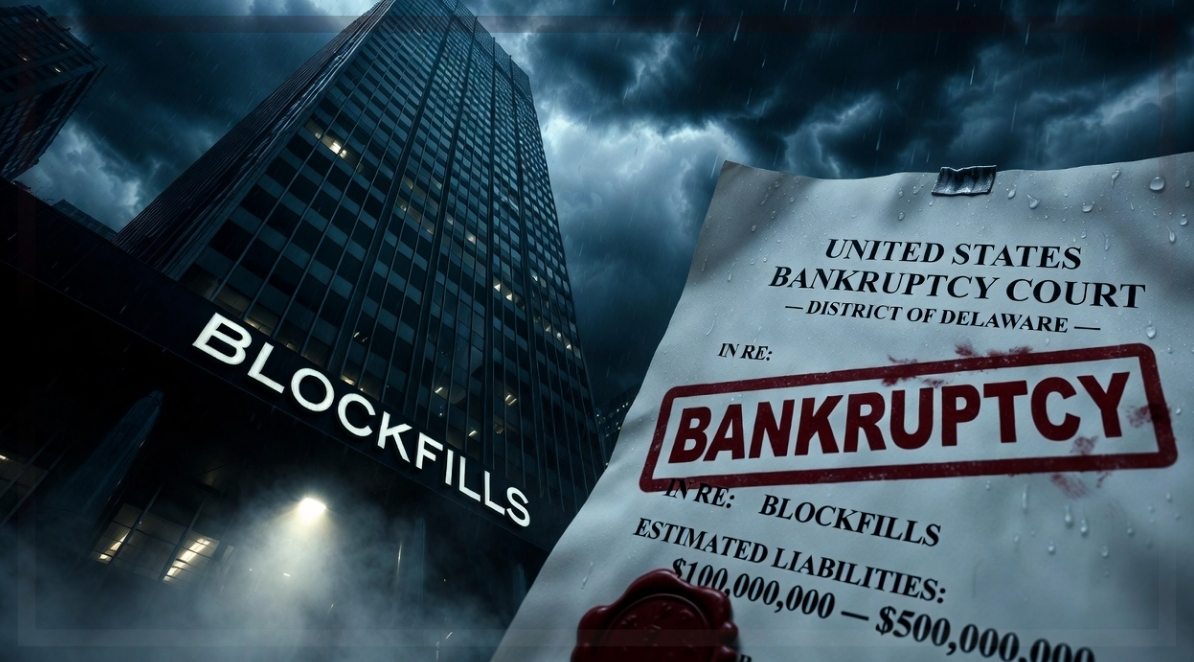
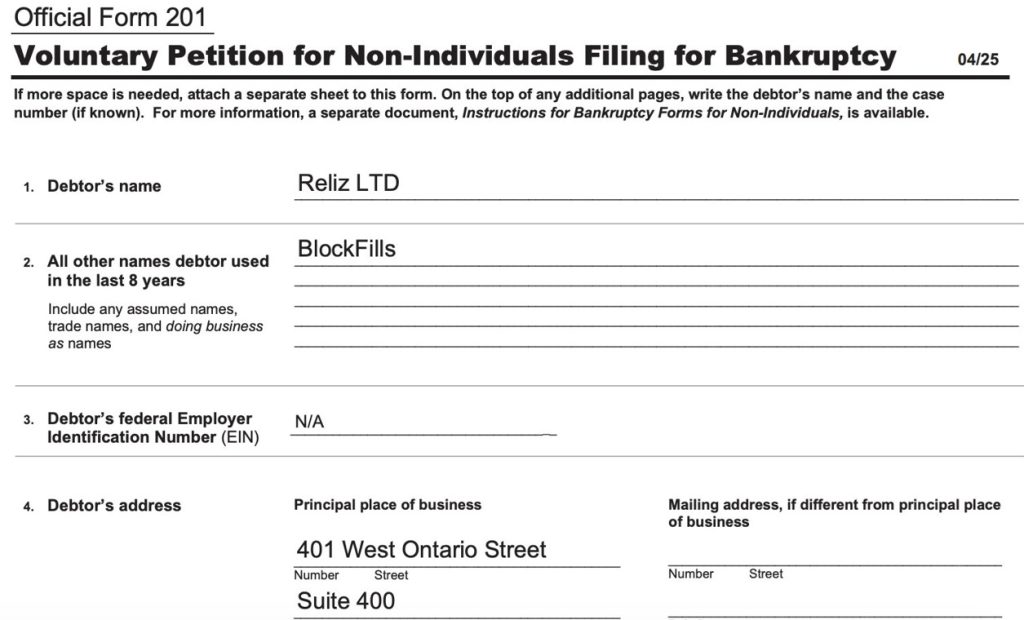
If you thought the wave of institutional crypto collapses was behind us, BlockFills just proved otherwise. On March 15, 2026, the Chicago-based crypto trading and lending firm filed for Chapter 11 bankruptcy protection in the U.S. Bankruptcy Court for the District of Delaware.
The firm listed estimated assets of $50 million to $100 million against liabilities of $100 million to $500 million, a gap that no court-supervised restructuring plan can paper over easily. This is a story about a firm that failed its 2,000-plus institutional clients in the most fundamental way possible.
From $61 Billion in 2025 Volume to Chapter 11 in Delaware
BlockFills operates through its parent entity, Reliz Ltd., a firm that provides liquidity, financing, OTC execution, and risk management to hedge funds, asset managers, mining companies, and market makers. In 2025, it processed over $61 billion in trading volume, a 28% increase from the previous year. It served clients across more than 95 countries. Its backers included Susquehanna Private Equity Investments, CME Ventures, and Nexo Inc. On paper, it looked like a serious institutional player.
Then February arrived. On February 11, BlockFills halted customer deposits and withdrawals, citing “recent market and financial conditions.” That phrase should have set off alarm bells immediately. It usually does, and it usually means things are far worse than a company is willing to say upfront.
They were. According to CoinDesk, the firm had suffered roughly $75 million in losses and was scrambling for a buyer or emergency funding. Co-founder and CEO Nicholas Hammer stepped down shortly after, and Joseph Perry took over as interim chief executive. By the time Reliz Ltd. and three affiliated entities filed their voluntary Chapter 11 petitions, the trajectory was clear.
Dominion Capital Lawsuit Reveals Alleged $77M Shortfall from Asset Commingling
The withdrawal freeze was just the surface. What came next made the situation substantially worse.
On February 27, New York investment firm Dominion Capital filed a lawsuit alleging that BlockFills had commingled client crypto assets with company funds on a single balance sheet and concealed significant trading losses. Dominion alleged that BlockFills used those pooled assets to cover its own operating costs, including crypto mining operations, equipment purchases, and settlements with other firms. According to the complaint, this created a balance sheet shortfall of roughly $77 million by the end of 2025.
Federal Judge Mary Kay Vyskocil of the Southern District of New York didn’t wait around. On March 3, she issued a temporary restraining order freezing approximately 70.6 Bitcoin, valued at around $4.8 million at the time, tied to the dispute and barred BlockFills from moving assets outside the United States.
The commingling allegations are where this story becomes more than just another bankruptcy. They carry uncomfortable echoes of what brought down Celsius Network and, before that, FTX. As the Harvard Law School Bankruptcy Roundtable has documented, intermingling customer funds with company operating capital is a recurring, and catastrophic, structural failure in institutional crypto. The industry still hasn’t fixed it.
Implications for Creditors and Lessons for Institutional Counterparty Risk Management
The Chapter 11 process will now determine how much institutional creditors actually recover. The gap between $50–$100 million in assets and up to $500 million in liabilities is stark. History suggests recovery rates in crypto bankruptcies are rarely satisfying, though the FTX case’s 118–142% creditor recovery stands as a rare outlier.
The broader lesson is one the industry should have internalized years ago: if a centralized crypto lending desk can’t demonstrate full proof of reserves, real-time audit trails, and strict asset segregation, its institutional pedigree means nothing. As we’ve noted in our coverage of how DeFi is reshaping financial trust, the architecture of trust in finance, centralized or decentralized, ultimately comes down to verifiability.
BlockFills had $61 billion in volume and some of the most recognizable institutional backers in the space. It still filed for bankruptcy with a potential liability hole of half a billion dollars. Volume doesn’t equal viability. Institutional backing doesn’t equal institutional standards.
Author: Ayanfe Fakunle
The editorial team at #DisruptionBanking has taken all precautions to ensure that no persons or organizations have been adversely affected or offered any sort of financial advice in this article. This article is most definitely not financial advice.
See Also:
How the Collapse of Synapse Has Affected the Fintech Landscape | Disruption Banking