The dam is built. No agreement exists. And a widening Middle East conflict is shifting the balance.
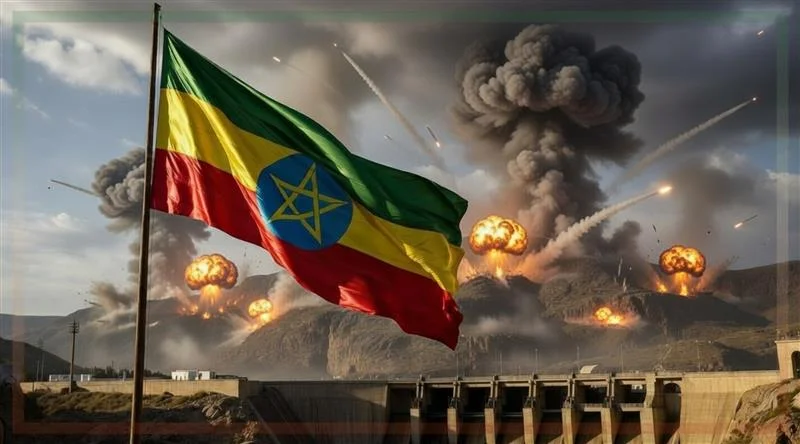
The Grand Ethiopian Renaissance Dam (GERD) is now fully operational, solidifying Ethiopia’s control over the Blue Nile while deepening one of the continent’s most dangerous diplomatic deadlocks. When we last covered the GERD here, the central question was why China was heavily involved in financing GERD-linked infrastructure, a project that threatened to destabilise an entire region. Two and a half years later, the dam has been inaugurated, the Nile has seen disruptive flooding, negotiations remain frozen and the Iran conflict is pulling Egypt, the U.S., and international mediators away from the table.
As Washington and Cairo divert attention to Red Sea security, Houthi maritime attacks, and the Gaza–Iran escalation, Ethiopia continues filling and operating the massive reservoir without a binding agreement, altering on‑the‑ground realities while global diplomacy looks elsewhere.
Here is where things actually stand.
GERD Dam Opens in 2025: Boosting Ethiopia’s Power Amid Regional Tensions
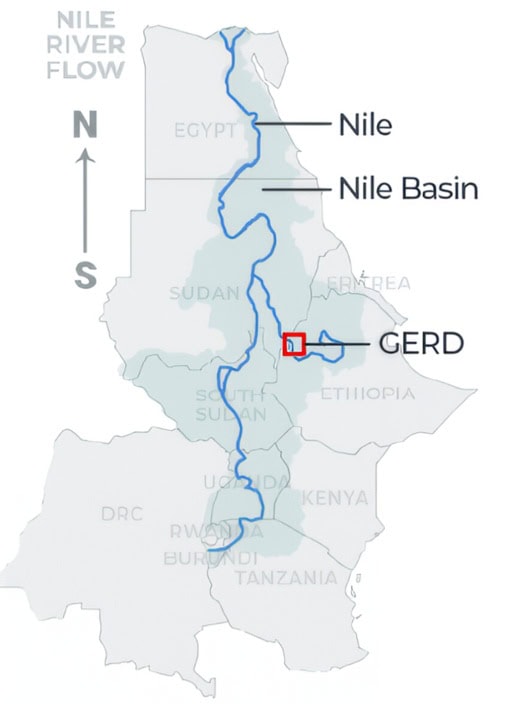
Ethiopia inaugurated Africa’s largest hydroelectric project on September 9, 2025, with Prime Minister Abiy Ahmed declaring it “not a threat, but a shared opportunity.” Kenya’s President William Ruto attended. Egypt and Sudan sent no senior officials. That optics alone tell you something wasn’t exactly sitting right with Ethiopia’s neighbours.
The $5 billion dam has a full capacity of 5,150 megawatts across its 13 turbines. Several were already spinning at inauguration; the project has now more than doubled Ethiopia’s electricity output, powering a country where almost half the population still lacks reliable power. The dam’s reservoir holds 74 billion cubic metres of water. Fill time: anywhere from five to fifteen years.
Egypt Appeals to UN Over GERD: Why Enforcement of Nile Agreements Fails
Cairo sent an immediate letter to the UN Security Council right after the inauguration warning that “Egypt categorically rejects such unlawful unilateral Ethiopian actions that constitute a continuous material breach of the DoP, which obliges Ethiopia to reach a legally binding agreement on the rules that govern the filling and operation of the GERD before commencing such filling and operation.”
Those words have limited immediate enforcement power because no binding operational agreement exists, though Egypt continues to argue the Declaration of Principles (DoP) creates legal obligations.
October 2025: Nile Flooding Rekindles the Region’s Most Dangerous Water Dispute
Within weeks of inauguration, record Nile flooding displaced over 1,200 families in Sudan’s Bahri district and inundated Egypt’s Nile Delta. Egypt’s Ministry of Water Resources and Irrigation publicly blamed what it described as “chaotic and reckless” dam management and “unilateral” water releases from the GERD, while Ethiopia strongly denied the allegation.
This is exactly the scenario experts warned about. The 2015 Declaration of Principles (DoP), signed in Khartoum, committed all three countries to cooperation, but never specified how the dam would be operated during floods or droughts. More than a decade of negotiations has still failed to produce a binding framework governing drought-year releases, the core technical dispute at the heart of the Nile crisis. What was once a technical blind spot on paper has now become an operational reality playing out in real time.
Egypt relies on the Nile for roughly 97% of its renewable fresh water. Any unpredictable release from upstream is a direct threat to its agricultural base and its 120+ million people, according to Al-Jazeera’s report.
Trump Re-Enters the Nile Dispute, Complicates U.S. Neutrality
In a July 2025 press conference with General Mark Rutte, NATO Secretary, U.S. President Donald Trump mentioned the GERD dispute among the conflicts his administration was working to resolve. He then hinted “I don’t know. I think the United States funded the dam,” a statement Ethiopian officials publicly rejected as false.
That remark likely complicated Washington’s ability to present itself as a neutral mediator. The Council on Foreign Relations (CFR) puts it plainly: Trump’s desire to declare victory “bows to no chronology or reality.” “But with so many forces jockeying for position in the already fragile Horn of Africa, bulldozer diplomacy risks crossing lines and triggering a logic of escalation.”
Ethiopia’s government relies on GERD as a symbol of national self-reliance. The core project was largely financed through domestic bonds and public contributions, with foreign partners mainly supporting transmission and equipment.
By January 16, 2026, Trump was writing a formal letter directly to President Sisi to “re-energize” U.S. mediation efforts. Ethiopia has not welcomed the overture.
China Stays Quiet as the Nile’s Geopolitics Shift
Conspicuously absent from the 2025 drama is China, the country that provided $1.2 billion in 2013 and a further $1.8 billion in 2019 for GERD-linked infrastructure, with Chinese state firms Sinohydro and Gezhouba heavily involved in key aspects of construction and equipment, according to a previous Disruption Banking coverage on the GERD. Beijing has said nothing publicly about the flooding, the inauguration standoff, or Trump’s mediation push. That silence seems deliberate.
Beijing has shown little public appetite for pushing a binding multilateral water framework in the Nile basin any more than it wants one on the Mekong. Its broader infrastructure playbook, financing upstream projects, and emphasizing national sovereignty, appear consistent here.
Iran Conflict Impact on GERD Negotiations
The escalating US-Israel conflict with Iran has quietly stalled GERD negotiations. Egypt has been forced to redirect military resources and diplomatic attention toward Gaza border security and Red Sea shipping disruptions caused by Houthi attacks, which slashed Suez Canal revenues by an estimated 40–60% in early 2024. International mediators, including the U.S., UN, and African Union, have similarly deprioritised the dispute amid Middle East crisis management.
The result: Ethiopia has continued filling the 74-billion-cubic-metre reservoir and operating the dam without a binding agreement, while Iran has reportedly increased diplomatic engagement with Addis Ababa as part of a broader Africa outreach strategy. Each filling season further cements the operational status quo, potentially narrowing Egypt’s leverage by the time Cairo can refocus on the Nile.
What Comes Next: The Nile’s Next Crisis May Come During Drought
The African Union mediation is stalled. The U.S. is not exactly trusted by Addis Ababa. No new legal framework is in sight. Meanwhile, the dam is producing power, and Ethiopia is negotiating export deals with Kenya and Djibouti. And Egypt has expanded its regional security footprint, including moves in Somalia that Ethiopian analysts increasingly interpret as strategic pressure.
The Atlantic Council warns that the most dangerous scenario is not immediate conflict but a prolonged drought that depletes both the GERD and Egypt’s Aswan reservoir simultaneously. At that point, a hostile or simply “careless” Ethiopia could trigger a genuine water crisis downstream.
That is not a hypothetical. It is now a planning scenario for Egyptian military strategists.
The dam is operational. The dispute is unresolved. And the region’s water security is, for the first time in history, increasingly in the hands of Addis Ababa.
Author: Richardson Chinonyerem
See Also:
Why is China financing the Grand Ethiopian Renaissance Dam (GERD)? | Disruption Banking
Will The Devaluation Of The Ethiopian Birr (ETB) Stoke Inflation? | Disruption Banking