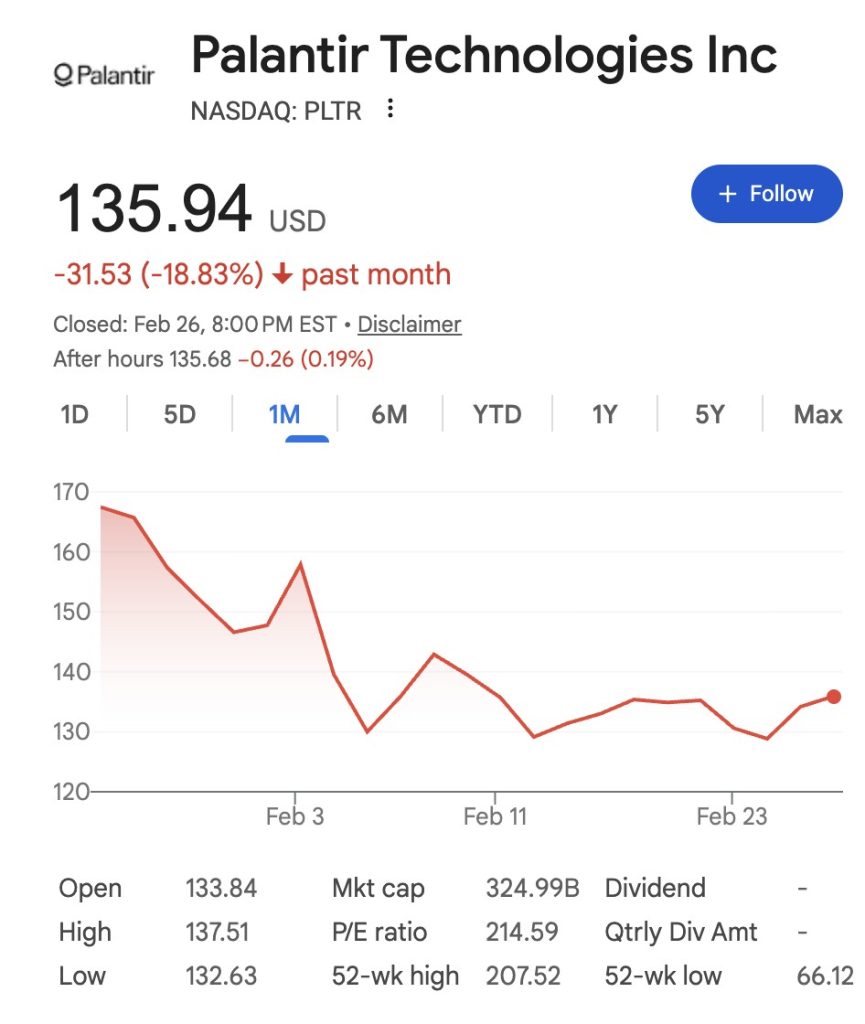
Palantir, a software and AI company with various government contracts, provides data-mining and intelligence products, and despite 70% revenue growth, Palantir’s stock price is down almost 20% over the past month, from nearly $170 to $135, and the company’s CEO Alex Karp is very unhappy about it.
Karp is known for his complete neglect of his personal appearance and his colorful public statements. Last year, he declared, “I love the idea of getting a drone and having light fentanyl-laced urine spraying on analysts that tried to screw us.”
Palantir’s PR team is much more careful and also rather pedantic. On their Medium page, Palantir meticulously dissects negative media coverage, splitting hairs to say that harmful statements aren’t true to protect their tarnished brand.
Allegedly AI Agent Hack
Two weeks ago, an odd announcement that Palantir had been hacked came from Kim Dotcom, a German web entrepreneur and hacker who has fought extradition to the US while living in New Zealand.
Dotcom’s unsubstantiated accusation was quickly panned by internet sleuths, as well as eventually, Palantir’s CTO.
Palantir has come under withering criticism of late. Whether it’s people accusing the company of ushering in a dystopian surveillance state, or being the real-life version of Terminator’s Skynet, or facilitating unlawful ICE enforcement, or questioning founder Peter Thiel’s qualified answer on whether the human race should continue to exist, critics abound.
To date, over half of Palantir’s revenue comes from government contracts, much of it focused on defense and immigration enforcement, much of it classified. Given this, is it reasonable to ask: To what extent, amidst its growing entanglements with the U.S. government, would Palantir be held publicly accountable if there were such a hack?
A Defense Contractor Before Defense Contractors were Cool
In the past year, Palantir has enjoyed one blowout financial quarter after another. In a year and a half, from spring of 2024 to fall of 2025, Palantir’s stock rose 1,000%.
But while hospitals and other sectors outside the government have signed large contracts with Palantir, the data analytics company owes its financial existence to the U.S. government. Long before Big Tech decided, seemingly en masse, to be defense contractors, Palantir was offering its services.
Twenty-three years after its inception, the company is deeply entrenched with the Department of Defense, (DOD), providing services in an overtly nationalistic, borderline jingoistic fashion.
While Dupont, a two-hundred-year-old defense contractor, softens its warfare bona fides with the well-known slogan: “At Dupont, we don’t make many of the products you buy. We make a lot of the products you buy better,” Palantir’s CEO openly talks about killing people.
In an earnings call last year, CEO Alex Karp said this to investors:
“We have dedicated our company to the service of the West and the United States of America…Palantir is here to disrupt and make the institutions we partner with the very best in the world and when it’s necessary to scare enemies and, on occasion, kill them. And we hope you’re in favor of that.”
To be clear, Palantir doesn’t make weapons. It collates and makes sense of data, and using AI, gives the military cutting-edge information, or actionable intelligence, as they call it.
It’s one thing for a company to not actively mislead the public about what they actually do. It’s another for the CEO of a SaaS company to gleefully gloat to investors about killing people.
But when these kinds of unhinged statements, which are strangely more and more common in the U.S., are viewed along with the thesis that Palantir plays too big a role within the DOD and DHS to fail, it begins to make more sense.
Blurred Lines
Much like other defense contractors, such as Palmer Luckey’s Anduiril, Alex Karp and his colleagues speak constantly of the threat of war, while skirting over how much they stand to profit from such a viewpoint.
Obviously, the outbreak of war is always possible. But the messaging from defense contractors who present themselves as America’s much-needed protectors, while they rake in billions, is problematic.
What’s more problematic is that some of these “tech titans” have become overnight officers in a new detachment in the military, including Palantir’s Chief Technology Officer (CTO), Shyam Sankar.
Detachment 201 was formed on June 13th, 2025, commissioning Sankar, along with the CTO from Meta, OpenAI’s Head of Product, and OpenAI’s former Chief Research Officer as lieutenant colonels in the Army Reserve.
The Army initiative, meant “to inspire more tech pros to serve without leaving their careers,” makes a lot of sense on paper. The world is changing quickly, and the military needs to adapt.
But the conflicts of interest and ethical concerns are staggering. Private sector executives have been commissioned as high-ranking officers in the military, while those same executives’ companies receive billions of dollars from the government. Nevermind, meaningful regulations regarding AI haven’t even begun to be legislated in congress.
In the past, an individual might go from the DOD into the private defense sector and back again, passing through the proverbial revolving door. Now the door has been blown off the bloody hinges.
Always the Contrarian
Meanwhile, everybody’s favorite contrarian, Michael Burry, has shorted Palantir stock to the tune of $912 million in puts. Burry, famous for correctly calling the housing market collapse in 2008, sees Palantir as wildly overvalued.
Palantir trades at 98 times forward earnings as a Software as a Service (SaaS) company. While that’s an extremely high multiple even for a hypergrowth company, the market has deemed Palantir worthy.
However, Burry argues that Palantir actually runs a consulting business and should be traded at a much lower multiple as a result. The problem for Burry, unfortunately, is that the market doesn’t necessarily care about the distinction as much as he does.
Palantir, like Tesla, has become a cult stock. While the company’s revenue of late has been staggering, its narrative as a disruptor has become even stronger. It would take a substantial earnings miss to get down to Burry’s projected stock price of $46 from $136, where Palantir currently trades. That’s unlikely to happen while the government contracts are rolling in.
Author: Tim Tolka, Senior Reporter
#Crypto #Blockchain #DigitalAssets #DeFi
The editorial team at #DisruptionBanking has taken all precautions to ensure that no persons or organizations have been adversely affected or offered any sort of financial advice in this article. This article is most definitely not financial advice.
See Also:
Palantir: Is The AI Hype Outpacing Reality? | Disruption Banking
Top 7 Stocks for 2026: The Hidden Winners Experts Are Quietly Buying | Disruption Banking