Bitcoin hit an all-time high above $126,000 in October 2025. Today, at the time of writing, it is trading around $63,000, down 50% from that peak, with fresh U.S. tariff jitters dragging it down. That collapse has a clear fingerprint. Hedge funds got in first, and they got out first.
How Hedge Funds Rushed In… Then Rushed Out
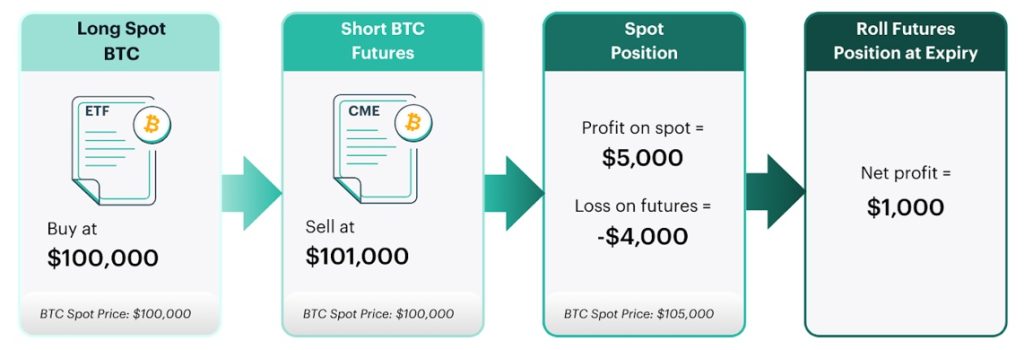
When the U.S. Securities and Exchange Commission (SEC) approved spot Bitcoin exchange-traded funds (ETFs) in early 2024, institutional money moved fast. Hedge funds were among the earliest and most aggressive buyers. The trade was straightforward: buy spot Bitcoin ETFs while simultaneously shorting Bitcoin futures on the Chicago Mercantile Exchange (CME), capturing the spread between the two prices. No Bitcoin price view required. Just pocket the carry yield.
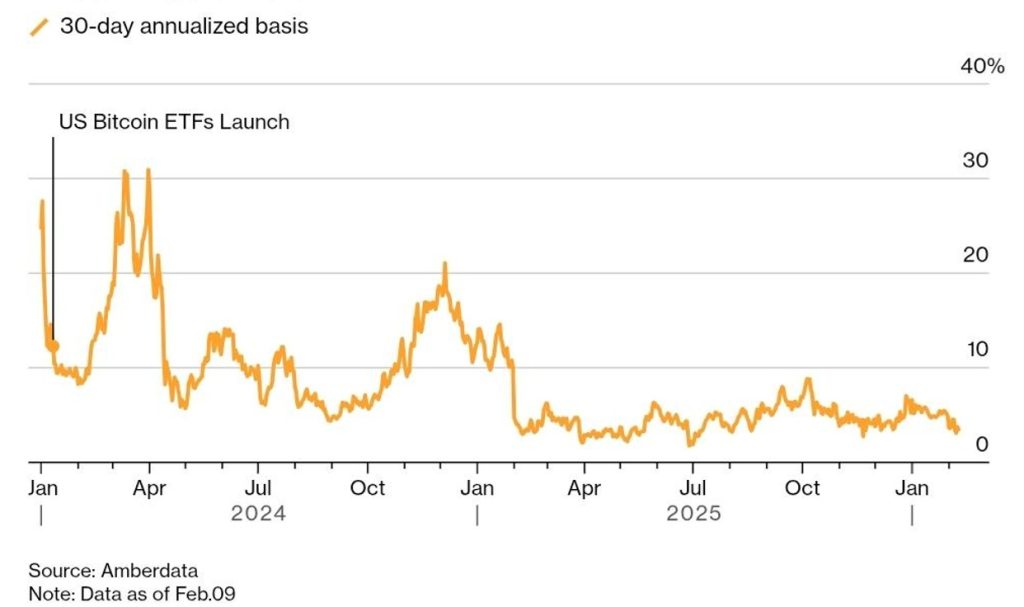
For much of 2024 and into 2025, that spread, known as the Bitcoin basis trade (which refers primarily to the leveraged returns achieved by hedge funds exploiting the premium between spot Bitcoin ETFs and CME futures contracts), generated annualised returns of 15–25%. The trade attracted desks with no particular conviction on Bitcoin itself. Then the basis compressed. Futures markets deleveraged. The easy money vanished. Out came the ETFs.
Evidently, it is the same old, popular “cash-and-carry” strategy in play here.
28% Slash in One Quarter: Brevan Howard Dumps 86%
Aggregate Bitcoin ETF allocations among the largest hedge fund holders, such as BlackRock’s iShares Bitcoin Trust (IBIT) alone, for instance, fell 28% from Q3 (114 million shares) to Q4 2025 (82 million), according to data compiled by CF Benchmarks, a subsidiary of the Kraken crypto exchange. The exits show up in SEC 13F filings.
Brevan Howard slashed its position in IBIT from 36.7 million shares at peak to just 5.5 million by year-end. An 86% reduction, cutting the value of its stake from approximately $2.4 billion to $275 million, according to a Bloomberg report. DE Shaw, Farallon Capital, Schonfeld, Sculptor Capital, and Symmetry Investments all cut hard or vanished from the top holders list entirely.
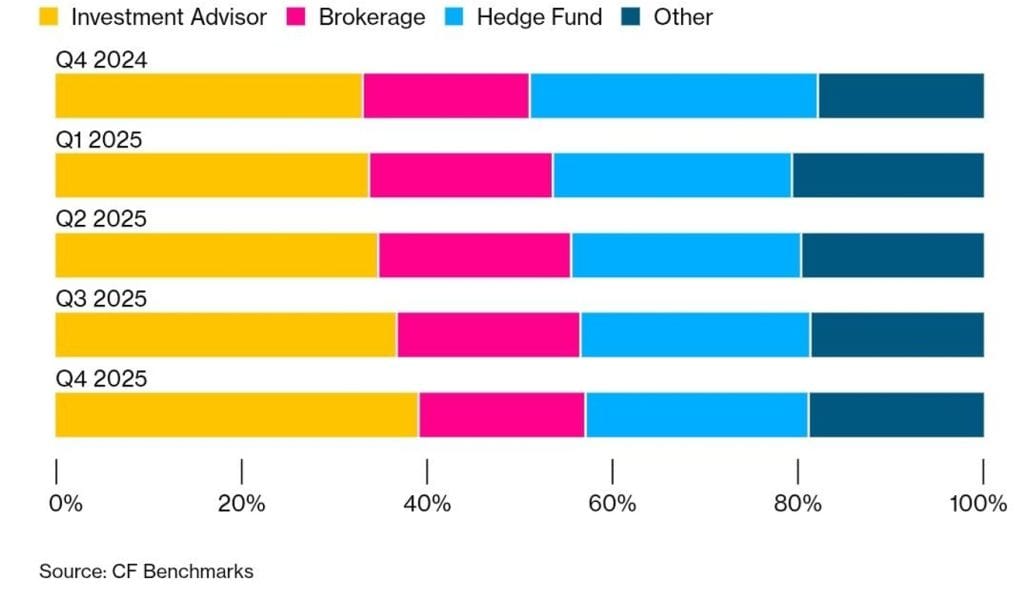
Gabe Selby, head of research at CF Benchmarks, wrote in the firm’s February 19 note: “The dominant theme of the last two quarters is hedge fund de-risking.” The October blow-off top triggered systematic position reductions tied to drawdown limits and risk budgets.
By the time basis trade returns had compressed to around 4% annualised as of February 9, barely above short-dated U.S. Treasuries, according to data provider Amberdata reported by Bloomberg, there was simply no reason to stay.
$4.5B ETF Bleed: Five Weeks of Non-Stop Outflows in 2026
U.S. Spot Bitcoin ETFs have now logged five consecutive weeks of net outflows, the longest streak since February-March 2025, according to SoSoValue data. Investors pulled approximately $316 million in the most recent week (ending February 20, 2026, a holiday-shortened four-day trading period due to Presidents’ Day).
For the broader 2026 year-to-date context (January 1 through February 20), net outflows stand at about $4.5 billion, partially offset by roughly $1.8 billion in inflows during the first and third weeks of the year.
BlackRock’s IBIT and Fidelity’s FBTC have been the largest contributors to the bleed. Bitcoin is down 28% in 2026, the first back-to-back double-digit January-February drop on record. The crypto Fear & Greed Index sits at 8 – 11 at the time of writing, extreme fear.
BlackRock’s digital assets head Robert Mitchnick has pointed out that hedge funds invested in ETFs were never driving Bitcoin’s wild price swings, leveraged perpetual contracts on other platforms were. Still, the 13F data confirms the institutional retreat was real and fast.
Advisors & Sovereigns Scoop Up the Dip
Here is the part the headlines missed. Investment advisers grew their aggregate IBIT holdings every quarter over the past five quarters, resulting in a 145% year-over-year increase, according to CF Benchmarks. BlackRock’s own proprietary IBIT stake jumped 328%. Morgan Stanley and LPL Financial kept adding.
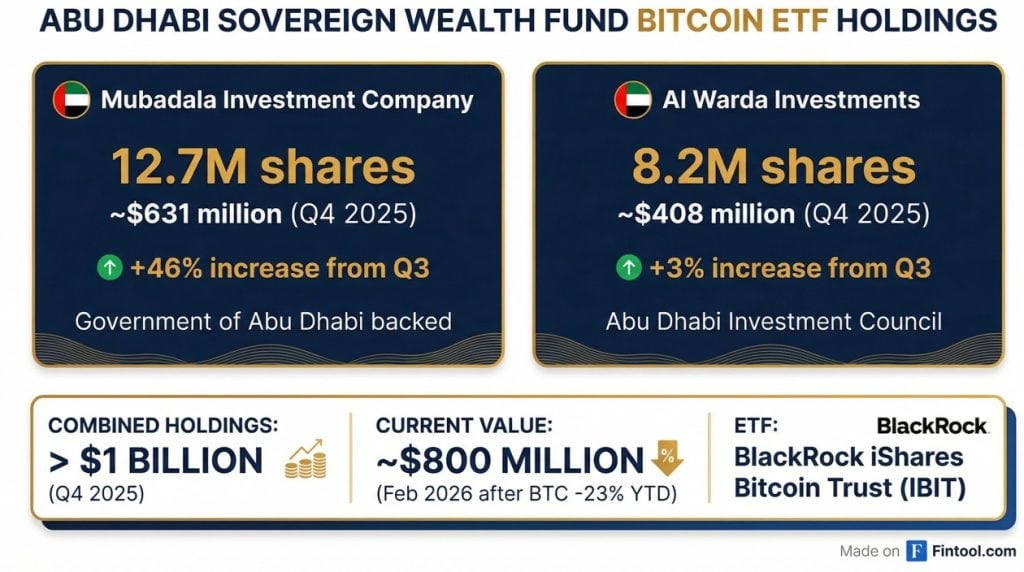
The Abu Dhabi sovereign wealth fund, composed of government-backed Mubadala Investment Company and the investment arm, Al Warda Investments, of the Abu Dhabi Investment Council, both increased their IBIT position 46% (12.7M shares) and 3% (8.2M shares) in Q4 2025 respectively, bringing their combined holdings north of $1+ billion at then-prices.
This matters.The seller is fast-money hedge funds. The buyer is longer-term capital: sovereign wealth, registered investment advisers, endowments, and retail through financial planners.
“It’s not the ETF investors who are driving the sell off,” said Matt Hougan, Bitwise Asset Management CIO on CNBC’s “ETF Edge.” “It’s really a tale of two sides.” Total net inflows into U.S. spot Bitcoin ETFs since the 2024 ETF launch still exceed $54 billion. The structure is intact, even if the composition of holders is shifting fast.
Rotation, Not Capitulation: Why This Isn’t the Bear Market Endgame
This is not capitulation. It is healthy maturation. Hedge funds chased the 2025 hype and basis carry. Now they are cutting risk in a choppy macro environment shaped by tariff threats, rising geopolitical noise, and compressed yields. The durable capital is stepping in at lower prices. That creates a sturdier floor than the leveraged frenzy ever did.
The hedge funds were never true believers. They were arbitrageurs. The trade stopped working, so they left. That is not a crisis, but it is a clear signal that the next Bitcoin rally, whenever it comes, will need to be built on something more durable than a basis spread.
The hedge fund exit is not a warning that Bitcoin is broken. It is proof the market is growing up. That is the more durable story for 2026. Use it. Position accordingly, or sit on cash until the dust settles.
Not Bottom Yet: $60K Remains the Critical Danger Zone
Do not mistake this for a clean bottom signal. Bitcoin remains extremely volatile. If you are an investor, the practical read here is to watch for the ETF outflow streak to break and on-chain activity to stabilise before making any meaningful move. Real institutional adoption is happening, just slower and quieter than the 2025 party suggested.
The next test for Bitcoin is simple: can longer-term holders absorb what hedge funds are still selling? If they can, a floor forms. If not, the $60,000 zone is very much in play.
Author: Richardson Chinonyerem
The editorial team at #DisruptionBanking has taken all precautions to ensure that no persons or organizations have been adversely affected or offered any sort of financial advice in this article. This article is most definitely not financial advice.
See Also:
Is the Bitcoin Four-Year Cycle Finally DEAD? | Disruption Banking
Jane Street’s ’10am Bitcoin Dumps’: Manipulation Myth or TradFi Reality? | Disruption Banking