

IBM delivered impressive results that stood out in 2025. While many investors pursued flashy AI pure plays, International Business Machines (IBM) posted a solid 35% gain, ranking as one of the top performers in the Dow Jones Industrial Average (DJIA). That performance helped lift the broader Dow Jones index, which rose approximately 13% to close 2025 at 48,063.29 points. IBM did not simply ride the overall market wave. Instead, it proved that its multi-year strategic pivot to hybrid cloud, watsonx AI, and modernized mainframes had finally delivered measurable enterprise value.
Skeptics had long written off IBM as a yesterday’s hardware giant stuck in slow growth. By the close of 2025, however, those doubts looked outdated. The stock’s re-rating reflected genuine execution on high-margin software deals and infrastructure upgrades that Fortune 500 companies purchased and renewed. This outcome stemmed from real cash flow and booking numbers, not mere market hype.
Key Drivers Behind IBM’s 35% Rally in 2025
The full year 2025 tested every major company with tariffs, interest-rate swings, and periodic AI fatigue that triggered sharp sell-offs. The Dow Jones itself suffered several notable drops, including a more than 3% single-day plunge in April 2025. IBM, however, shrugged off most of those challenges and kept delivering steady gains.
For the full year, IBM reported total revenue of exactly $67.5 billion, up 8% on a reported basis and 6% at constant currency, marking its strongest annual growth rate in several years. Software revenue led the way with an 11% increase, while infrastructure revenue jumped 12%, driven largely by strong demand for the new z17 mainframe designed specifically for AI workloads. Free cash flow reached a record $14.7 billion, an increase of $2 billion from 2024 levels.
Q4 2025 capped the year on a high note. Revenue came in at $19.7 billion, beating analyst estimates, while adjusted earnings per share hit $4.52, also ahead of forecasts. The stock rose sharply on the news, gaining almost 7% in the trading session following the January 28, 2026 release.
This strong 2025 showing built directly on the points we made in our earlier Disruption Banking piece that highlighted IBM alongside Caterpillar and Goldman Sachs as the three Dow Jones stocks that truly dominated 2025 performance. It also extended the resilience story we first detailed in our 2025 article here, when IBM was already demonstrating why it deserved its place in the DJIA.
Explosive AI Growth: watsonx and $12.5B+ in Enterprise Deals
The real story behind the surge sat firmly in IBM’s expanding AI pipeline. The company’s generative AI book of business grew past $12.5 billion by the end of 2025, more than double the $5 billion level recorded in late 2024. Watson platform deals and Red Hat hybrid cloud contracts kept flowing in from large enterprises that wanted to add AI capabilities without replacing their existing core systems.
Within software, automation revenue grew 18% in the fourth quarter alone, while data and analytics offerings rose 22%, per the IBM Q4 earnings report. These were not isolated wins. They demonstrated IBM’s ability to sell into the mission-critical back-end infrastructure where enterprises commit long-term budgets.
IBM Chairman and CEO Arvind Krishna commented on the earnings call: “We enter 2026 with momentum and in a position of strength.” The numbers fully backed that statement, with operating margins expanding (at the time) and the long shift from legacy hardware to higher-margin software and services now clearly complete.
Quantum computing provided another forward-looking dimension. IBM has outlined plans to achieve quantum advantage by the end of 2026. For a company frequently labelled “old tech,” these concrete bets helped justify the higher valuation multiple investors finally awarded.
Why the Re-Rating Holds: From Legacy Skepticism to Growth Premium
Investors awarded IBM a growth multiple in 2025 because the company stopped shrinking in key areas and began expanding profitably across software and services. That shift gave the stock a new, well-earned premium within the Dow Jones Industrial Average.
Compare IBM’s 35% gain to the broader Dow Jones performance: the index rose 13%, so IBM clearly outperformed many of the others. Yet the re-rating carried a realistic price. IBM traded near all-time highs around $325 in late December 2025. Today the stock price is nearer to $255 due to concerns over the company’s falling operating margin and long-term liabilities.
The Dow is price-weighted, not market-cap-weighted: share price drives influence. On the latest available close (February 20, 2026), IBM was about $255 and roughly 3.18% (SlickCharts) of the Dow’s weight, according to index data. A $1 move in any component shifts the Dow by roughly 1/divisor points, so IBM volatility still visibly tugs the headline.
Challenges Ahead: Confluent Acquisition, Debt, and AI Cycle Risks
Challenges still exist and deserve clear acknowledgment. Consulting revenue growth slowed to low single digits in 2025, and some infrastructure demand softened mid-year. The $11 billion acquisition of Confluent raised valid questions about share dilution for certain investors. Reuters reported the deal is expected to close by mid-2026 with earnings accretion within a year.
Broader AI spending cycles could cool, and IBM carries more debt than pure-play software peers. The Dow Jones blue-chip status provides protection in downturns, yet IBM is not completely shielded. Should enterprises delay major AI projects, growth could fall short of targets.
IBM’s 2026 Momentum: Agentic AI, Defense Wins, and Hiring Push
Fresh developments at the time of writing continue to support the positive case. On February 17, IBM announced broad agentic AI rollouts across its entire software portfolio for the first quarter. Autonomous agents that can handle Db2 administration, advanced analytics, and supply-chain tasks directly inside the systems enterprises already operate.
The company also plans to triple entry-level hiring in the United States throughout 2026. Chief Human Resources Officer Nickle LaMoreaux explained the move as a deliberate counter to the AI-layoff narrative, stressing the ongoing need for human judgment combined with Gen Z’s native AI fluency.
Earlier, on February 5, IBM secured a major defense contract with the U.S. Missile Defense Agency‘s mult-vendor $151 billion Scalable Homeland Innovative Enterprise Layered Defense (SHIELD) program.
IBM said it was “proud to partner with the Missile Defense Agency,” with Susan Wedge, IBM’s managing partner for the U.S. Federal Market, adding the collaboration would help ensure “the warfighter is equipped to respond with greater speed, agility, and confidence.”
IBM’s Outlook: Steady Growth, Moderate Buy Consensus
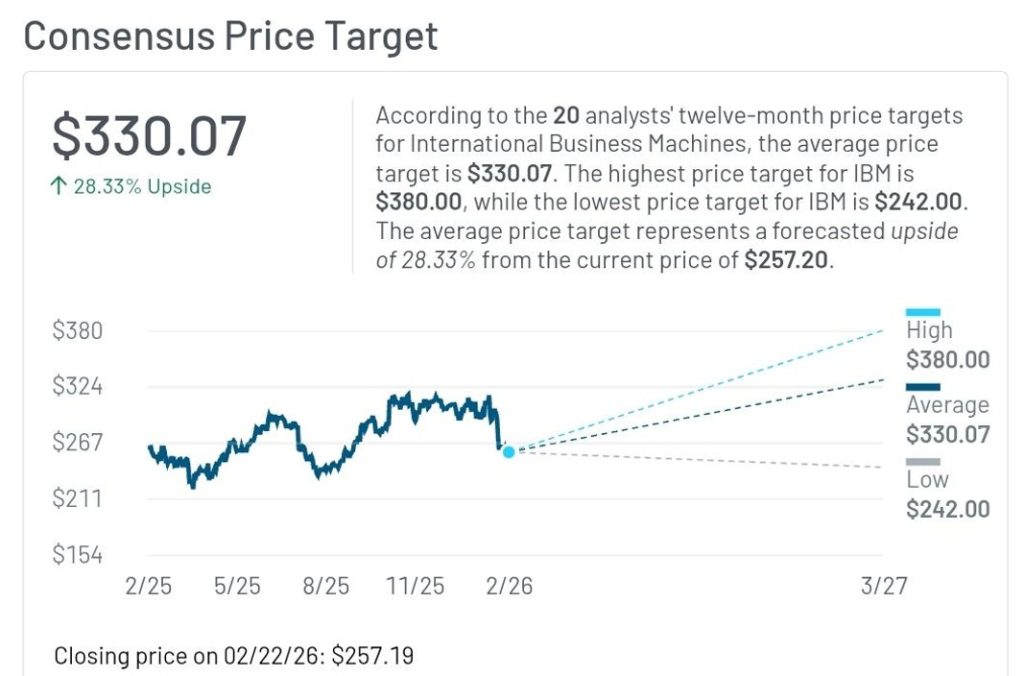
Official 2026 guidance for IBM calls for more than 5% constant-currency revenue growth and another $1 billion increase in free cash flow. That outlook is solid and predictable rather than explosive. Analyst consensus as of the time of writing remains a Moderate Buy, with average price targets near $330, according to MarketBeat.
The 2025 re-rating case closed on a strong note. The real question now is disciplined execution through 2026. Early signs as of late February indicate IBM is well-positioned to deliver.
Author: Richardson Chinonyerem
The editorial team at #DisruptionBanking has taken all precautions to ensure that no persons or organizations have been adversely affected or offered any sort of financial advice in this article. This article is most definitely not financial advice.
See Also:
NVIDIA’s +40% Surge in the Dow Jones: Why 2025 Was Not Just AI Hype | Disruption Banking
How Johnson & Johnson Outperformed the wider Dow Jones in 2025 | Disruption Banking

Richardson Chinonyerem
Contributing author at Disruption Banking, covering capital markets.