
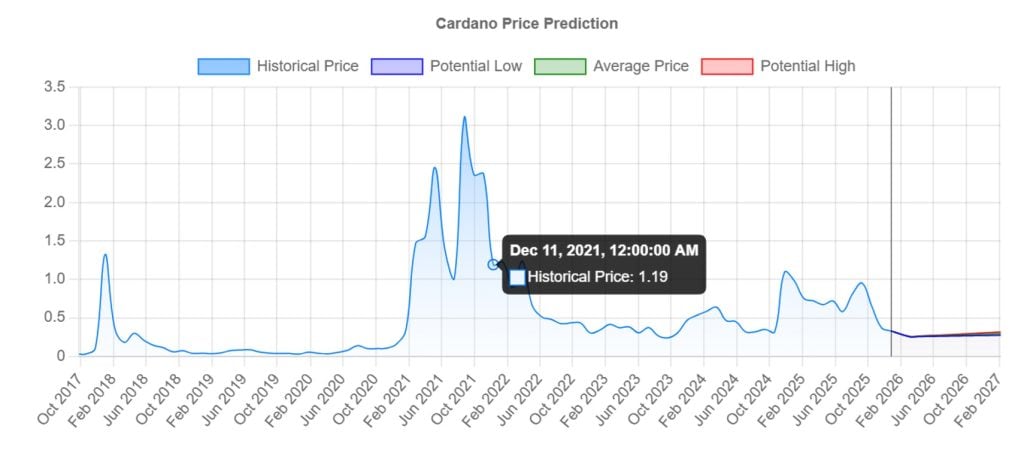
Cardano (ADA) enters 2026 at a pivotal point. After underperforming in 2025, it just posted a modest rally, up about 7% since Jan 1, 2026, putting ADA near ~$0.26–0.30 (market cap roughly $9-10B). That’s a far cry from its $3.10 peak in 2021.
Traders note that trading volumes remain thin and on-chain activity is weak, suggesting the recent uptick is more a technical bounce than a broad revival. In short, Cardano needs tangible catalysts to prove it can stay strong. This analysis digs into the facts: market trends, ecosystem stats, tech roadmaps, and expert views to form a clear-eyed 2026 outlook for ADA.
Cardano’s Market Position: Current Price, Cap, and 2026 Forecasts
At the time of writing, ADA trades around $0.27. Crypto analysts expect that to remain near flat by year-end: pegging Cardano’s 2026 average price at about the same as it is today, $0.27 (with a bear-case ~$0.24 and bull-case ~$0.29).
In other words, without a crypto boom or major adoption surge, ADA will likely stay in the $0.20–0.30 range. Its 7% YTD gain already outpaces larger coins (Bitcoin, Ethereum) in 2026, but it doesn’t mean there will be a run necessarily. Market sentiment is subdued: data shows ADA’s technical ratings in early Feb leaning towards “strong sell”, and wallet holders have barely moved the needle.
Analysts note that Cardano’s trading volumes have “dried up” and on-chain metrics are “depressed,” suggesting today’s price is on tenuous ground. Risk factors abound (macro headwinds, competitors), so any rally needs solid fundamentals, not just momentum.
DeFi and On-Chain Activity: Growth, TVL Trends, and Stablecoin Challenges
Cardano’s usage is growing but still modest by DeFi standards. On-chain, Cardano surpassed 115 million total transactions since the token listed. a clear sign of sustained baseline activity. Also, developer activity on Cardano is growing strong.
However, the DeFi ecosystem on Cardano remains small. Total value locked (TVL) fell from about 672M ADA in Oct 2024 to 495M ADA by end-2025, reflecting outflows to bigger chains. In dollar terms, that’s only about $130–150M TVL today, compared to billions locked on Ethereum or Solana. Even stablecoins are scarce: Cardano’s first dollar-pegged token (Moneta USDM) has only ~$15M market cap. By contrast, Solana and others boast a stablecoin supply in the billions. This lack of liquidity has held back competitive lending and trading markets.
One bright spot: a major stablecoin deal. Cardano is integrating Circle’s USDCx product, a USDC-backed token that could tap into Circle’s ~$70B USDC pool. Even capturing a tiny slice (0.1%) of that supply would inject ~$70M liquidity, roughly doubling Cardano’s current stablecoin base. If successful, USDCx would help Cardano “close its liquidity gap” and make DeFi apps more viable.
Scaling Progress: Leios, Hydra, and Upcoming Protocol Upgrades
Cardano’s long-term strengths depend on its tech roadmap. The next-gen consensus Ouroboros Leios (aimed at 10k+ TPS) is under active development. The Input Output Research (IOR) team reports they have prototyped Leios endorsement blocks and are integrating the latest node version.
Off-chain, Hydra (Cardano’s layer-2 scaling) has seen progress too: notably, Pondora recently launched “Echo,” the first non-custodial DEX built on Hydra. This shows developers are experimenting with Cardano’s state channels. Also, the Cardano protocol is eyeing an intra-era upgrade (Voltaire era) to version 11, which will enable on-chain governance and treasury. These moves signal genuine engineering momentum.
This project hasn’t been completed yet, and past delays warn caution. For example, a mainnet chain partition bug on Nov 21, 2025, required a coordinated fix, reminding us that Cardano’s code is still maturing. Until Leios and Hydra launch in earnest, Cardano’s TPS and latency remain limited.
In 2026, success hinges on these upgrades delivering real throughput gains. If they do, ADA could claim a practical edge (fast finality, lower fees); if they falter, Cardano risks being seen as perpetually late. In any case, the network’s evolutionary work is on track but needs to translate to user adoption. For now, Cardano’s tech fundamentals are solid in theory, but the market will judge it by on-chain results.
Institutional Adoption and Real-World Momentum
2026 brings notable mainstream milestones. CME Group announced it will launch a regulated ADA futures contract on Feb 9, 2026 (pending approval). This is huge for institutional recognition; ADA will join Bitcoin and Ether as a CME-traded asset. Such futures could attract hedge funds and arbitragers, deepening liquidity and price discovery.
Cardano is also seeing enterprise tie-ins. For instance, auditors Grant Thornton anchored a financial audit on Cardano’s chain via its Reeve system, a world-first case of on-chain reporting. Pilots continue globally (supply-chain projects in Africa and Asia), and in 2026 there is a Cardano Africa Summit in Nairobi scheduled to showcase regional innovation. Each of these steps (futures, audits, summits) adds legitimacy. Yet it is important to note: enthusiasm in crypto often outpaces adoption. These are encouraging developments, but ADA’s price needs user traction to match.
2026 Outlook: Execution as the Key to ADA’s Strength
In summary, Cardano’s 2026 strength is uncertain. On one hand, the fundamentals show promise: ongoing development, strategic partnerships, and new tools (like USDCx) which could finally move the needle. On the other hand, Cardano is still playing catch-up. Its price is anchored near the bottom of its long-term range, and forecasts reflect that.
If Cardano hits its delivery targets (scaling upgrades, liquidity boosts, real-world use cases), ADA could inch higher in 2026. However, a spike to new heights isn’t likely without a crypto-wide boom. Realistically, expect ADA to trade somewhere well below $1 in 2026 unless it proves its utility.
Cardano has a few aces up its sleeve (strong codebase, large community, institutional entry), but also big challenges (competitors, modest usage, delayed features). The only guarantee is that 2026 will continue to test Cardano’s claims. But it’s important to trust the data: ADA’s strength next year will depend on actual adoption and execution.
Author: Ayanfe Fakunle
The editorial team at #DisruptionBanking has taken all precautions to ensure that no persons or organizations have been adversely affected or offered any sort of financial advice in this article. This article is most definitely not financial advice.