

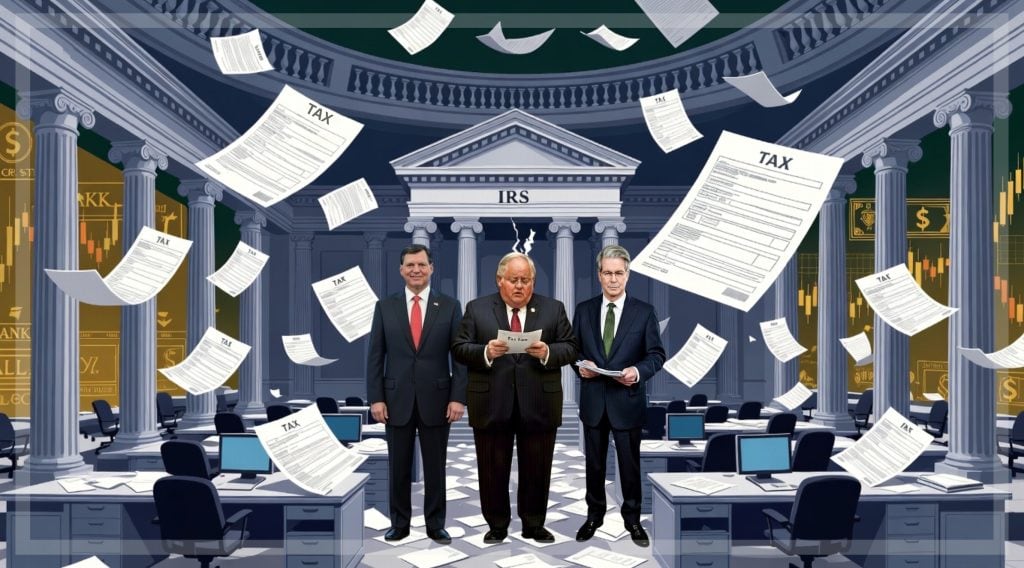
Eight different people led the Internal Revenue Service in 2025. In the first half of the year, five individuals assumed the helm as acting commissioner, some just for days. Then, former Missouri U.S. Representative Billy Long, who previously co-sponsored a bill to abolish the IRS, was confirmed as its commissioner in June of 2025.
Billy Long’s Brief and Bizarre Tenure
Long, who has a scant background in tax law and even less relevant managerial experience, was heavily scrutinized by Democratic senators during the confirmation process, namely for Long’s financial ties with two firms accused of fraud for selling bogus, nonexistent tax credits. Nevertheless, Long was approved on a party-line vote.
Then, in August, less than two months after Long’s confirmation, President Trump fired him. Some reports indicate Long’s removal was due to his unwillingness to share legally protected tax records with the Department of Homeland Security (DHS).
The DHS, the MOU, and the Trust Problem
However, in April of 2025, a memorandum of understanding (MOU) was signed between the DHS, the Treasury Department, and the IRS that allowed for the legally dubious sharing of taxpayer information. Upon this announcement, then acting commissioner of the IRS, Melanie Krause, resigned in protest.
That being said, the existence of the MOU two months before Billy Long’s confirmation casts doubt on why he would refuse similar requests by the DHS. Moreover, immediately upon his dismissal, Long happily announced that he had been nominated to be ambassador to Iceland. So, clearly, there were no hard feelings.
In the meantime, Treasury Secretary Scott Bessent, perhaps wanting to compete with the multi-hyphenate Secretary of State, Marco Rubio, assumed the mantle as acting commissioner of the IRS.
To date, Secretary Bessent still acts as the acting commissioner of the IRS. No known efforts have been made to find a new IRS commissioner, a role that requires Senate approval.
Instead, since October, the IRS has a CEO, Frank Bisignano.
Can CEO-Magic Save the IRS?
The name Frank Bisignano might sound familiar to you. That is because he is also the current Senate-confirmed commissioner of the Social Security Administration. (It appears there’s room for one more multi-hyphenate member of the Trump Administration).
Bisignano comes from Wall Street. He worked as a lieutenant under Jamie Dimon at J.P. Morgan. He was Chief Administrative Officer at Citigroup. Before becoming commissioner of the Social Security Administration, he was CEO of Fiserv. Now he works part-time as CEO of the IRS.
As reported by the New York Times, in the fall of 2025, Bisignano met at a steakhouse with former IRS commissioners. They came away from the dinner heartened by his competence and professionalism, if confused by his title.
Now, tax season is upon us in the United States. More than 25,000 IRS employees have left the agency since Trump reassumed the presidency, or more than a quarter of the staff. With these reduced numbers and amidst significant changes to the tax code, Bisignano must deliver the goods. That is, taxpayers want their refunds and things to go smoothly.
What more is expected of Bisignano is uncertain. What is the long term trajectory of the IRS? Will it remain the primary source of revenue for the U.S. government?
To Look Forward is To Look Back
Since January 2026, Congress has clawed back nearly half of the $80 billion allocated to the IRS by the Biden-era Inflation Reduction Act (IRA). While this money was intended to modernize technology and beef up the IRS’ enforcement capabilities, acting IRS commissioner Scott Bessent says the Biden-era cash infusion only made for government bloat.
The Trump Administration, as well as many Republicans in Congress, have openly displayed their disdain for the IRS. The Trump Organization, just this week, sued the IRS and Treasury Department for $10 billion, which sets up an enormous conflict-of-interest.
Republican Hostility Is Not New
The gutting of the IRS didn’t start with Trump, but in the Newt Gingrich era in the 1990s, when calls to abolish the IRS first began. These calls were then reignited after Republicans took control of Congress in 2011. While President Obama consistently sought higher budgets for the IRS, the Republican-controlled Congress only approved cuts.
During Obama’s time as president, the IRS lost 20% of its funding. A scandal in 2013 hastened the effect, when it was revealed that IRS agents were targeting conservative-leaning nonprofits. President Obama subsequently forced out the commissioner of the IRS.
Obama then appointed John Koskinen to lead the IRS. Koskinen, who had previously been tapped to lead the mortgage giant Freddie Mac after the financial crisis of 2008, was due for a rude awakening. Year after year during his tenure, the IRS’s budget, resources, and personnel were diminished.
Speaking in bewilderment of the IRS cuts, Koskinen told the Senate, “I don’t know any organization in my 20 years of experience in the private sector that has said, ‘I think I’ll take my revenue operation and starve it for funds.’”
Then in 2018, President Trump appointed tax attorney Charles Rettig as IRS commissioner. Two years before, while Trump was still a candidate, Rettig wrote an Op/Ed for Forbes arguing that Trump shouldn’t release his tax returns while being audited.
Serving a five-year term, Rettig’s time as commissioner stretched into the Biden era. It was then, in 2021, that Rettig stated at a Senate Finance Committee hearing that the IRS was losing an estimated $1 trillion in unpaid taxes each year. Most of the tax loss could be attributed to evasion by the wealthy and large corporations, Rettig explained.
The Long Term
It’s unclear how concerned the current IRS is with the tax gap, i.e., the money owed to the IRS that it does not receive due to a lack of enforcement. Beyond vague proclamations by Secretary Bessent of how technology will do the heavy-lifting, there’s been no rousing speeches about better enforcement.
Meanwhile, there is a new CEO, who splits his time running another gigantic agency. Where Frank Bisignano’s duties end and Treasury Secretary Bessent’s start is also unclear, or how they expect the IRS to function in the long-term.
Speaking of long term, last October during an earnings call, the new CEO at Fiserv, Mike Lyons, laid bare that Fiserv, under Frank Bisignano, had not invested enough in the company’s long-term trajectory, and that it would fall short of its financial forecasts. Fiserv’s stock is down nearly 70% in the last year.
Author: Tim Tolka, Senior Reporter
#Crypto #Blockchain #DigitalAssets #DeFi
The editorial team at #DisruptionBanking has taken all precautions to ensure that no persons or organizations have been adversely affected or offered any sort of financial advice in this article. This article is most definitely not financial advice.

Tim Tolka
Tim Tolka, Senior Reporter at Disruption Banking, covers digital assets, monetary policy and the politics of global finance. Based in Mexico City, he brings an investigative edge to his reporting, informed by a Master's in International Affairs and his work as an author and screenwriter.