
Hedera Hashgraph (HBAR) is positioning itself for a breakout year in 2026. Backed by a governing council of blue-chip firms and rapid tech upgrades, the network’s fundamentals are strengthening.
Unlike a meme coin, HBAR’s value rests on enterprise traction and real-world use cases. The latest data and expert commentary help to cut through the hype and deliver a clear-eyed 2026 outlook. HBAR looks poised to be materially stronger than today, but progress will be built on continued delivery, not wishful thinking.
Governing Council Expansion Fuels Real Enterprise Traction
2025-2026 saw Hedera bolster its credibility through high-profile council members and pilots. In December 2025, energy giant Repsol (Fortune 500) joined the Hedera Governing Council to explore decentralized identity for its 24 million customers. Hedera’s council already reads like a tech Fortune 500: Google, IBM, Boeing, LG, Deutsche Telekom, and others.
As Hedera CEO Eric Piscini notes, each new council member “strong validation that Hedera has achieved market fit with a diverse range of organizations”. These partnerships aren’t symbolic: enterprises like Tata Communications are already adopting Hedera for billing and asset tokenization, and central banks and fintech firms are eyeing Hedera for real-world asset (RWA) tokenization.
In Q4 2025 alone, Hedera hosted 12 industry events worldwide to showcase live pilots (from stablecoins to carbon credits), a “strong global presence” that sets the stage for 2026 expansion.
Metrics Heating Up: From Pilots to Billions in Tokenized Assets
On-chain metrics paint a picture of accelerating adoption. According to DappRadar, Hedera’s daily active wallets leapt to ~2,069 in Q3 2025, a 190% year-over-year jump, and total on-chain transactions hit 2.7 million that quarter (up 386% YoY).
Smart-contract volume topped $3.7 billion in Q3 alone (88% above Q2). Growth isn’t just in DeFi: NFTs and gaming are gaining ground (their share of activity rose as DeFi’s dominance eased from 83% to 67% YoY). Real-world asset tokenization is a killer app: Archax, Lloyd’s Banking Group, and others tokenized £10 billion in FX collateral on Hedera, triggering a 49% HBAR surge in September 2025.
Meanwhile, Hedera’s Guardian sustainability platform is making headlines. In March 2025, the Hedera Foundation integrated its Guardian open-source tech with the UNDP’s new National Carbon Registry, enabling auditable carbon markets. All told, 2025’s momentum, from NVIDIA AI collaborations to national digital currency pilots, sets a higher base for HBAR’s use in 2026.
HBAR Market Performance and Price Outlook
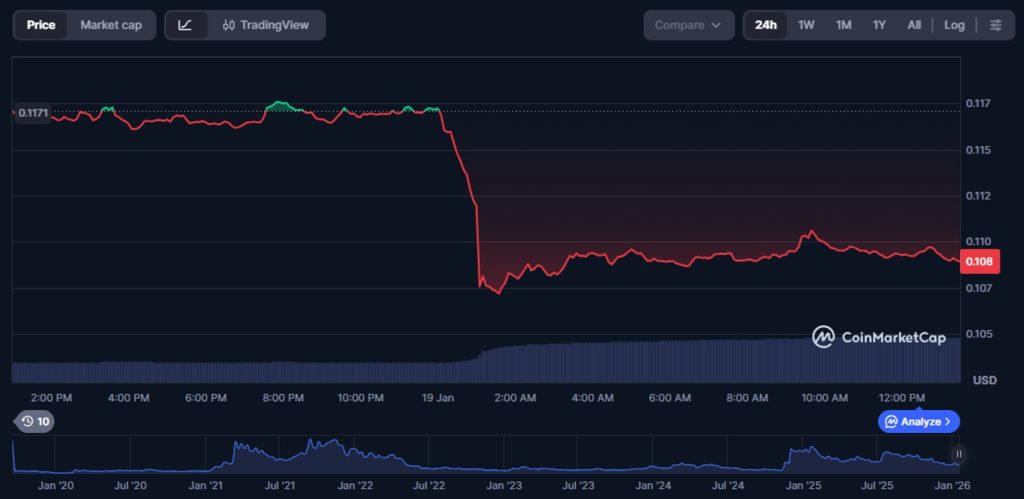
As of mid-Jan 2026, HBAR trades around $0.12 with about $5 billion market cap. The token has largely flatlined in the $0.10-$0.14 range through 2025, absorbing macro headwinds in crypto. Growth catalysts are lining up: the combination of network upgrades and enterprise deals could drive renewed demand.
Algorithmic forecasts are cautiously optimistic. For example, one model predicts HBAR might average ~$0.18 over 2026 (with upside to ~$0.20). That represents roughly 50-60% growth from current levels. Of course, automated predictions vary wildly; the real test is fundamentals. If Hedera achieves key milestones (e.g., live stablecoin on Hedera, large-scale identity projects, wider DeFi adoption), HBAR’s price could break above technical resistance zones (analysts note ~$0.25-$0.35 may be the next hurdles).
On the other hand, limited liquidity and general crypto volatility mean any rally will likely be gradual. In sum, HBAR’s 2026 price path could be a steady climb punctuated by spikes as major news or contracts break.
ETFs & Regulatory Tailwinds: Institutions Warming to HBAR
The institutional picture is taking shape favorably. Hedera has had dollar-based ETFs since early 2025 (e.g., Hashdex, 21Shares), and inflows are picking up again. One report notes over $1.4 million in HBAR ETF inflows in late 2025.
On the regulatory front, U.S. policymakers are moving toward clarity for digital assets. A January 2026 Senate draft bill would definitively label tokens as securities or commodities and give the CFTC regulatory authority. If passed, it would likely classify native crypto like HBAR as a commodity, clearing the way for SEC-approved spot ETFs and institutional investment.
Hedera’s highly structured governance and compliance focus (carbon-negative, Council oversight) play well with regulators. In 2026, we could see banks and funds become more comfortable with HBAR as part of diversified crypto portfolios. Still, nothing is guaranteed: new regulations might impose stricter reporting or custody standards that could slow trading. The bright side is that clarity tends to broaden the investor base, and HBAR should benefit if it avoids the SEC’s definition of a security.
Centralized Strength or Vulnerability? Facing ETH, SOL & DLT Rivals
Hedera remains more centralized than fully permissionless networks, and any council shake-up could rattle confidence. Adoption by Fortune 500s can take years to materialize into token demand. The Standard.io analysis notes that enterprise DLT faces integration hurdles and competition from other blockchains.
Technically, Hedera’s long-term strength depends on executing its roadmap flawlessly. Any major bugs or delays in protocol upgrades (staking or smart contract enhancements) could give rivals an edge. On the market side, HBAR’s liquidity is still much smaller than top coins, so prices can be volatile. And macro factors (interest rates, risk appetite) will sway crypto at large.
Finally, some analysts warn that technology alone won’t guarantee market share: Hedera must out-execute competitors in use cases and developer mindshare. In practice, 2026 will test whether Hedera’s enterprise niche and sustainability angle truly resonate with developers and users.
2026: Hedera’s Make-or-Break Inflection Year
Industry observers take a cautiously optimistic stance. One recent analysis emphasizes that 2026 is “the first major inflection point” for Hedera, as initial pilot projects go live and regulatory clarity arrives. Gartner and Forrester reports (cited by analysts) project large growth in enterprise DLT adoption; Hedera’s strong compliance credentials could let it capture a slice of that market, say proponents.
Executives like Hedera Council President Tom Sylvester highlight how multinationals like Repsol need “verifiable trust at scale,” exactly what Hedera aims to provide. On balance, the consensus view is that HBAR won’t quintuple in price overnight, but it could gain ground if the team keeps delivering.
As one Hedera insider bluntly puts it, institutional “adoption by Council Members is a strong validation” of product-market fit. Savvy readers should note: all bullish scenarios hinge on execution. Missed deadlines or token release shocks could temper expectations. But if Hedera avoids major pitfalls, HBAR by year-end 2026 should be at least modestly stronger, potentially well above the mid-$0.20s range if everything goes right.
Real-World Wins, Not Buzz: The True Driver for HBAR
In plain terms, HBAR in 2026 is likely to be stronger than it is today, driven by enterprise deals, network upgrades, and a maturing crypto landscape. Nobody is claiming that HBAR will suddenly compete with Bitcoin or Ethereum in market cap, which is unrealistic. But Hedera’s unique selling points (speed, finality, green consensus, corporate governance) address real market needs.
Investors and observers should keep an eye on the Council’s moves, adoption news, and network health, as these will indicate whether Hedera is following through on its promise. Whatever happens, we’ll be tracking it closely, because in 2026, HBAR’s strength will be defined by real-world utility and outcomes, not hype.
Author: Ayanfe Fakunle
The editorial team at #DisruptionBanking has taken all precautions to ensure that no persons or organizations have been adversely affected or offered any sort of financial advice in this article. This article is most definitely not financial advice.
See Also:
21Shares Launches 21Shares Hedera ETP (HDRA) on Euronext | Disruption Banking
How Hedera is Gaining in Popularity Down Under | Disruption Banking