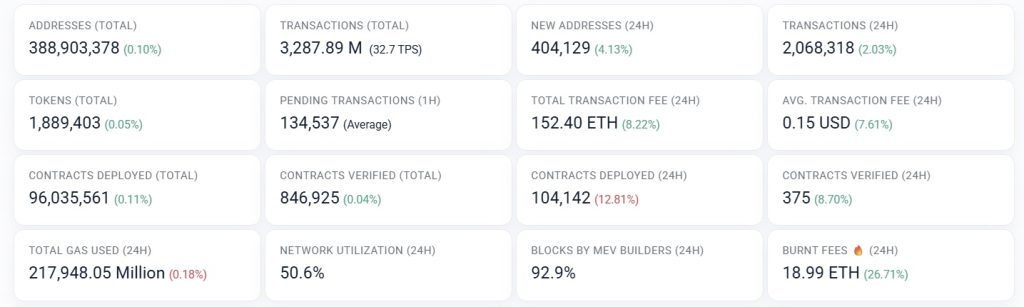
Ethereum, the world’s second-largest blockchain by market cap, remains the leading platform for smart contracts and DeFi. Its daily transactions are above 2 million (~23 transactions/sec), drawn from more than 400 million unique addresses. Average gas fees are low (roughly $0.10–$0.20 as of early 2026), and throughput is only about 50% utilized.
Notably, roughly one-third of all Ether (≈37 million tokens) is locked in staking, securing the network and generating yield. In other words, tens of billions of dollars of Ether are committed to Ethereum 2.0 validators, a sign of holder confidence and reduced liquid supply.
In short, the Ethereum network itself is active and robust going into 2026, with strong usage and security.
Price Outlook: Modest Gains Amid Volatility
Ethereum’s price has been volatile. From an all-time high near $5,000 in late 2025, ETH traded at around $1,900 in early 2026. That drop reflects macro headwinds (rising interest rates, risk-off sentiment) and crypto-specific flows (e.g., Grayscale trust conversions).
Analysts’ 2026 price forecasts range widely, illustrating uncertainty. For example, Standard Chartered projects a short-term dip to ~$1,400, followed by a rebound to about $4,000 by end-2026. Citigroup is more bullish: a Citi report (Oct 2025) raised its 12‑month Ether target to $5,440 (implying a potential rally toward late 2026). Additionally, Motley Fool’s recent analysis suggests a doubling to $5,000 in 2026 is possible if conditions are favourable.
These forecasts hinge on execution of Ethereum’s roadmap and broader market flows. In practice, Ethereum is unlikely to quadruple overnight, but many experts agree that if institutional capital (via ETFs or staking products) returns, ETH could recover significantly by late 2026.
PBS, Account Abstraction and Ethereum’s 2026 Protocol Push
Ethereum’s technical roadmap is aggressive. The Ethereum Foundation’s 2026 “Protocol Priorities” update splits work into three tracks: Scale, UX, and Harden L1.
The Scale track aims to dramatically boost capacity. For instance, the upcoming “Glamsterdam” upgrade (slated for H1 2026) introduces parallel transaction execution and vastly higher gas limits (targeting >100 million gas per block). It also enshrines Proposer/Builder Separation (PBS) building on EIP-4844 with further blob enhancements.
The Improve UX track focuses on user-friendly features like native account abstraction (making smart-contract wallets first-class) and faster Layer‑2 interactions. Meanwhile, Harden L1 works on security (post-quantum readiness, transaction safety) and censorship resistance to ensure Ethereum remains robust as it scales.
If these upgrades ship smoothly, Ether’s technical strength should be much higher by 2026, able to handle hundreds of thousands of transactions per second (through rollups and sharding). This roadmap is a key reason many believe 2026 will see a more powerful Ethereum.
Institutional Capital Reshapes Ethereum Price in 2026
Ethereum’s ecosystem is maturing on the institutional side. A critical catalyst was U.S. approval of spot Ether ETFs in mid-2024. These products began trading in July 2024 and have since drawn substantial inflows.
In 2025, Ethereum ETFs saw roughly $9.8 billion in net new assets, and by early 2026 total ETH ETF assets are about 4.7% of Ethereum’s market cap. These funds complement high-yielding staking and DeFi products that let institutions earn yield on locked ETH (currently ~3–4% APR) while Ethereum’s supply is being burned in fees and staking.
Broader crypto adoption is also rising: industry surveys find that over half of traditional hedge funds now have crypto exposure, and many asset managers plan to allocate more as regulatory clarity improves.
In the U.S., a draft crypto bill (early 2026) aims to classify tokens as securities or commodities under CFTC jurisdiction, a change likely to treat ETH like a commodity. That would clear the way for SEC-approved spot ETFs and broader institutional use. Taken together, these regulatory and market shifts create a stronger institutional backdrop for Ethereum in 2026 (though always with a caution: uncertain rules or a crack-down on staking could add volatility).
Strong Infrastructure, Conditional Price Upside
Ethereum fundamentals (network usage, staking, DeFi) will keep it robust. Yet, “strong” in price terms means outperforming risk assets more than soaring. A conservative estimate is that ETH will end 2026 modestly above today’s levels, driven by normal DeFi and NFT growth plus ETF inflows. In a best-case scenario (economic tailwind + flawless upgrades), it could reclaim much of the lost ground. In a downturn or if execution falters, it could underperform.
Its 2026 strength will derive from delivering on promised upgrades, scaling its ecosystem (via rollups and sharding), and capturing tokenized finance flows. As experts note, Ethereum’s future isn’t guaranteed, but its large existing base and planned improvements give it a strong platform to build on.
By the end of 2026, Ethereum should still be a very strong blockchain, albeit one navigating the same macro currents and competition that affect all crypto.
Author: Ayanfe Fakunle
The editorial team at #DisruptionBanking has taken all precautions to ensure that no persons or organizations have been adversely affected or offered any sort of financial advice in this article. This article is most definitely not financial advice.
See Also:
The Surge: Vitalik Buterin’s Vision To Transform Ethereum | Disruption Banking