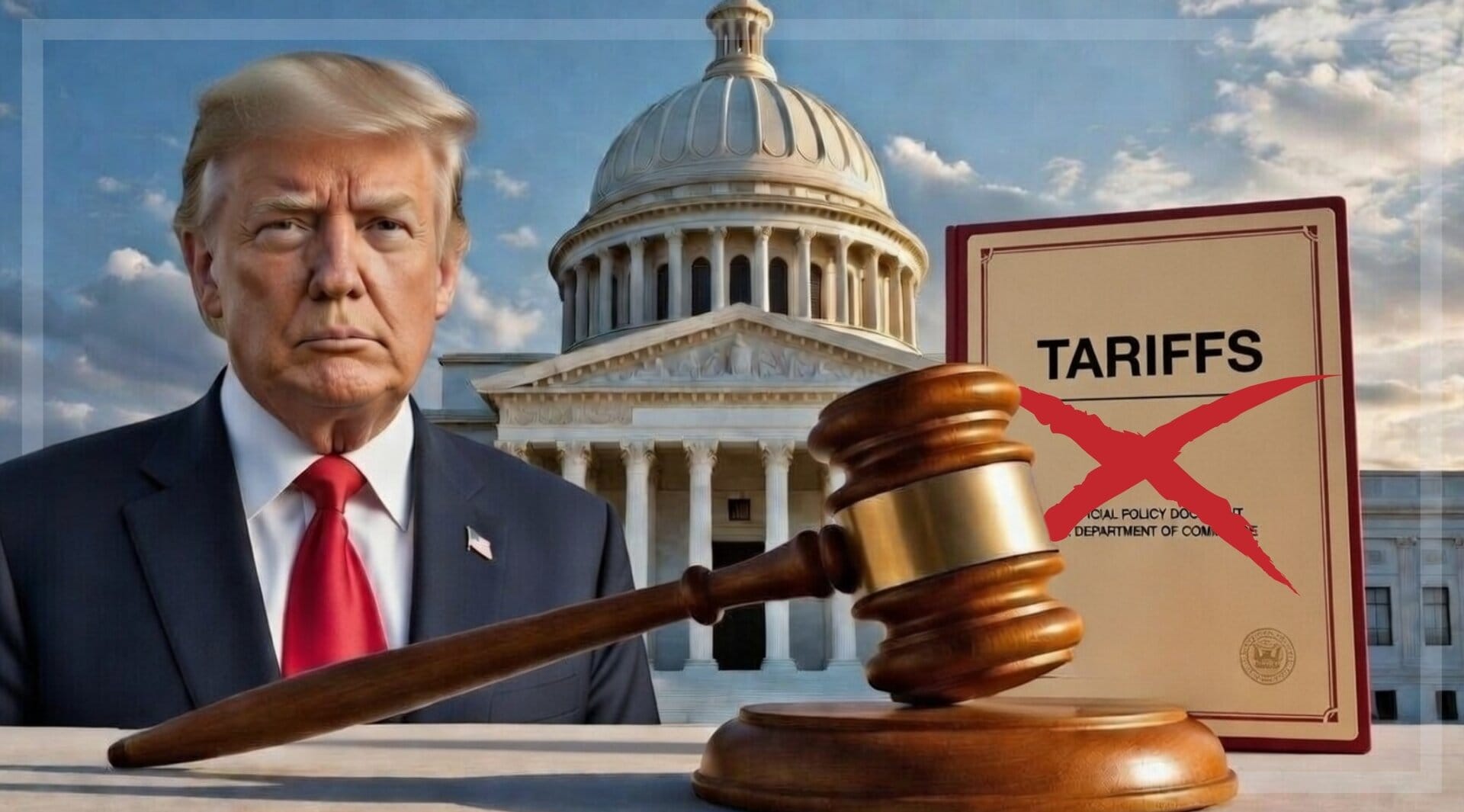
Last week the Supreme Court of the United States published a decision about Trump’s Liberation Day tariffs. In April 2025, with much pomp, Trump unveiled his initial plans for new trade tariffs. Last week the Supreme Court scuppered those plans in a 6 – 3 vote. What does this mean for global trade?
In its decision the Supreme Court pointed to the International Emergency Economic Powers Act (IEEPA). The Act does not authorize the President to impose tariffs. Tariffs were raised on the back of a national emergency that was called by Trump related to “large and persistent” trade deficits with other countries, as well as the influx of illegal drugs which “created a public health crisis.”
Several plaintiffs, including small businesses and states, sued in multiple courts, including the United States District Court for the District of Columbia and the Court of International Trade. The court granted the plaintiffs’ motion for a preliminary injunction, concluding that IEEPA did not grant the President the power to impose tariffs.
The Supreme Court also upheld this decision. It pointed to Article I, Section 8, of the Constitution which specifies that “The Congress shall have Power To lay and collect Taxes, Duties, Imposts and Excises.”
The Government conceded that the President cannot impose tariffs during peacetime, but they argued IEEPA provided that delegation. The Court disagreed. The emergency declaration remains intact, but the tariffs have been removed.
The Chief Justice shared in his decision how IEEPA authorizes the President to “investigate, block during the pendency of an investigation, regulate, direct and compel, nullify, void, prevent or prohibit …. Importation or exportation.”
He added how if Congress intended to convey the distinct and extraordinary power to impose tariffs, it would have done so expressly, as it consistently has in other tariff statutes.
Trump Responds to the Supreme Court
Trump didn’t stay quiet for long. In a press conference on the same day (February 20) he called the decision “deeply disappointing” and a “disgrace.”
The President is not one to lie down after a defeat. He is already planning workarounds, signing an executive order imposing a new 10% global tariff under Section 122 of the Trade Act of 1974. On February 21 he went a step further by hiking the tariff to 15%.
What Does This Mean for Global Trade?
The ruling vacates most of the IEEPA-based tariffs (the bulk of Trump’s 2025 regime), potentially opening the door to billions in refunds for importers. Estimates ranging from $85–170 billion collected in 2025 alone, though claims could drag through courts for years. Markets wobbled initially but stabilized somewhat, with some sectors (importers, retailers) rallying on reduced uncertainty and lower short-term costs.
The real disruption lingers: Trump’s pivot to alternative authorities (Section 122, plus potential Section 232/301 expansions) means tariffs aren’t dead. Instead, they’re evolving. Ongoing negotiations with Canada, Mexico, China, and others could get thornier, with ripple effects on supply chains, trade finance, currency volatility, and banking exposure to import/export risks.
For now, it’s a win for congressional authority and constitutional checks.
Author: Andy Samu
The editorial team at #DisruptionBanking has taken all precautions to ensure that no persons or organizations have been adversely affected or offered any sort of financial advice in this article. This article is most definitely not financial advice.
See Also:
Will Trump’s Liberation Day Cause a Stock Market Crash? | Disruption Banking