Europe is abuzz with plots against the supremacy of the US dollar and conspiracies against the Magnificent 7 US tech firms.
Weaponization of the Financial System
A confidential note has been making the rounds among EU finance ministers. According to Politico, an unnamed EU executive wrote, “The recent evolution in the international monetary and financial landscape necessitates a comprehensive reassessment of the euro’s global positioning strategy. The EU needs to act to increase its resilience against the potential weaponisation of the international monetary and financial system.”
Secretary Bessent, in his smarmy way, alluded to this weaponization in Davos: “It’s exciting to be able to make a difference, that we can do things without firing bullets.”
He was referring to Iran, but he could just as easily have been speaking of Europe.
The US dollar has fallen against other currencies, and analysts are warning of a potential global recession. The smart money is reducing exposure to dollar-denominated assets, leaving retail investors holding the bag.
The greenback remains strong historically, but Treasury Secretary Bessent and President Trump have given contradictory signals on whether they are trying to strengthen the US dollar or weaken it.
Strong Dollar Policy
Bessent touted the administration’s “strong dollar policy” while Trump said he thought the dollar’s recent slide was “great.” Asked for clarification, Bessent slathered the President with praise, “Are we making the US the best place for capital in the world? and I think no one’s done that better than President Trump.”
Apparently, that wasn’t enough. Bessent tweeted a video with more sychopanthic Trump boosting in an effort to clarify the administration’s stance on the value of the dollar.
Naturally, X users were quick to point out that the dollar has lost 10% of its value since the President took office and that the BRICS nations are de-dollarizing.
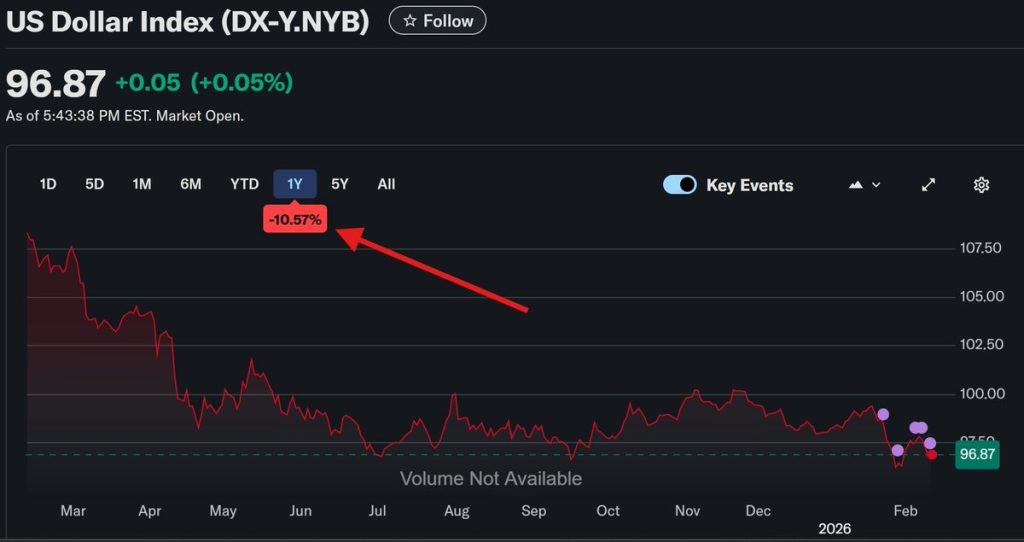
Nevertheless, the narrative of dollar collapse and de-dollarization may overstate the real situation. The dollar still reigns supreme in terms of foreign exchange, commanding 80-90% of transactions, as well as global reserves, with 58-60%.
Europe still has a bevy of issues to work through before they dethrone the dollar. Global currency reserves held in the Euro is at about 20%. Disruption Banking wrote about European pension funds shedding US Treasury bills already. Expect this trend to intensify.
The Political Optics: From Consumer Boycott to Institutional Strategy
As in Canada, there is a movement gathering steam in Europe to ditch big tech platforms headquartered in the U.S., the leaders of which support Trump, choosing European alternatives. The EU spends an estimated $264 billion annually on US cloud services.
Visio is part of France’s Suite Numérique plan, a digital ecosystem of sovereign tools designed to replace US online services such as Gmail and Slack. Viso is also hosted on the French company Outscale’s sovereign cloud infrastructure, which is a subsidiary of French software company Dassault Systèmes.
David Amiel, minister for the civil service and state reform, said, “The aim is to end the use of non-European solutions and guarantee the security and confidentiality of public electronic communications by relying on a powerful and sovereign tool. This strategy highlights France’s commitment to digital sovereignty amid rising geopolitical tensions and fears of foreign surveillance or service disruptions.”
Amiel’s comments about ending reliance on “non-European solutions” reflect a recognition that in a crisis, digital chokepoints can be as powerful as financial ones.
EU commissioner Maria Luís Albuquerque declared, “Europe must retain control over the key technologies that underpin and drive our economies.”
The message is clear: Europe does not want its public administration reliant on foreign-controlled software stacks or the government bonds of a hostile regime.
American Billionaires: Vive la Resistance!
US companies have taken notice, and they are adapting, trying to sneak their EU-compliant services under the blue curtain. Amazon and Nvidia have attempted to form new partnerships with EU companies, dubbed by critics as “sovereignty-as-a-service.”
This is less a withdrawal and more a reconfiguration of American hegemonic dominance. Europe’s push for digital sovereignty is not a cultural boycott or a passing anti-American mood. It is a strategic response to geopolitical risk.
After watching Russian central bank reserves frozen, Iranian banks cut off from SWIFT, and U.S. export controls reshape semiconductor supply chains overnight, European policymakers have drawn a hard conclusion: control over financial and digital infrastructure is leverage.
The result is an accelerating effort to reduce dependency on U.S.-controlled platforms. Not just for ideological reasons, but for operational resilience.
Why This Matters for the Dollar
The dollar is not on the brink of collapse, nor is Europe poised to dethrone it overnight. But reserve currency dominance rests not only on liquidity and military power, but on trust that financial infrastructure will remain neutral, predictable, and open.
As Europe builds sovereign digital systems and diversifies its monetary exposure, and as BRICS nations experiment with alternative trade settlement mechanisms, the world is insulating itself from the dollar. The result may not be the end of dollar supremacy, but the end of its unquestioned monopoly.
Author: Tim Tolka, Senior Reporter
#Crypto #Blockchain #DigitalAssets #DeFi
The editorial team at #DisruptionBanking has taken all precautions to ensure that no persons or organizations have been adversely affected or offered any sort of financial advice in this article. This article is most definitely not financial advice.