Qube Research & Technologies’ (QRT) main hedge fund delivered an eye-popping return of about 30% in 2025. That gain roughly matches its long-term performance average and far exceeds the broader market: the HFRI Global Hedge Fund Index returned only ~12.6% in 2025.
QRT’s other vehicles also profited: the Torus fund was up ~20.4%, and the Prism fund was up ~7.4%. To add context, one market participant observed that QRT’s edge “handed it returns that make those of the established hedge fund elite look mediocre by comparison.”
QRT has quietly become a multi-billion-dollar quant powerhouse, roughly $38 billion under management by January 2026. So, generating ~30% with such a scale is extraordinary.
2025 Macro Mayhem: Why Volatility Was Pure Gold for Hedge Funds
Last year’s market volatility created ideal conditions for hedge funds. With AI hype, geopolitical shocks and big central-bank moves, the industry enjoyed its best year since 2009. Even so, QRT’s return stood out.
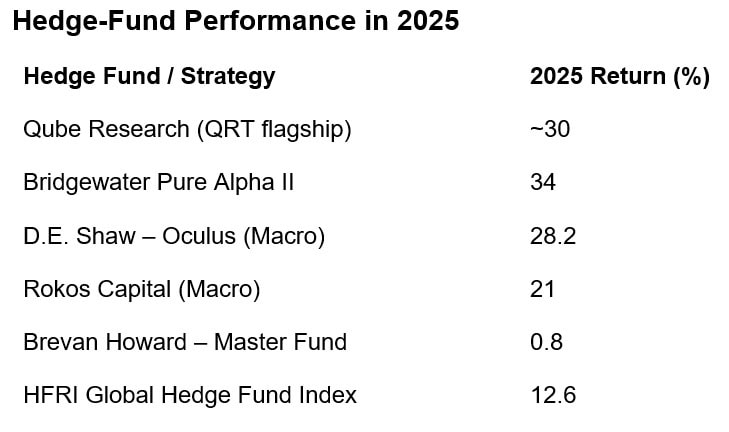
Bridgewater Associates’ Pure Alpha II led the pack, thanks to massive macro bets. D.E. Shaw’s large funds also soared. In this context, QRT’s 30% return is among the best, especially for a fund of its size. By comparison, US multistrategy managers like Millennium and Point72 saw more modest returns.
Top Performers Table: QRT Joins the Elite
Those figures tell the story: QRT’s strategy, a heavily quantitative, data-driven macro system, outperformed the pack. Hedge funds that bet on aggressive rate cuts or market trends largely did well. In contrast, many traditional macro giants lagged.
For example, Brevan Howard’s flagship Master Fund managed just +0.8% in 2025, a tiny fraction of peers. Across the platform, this put Qube firmly in the top 1% of hedge funds globally on a multi-year lookback, according to Bloomberg’s reporting on its rise.
This performance gulf underscores a common theme: volatility was king in 2025. Funds nimble enough to exploit large FX rates and equity swings, like QRT or Bridgewater, racked up big gains. Quantitative strategies with advanced models and ample computing power appear to have capitalized on the chaos.
Explosive Growth Unlocked: $23B → $30B → $38B AUM in Record Time
By early 2025, Bloomberg put QRT at roughly $23 billion in assets, up from a tiny $800 million Credit Suisse spin-out just seven years earlier. A March 2025 update then flagged that QRT had added another $5 billion so far that year, taking assets “to about $28 billion,” driven by both fresh capital and gains.
By July 2025, Bloomberg described Qube as having “built a $30 billion hedge fund empire,” cementing its status as one of the fastest-growing quant firms on the planet.
That growth rate is not just impressive; it is structurally important, because size becomes a constraint for any systematic manager running short-term and high-capacity strategies.
What Powered the 30%? Commodities, Data Centers, and Quant Edges
Bloomberg’s coverage makes it clear QRT is a diversified quantitative platform, not a one-trick stat-arb pony. Its build-out of a dedicated commodities operation, including the decision to open a Houston office and eventually trade physical commodities, shows a deliberate push into markets where data, infrastructure, and speed are hard moats.
In 2025, that likely meant monetizing volatility and dislocation across energy and power markets, the same space where the firm hired Goldman Sachs’ former co-head of US power trading, Naveen Arora, to drive the US push.
Combine that with the firm’s Icelandic data-center gambit and you get a picture of a shop leaning into latency-sensitive, data-hungry strategies that can scale with capital and computing power.
Can 30% Stick? The Real Talk on Sustainability at $38B Scale
A 30% return in 2025 would be exceptional in isolation; maintaining that as an approximate annualized rate over several years is rarer still. On one hand, consistent high returns with rising assets under management (AUM) suggest Qube has genuine structural edges, in data, technology, and execution, that competitors have not fully replicated yet.
On the other hand, any quant investor who has lived through factor crowding knows this can change quickly as flows pile into similar signals and liquidity thins at the margin. The fact QRT’s 2025 gain is “in line with its long-term average” should be read with skepticism by allocators. It raises the bar for what LPs will expect next, yet markets do not care about your last five years of outperformance.
Here’s one argument: assuming 30% net as a base case for the next decade is naive. The more realistic forward range is that Qube remains an upper-quartile performer, but its flagship strategy mean-reverts toward high-teens or low-20s once capacity and competition fully bite. That is still elite; it is just not the fantasy many investors project after a streak like 2018-2025.
What This Means for 2026 Allocators
Going into 2026, Qube QRT sits in a rare space: a roughly $30 billion, top-1% quant hedge fund that just printed another ~+30% year on its flagship strategy. The Houston expansion, the continued asset growth, and the diversification across Torus and Prism suggest management is playing offense, not just clipping performance fees.
For allocators, that cuts both ways: you get exposure to one of the most successful systematic franchises of the last decade, but you also inherit rising size, more complex risk, and the ever-present risk that yesterday’s edge becomes tomorrow’s crowded trade.
If you are evaluating Qube in early 2026, anchor your thesis on one hard fact: the firm made about 30% in 2025, but the only question that matters now is how much of that was repeatable process versus right-place, right-time positioning in a regime that may not last.
Author: Richardson Chinonyerem
The editorial team at #DisruptionBanking has taken all precautions to ensure that no persons or organizations have been adversely affected or offered any sort of financial advice in this article. This article is most definitely not financial advice.
See Also:
How Brevan Howard Fell Behind in the Macro Surge of 2025 | Disruption Banking
How Much Returns Did TCI Fund Management Make in 2025? | Disruption Banking#
Why is Qube Research & Technologies Focusing on Texas? | Disruption Banking