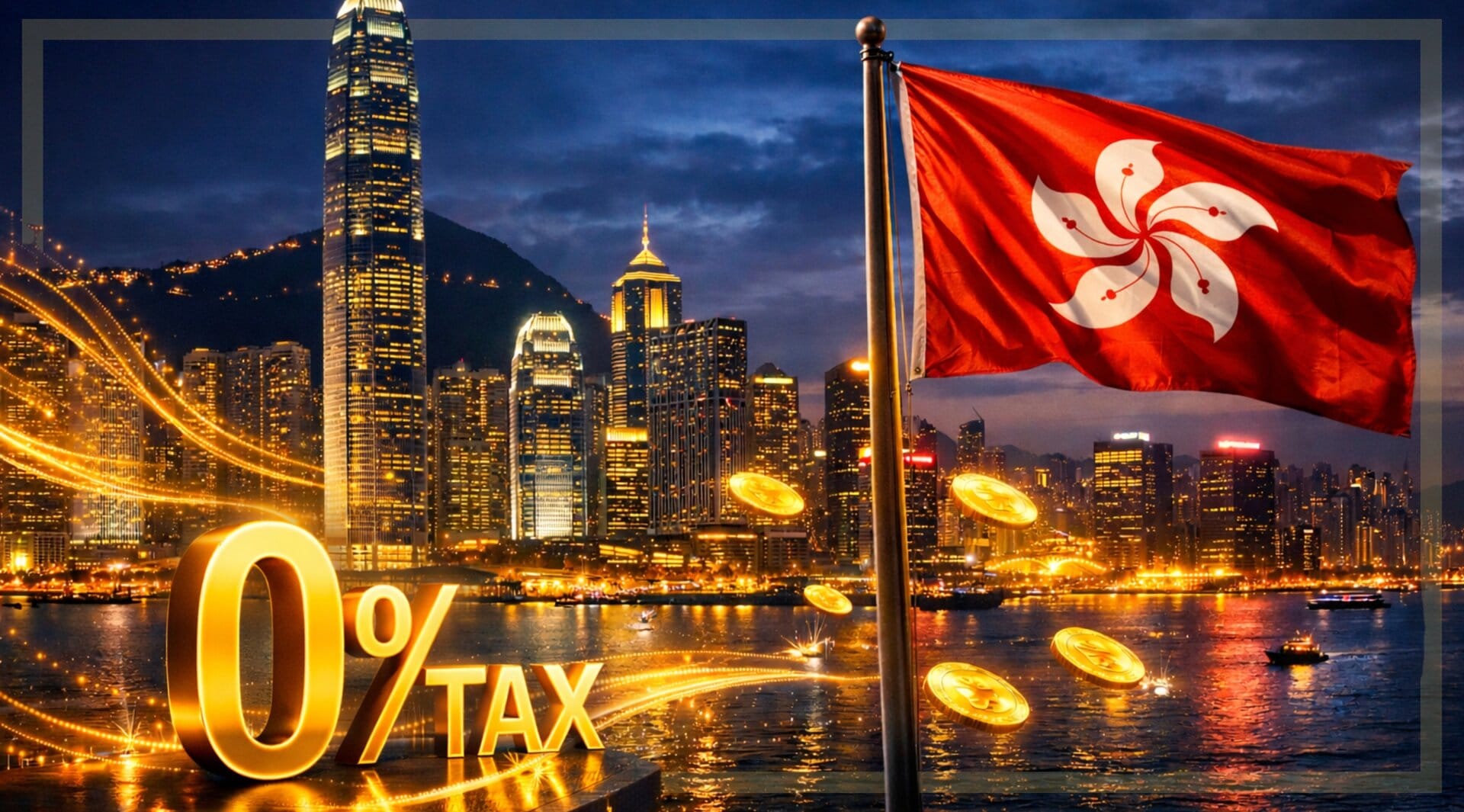
Hong Kong’s skyline at dusk masks a bold strategy to attract crypto capital through zero-tax incentives targeted at hedge funds, private equity firms, and ultra-wealthy family offices. In November 2024, the Financial Times circulated a 20-page draft proposal to waive taxes on gains from cryptocurrencies and other alternative assets for private funds and family investment vehicles. The message was clear: “taxation is one of the key considerations” for asset managers choosing their base.
Hong Kong promises to expand its existing fund-tax exemption regime, which already covers offshore fund companies, to include “virtual assets” and related investments.
Zero-Tax Gains for Crypto Powerhouses
Investors have taken note of this development. Hong Kong has been touting itself as a crypto hub, as Bitcoin and other tokens boom globally. Some traders had bet President Donald Trump’s election win would turbocharge crypto markets, but the HK pitch is more structural: relocate here and pay no tax on crypto profits. The six-week public consultation on the proposals ran through late 2024 and 2025. No law is in force yet, but the government’s intent is to target big pools of capital: hedge funds, private equity, and “super-rich” family offices with offshore investment vehicles.
Patrick Yip, Deloitte China Vice Chair and International Tax Partner, calls the move “an important step” toward making Hong Kong a crypto trading hub. He notes many family offices already hold up to ~20% of portfolios in digital assets, so tax certainty matters. With no capital-gains tax on cryptocurrencies, exempting fund-managed gains simply formalizes the benefit.
The proposal even covers private-credit loans, overseas property, and carbon credits, signaling Hong Kong’s ambition to become an all-in-one low-tax base for private capital.
2,700+ Family Offices Poised to Benefit
Consider the potential beneficiaries. Hong Kong prides itself as Asia’s largest hedge fund hub and the second-biggest private equity market by assets under management. Official data show over 2,700 single-family offices operate here, more than half managing over $50 million each. In other words, a crowded field of wealthy funds and families could suddenly pay effectively zero tax on their crypto winnings. Deloitte estimates some families already dabble heavily in crypto, so their allocations (and deal flow) might increase under the new rules.
Skeptics note that absolute winners are clear: offshore fund managers. Smaller traders or ordinary investors see little change (HK already has no personal capital gains tax on crypto). This mainly sweetens the pot for bigger financial institutions. As Deloitte’s Yip puts it, it “boosts Hong Kong’s status” as a financial and crypto hub by removing a major tax headache.
Offshore Hub Showdown: Hong Kong Challenges Singapore
Hong Kong’s move is also a direct shot at rivals. Regional reports emphasize that Singapore and even Switzerland are being eyed. Singapore’s 2020 Variable Capital Company (VCC) regime has drawn 1,000+ funds, dwarfing Hong Kong’s ~500 open-ended fund companies (OFCs) so far.
Technode noted: “HK and Singapore are fighting to boost their position as top offshore finance destinations.” Hong Kong’s relative lag, slower fund launches than Singapore, is cited as motivation. The crypto tax breaks are designed to narrow that gap.
Singapore already offers its own crypto incentives; Hong Kong now responds with an aggressive “zero gains” pitch. The hope: attract hedge funds and family offices that might otherwise domicile in Singapore (or Switzerland, which also has no crypto-capital-gains tax).
Anecdotes suggest this could trigger a wave of new fund registrations in Hong Kong, like the rush when Singapore opened its VCC regime.
CCP is overseeing the demise of Hong Kong. Financial services industry has been the core pillar of HK economy. Wealth mgt AUM in HK peaked in 2020, and fall off the cliff in 2022 (down 16%). HK wealth mgt industry grew because China wealth owners wanted to be out of ccp reach.… pic.twitter.com/OWzcQw3lR7
— Desmond Shum (@DesmondShum) August 5, 2023
From Consultation to Legislation: The 2025-2026 Timeline
After unveiling the draft, the government asked for feedback. A six-week consultation ended in early 2025. Industry lobby groups weighed in, opining that some big private equity and fund associations pushed for further broadening of the tax breaks, while a few questioned the fairness of carve-outs. The public response was largely positive among financial insiders, who want certainty.
In the 2025–2026 Budget speech (February 2025), EY confirmed that Hong Kong would indeed enhance its preferential tax regimes for funds and family offices, explicitly naming “virtual assets” among the eligible investments. Confirming that the budget proposals would enshrine crypto in the carve-out list.
The draft legislation is expected to be tabled sometime this year, and only then will it become law. For now, the HK$0 crypto tax remains a promise, albeit one formally backed by policy documents.
Crypto Tax Basics: Profits vs. Capital Gains in Hong Kong
What does this mean in practice? Under Hong Kong’s tax code, there is already no capital gains tax on cryptocurrencies. Casual crypto investors (buy-and-hold) have never paid tax on token gains, just like most jurisdictions. Hong Kong also imposes no VAT/GST on crypto, treating tokens as intangible assets.
The one tax relevant to crypto has always been the 16.5% profits tax. But even that only applies to business profits. If someone trades crypto as a business in Hong Kong (for example, a registered crypto broker or fund), only Hong Kong–sourced income is taxable.
A landmark HK tax case analogy: long-term holdings are usually viewed as capital, not trading stock, so gains aren’t taxed. In short, unless you’re running a crypto trading operation in Hong Kong, crypto gains are effectively tax-free today.
The proposed changes simply extend the tax-free status to include all crypto gains of qualifying funds and family offices, regardless of source. In effect, HK’s finance chiefs want fund managers to feel 100% confident that every crypto profit can escape the 16.5% tax.
CARF on the Horizon: Balancing Tax Cuts with Global Transparency
Hong Kong isn’t ignoring the tax authorities either. In December 2025, the government launched a consultation on the OECD’s Crypto-Asset Reporting Framework (CARF). This will force crypto exchanges and custodians to collect and share customer transaction data with tax authorities by around 2028.
Secretary Christopher Hui said Hong Kong will amend its laws to implement CARF and start information exchange by 2028. In other words, while Hong Kong lowers taxes for crypto investors, it simultaneously tightens transparency to meet global standards.
🚨PUSHBACK ON OECD’S CRYPTO FRAMEWORK
— Coin Bureau (@coinbureau) January 25, 2026
HK crypto firms say adopting the Crypto-Asset Reporting Framework (CARF) could create legal and operational risks without clearer guidance.
CARF mandates cross-border sharing of crypto user and transaction data, with rollout by 2028. pic.twitter.com/BDAfne4MUu
Hong Kong’s Crypto Tax Gamble: Awaiting 2026 Approval
Hong Kong has thrown out the tax carpet for crypto-rich funds and family offices. The promised exemption for virtual assets (crypto) is very real in policy documents, but it still needs Legislative Council approval.
Meanwhile, current investors already pay no crypto tax under Hong Kong’s profit-oriented tax system. The new incentives will likely boost fund registrations in HK, but the real onus is on lawmakers to enact the changes in 2026.
The policy intent is clear: Hong Kong has made an unmistakable bid to be Asia’s premier crypto fund hub. And only time will tell if the bet pays off.
Author: Ayanfe Fakunle
The editorial team at #DisruptionBanking has taken all precautions to ensure that no persons or organizations have been adversely affected or offered any sort of financial advice in this article. This article is most definitely not financial advice.
See Also:
Hong Kong Stocks Slide on China GDP Slowdown & Trump Tariff Threat | Disruption Banking