






Bobby Gray, the founder of TEXITcoin, holds weekly Miner’s Updates, during which he transparently describes the chaos and financial mismanagement inside his centralized secessionist crypto project.
The unfortunate news for TEXITcoin investors is that everything is far worse than Gray likes to admit, and Gray admits a lot; it’s just all very carefully framed. Disruption Banking has been pulling apart Gray’s claims since last September in a series of stories that uncovered the holes in Gray’s architecture of obfuscations, half-truths, and lies.
Gray’s Rocketship Crashed
Gray has been a bit testy lately because of the collapse of his flagship token, TXC, over the last few months.
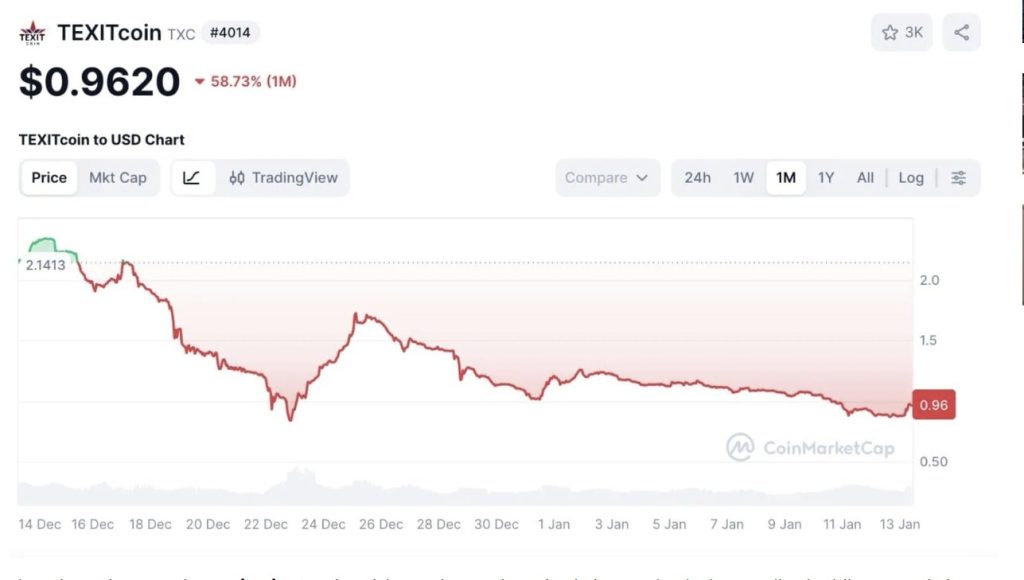
The price trajectory mirrors Bitcoin, Gray is quick to point out, but Bitcoin is completely decentralized, while TEXITcoin is Gray’s personal project, subject to his whims, idiosyncrasies, weaknesses, and narcissism.
TEXITcoin was marketed to crypto noobs at gun shows, so when the bear market hit, many investors ran for the exits, and having been fed Gray’s fantastical “rocketship to $16,” they were understandably upset. Therefore, Gray has aggressively suppressed internal dissent, admitting systemic MLM-style ‘gaming’ of the project, officially abandoning previous financial promises and compensation plans, and revealing a previously concealed hack by an insider.
Insider Backdoor Hack Revealed
In the Week 93 Marathon Call, on January 10, 2026, Gray tried to keep the tone upbeat while informing investors of bad news on multiple fronts and admitting to a second hack, which Disruption Banking alluded to in our previous article on the October security breach.
We knew a TEXITcoin insider had commented on YouTube that the October breach was “not the first time,” but no other information was forthcoming, until this past weekend, when Gray not only admitted an insider created a backdoor but also put a number on the funds lost.
During the Marathon Call, Gray revealed, “It’s hard to find good people, especially when you’re dealing in crypto, man, it’s tough, scams around every corner. I start handing off people’s data, and I go ‘Oh shouldn’t have trusted that developer.’ You saw what happened, what was it, January, we got hacked for $210,000 because we trusted a developer that put a back door in, and we regret it to this day.”
Like many of Gray’s most damaging disclosures, this one was made in the midst of talking about other things and trying to convince investors not to lose heart. Ten seconds later, he was on about new swag giveaways and the struggle to relaunch the project’s website, which is still under construction. He also advised his followers to provide liquidity on exchanges through “limit buy orders.”
After disclosing that there was no progress on the Victoria mining operation and that a power outage in Conroe caused a drop in hash power, Gray admitted he fired the IT team, soliciting his audience, “Anybody know some good IT people?”
Compensation Plan Discarded due to Price Pressure
The mining program was previously the main attraction Gray used to recruit new investors. Not anymore.
Gray explained in a Marathon Call on January 10, “We want our mining program to stand on its own two feet and be profitable all by itself, and right now it isn’t.”
A few months ago, Gray was talking about a 6-month ROI for a $995 investment.
He said, “They’re going to make their money back in 2,618 days… a seven-year ROI,”
adding, “We’re really, really far off from where we started this thing when we were talking about a six-month ROI.”
Gray has tried to bar the exits because he knows he must control the whales of TXC. If they leave, the token goes to zero, so he’s framed HODLing as a loyalty test and ramped up pressure on his remaining followers to relentlessly market to their friends and family.
Hitting Rock Bottom or More Losses?
On January 10, Gray assured his audience that the price won’t go lower, saying, “I think we’re calling the bottom.”
He pressured outreach, saying, “If you want to continue to participate, you’ve got to stay active.”
Gray argued that inactive participants in their rewards program are dumping tokens on the open market, driving down the price, so he changed the compensation plan.
He said, “We can’t continue to pay those people out week in, week out… They go, ‘Well I’ll just dump my extra TX on the open market.’” concluding, “We’re going to put a couple of requirements and stipulations into the comp plan. It’s going to piss a bunch of people off, and it has.”
However, he promises the price will increase from here, saying, “You’ll start to see the price show some signs of life again.”
It might be reasonably asked by our dear idle readers, “But how can he guarantee an upward price trajectory?”
Easy: Gray deploys funds to manipulate the price level. Disruption Banking already reported that Gray burned through $15 million, trying to defend utterly unrealistic price levels.
On January 10, Gray insisted that inflows will be forthcoming at a clip of $100K per week, asking, “What do you think $100,000 will do to the market?”
At the same time, Gray disclosed that the TXC whales are kept in line with a manual, off-market liquidity system designed to prevent large holders from selling on the open market and (further) crashing the price.
Later in the call, he advised, “We connect buyer and seller off-market so it doesn’t affect the price,” adding…“If you want to sell, call me up instead of crashing the market,” later warning, “That’s how small and fragile our market still is.”
The Captain of the Rocketship
Sounds tenuous, but Gray paints a picture of running a tight ship, saying on January 10, “65% of all the coins in existence are locked away on cold storage coins,” and “Only about 35% of the daily output is marketable.”
Okay, Gray is the captain of the rocketship — he actually uses this metaphor to sell his wares — bragging that he personally decides how much capital to allocate to influence the price.
At one point, during the January 10 call, he said, “I do it. And I decide how much capital to allocate. We don’t have a bureaucracy yet. Maybe someday we will.”
He makes bureaucracy sound like a bad thing, while at the same time claiming that the project is decentralized. It’s hard to understand how people square that circle; maybe the idea of Texas seceding from the union (TEXIT like BREXIT) is all they really care about.
Otherwise, it would have to raise red flags when Gray says things like, “We were buying back coins off the market primarily from the miners.”
It should be clear that Gray runs anything but a tight ship, and his narrative of control has been unraveling, but like he said on January 10, “Most people are stockpiling, crossing their fingers.”
Kind of an MLM, but Definitely Not an MLM
On the January 13 Miner’s Update, Gray went into a protracted discourse on how TEXITcoin is definitely not an MLM, but he got a little bogged down, observing, “Look, we’re going to kind of call it an MLM because everyone’s going to think it’s an MLM so soon as we start drawing circles and lines on the board and that pyramid shows up everyone’s going to go ‘Ah see told you pyramid knew it.’ So, take a deep breath guys; it’s going to take a little bit of time; it’s going to take a little bit of energy, but we’re going to convince people. We’re going to show them how it’s not an MLM.”
This went on for some time, until Gray, seeming to lose the thread and become uncharacteristically fed up with his own discursive blathering, announced, “So, let’s not call it anything at all.”
CoinMLS, a certified cryptocurrency consultant, wrote in an email to Disruption Banking, “Unless they can get recruiting numbers up, I’m not sure they’ll have the money for the big sponsorships and advertising so much anymore. I think the low price is going to be an insurmountable headwind to future growth. If they are using OTC TXC sales revenue to prop up the price, I think they’ll be able to keep it at current levels unless news or rumors inspire early TXC investors to start unloading to recoup investment or lock in gains. Bobby mentioned that something like 2/3 or all TXC are sitting in cold storage wallets and haven’t moved. We also know the majority of investors are crypto noobs who probably couldn’t figure out how to sell them if they wanted to without some help.”
Notice, this researcher, who knows the project intimately, emphasizes the “recruiting numbers” to maintain the marketing campaigns, which have likely brought many new investors into the project, in addition to the MLM activities of previous investors. If it sounds like a house of cards, that’s because it is, and Gray’s own words reveal this over and over.
Downtown Digital Dollars
Nevertheless, Bobby Gray is pivoting to an even more illegal scheme he calls Downtown Digital Dollars, a stablecoin, despite the GENIUS Act requiring stablecoin issuers to be registered and have reserves, none of which Gray has done or claimed to have even the intention of doing.
The business model’s economics are weak, according to CoinMLS, after doing a deep dive on the project. The slim profit margins become increasingly untenable as the system scales, and the public blockchain model exposes sensitive business data. Overall, the project is legally dubious, operationally flawed, and unlikely to succeed.
CoinMLS concluded, “Bobby gleefully exclaims, ‘No one has ever done this before!’ And there’s plenty of reasons for that. It’s a lot of work for very little profit, fraught with piles of legal regulation and compliance. Profit margins are slim when you have to deduct the legal, administrative, marketing, and tech support expenses. This does not appear to be a promising endeavor.”
Permissioned v. Centralized
Gray rejects the label “centralized” and instead calls TEXITcoin a “permissioned blockchain,” which is clever but effectively meaningless. It’s a distinction without a difference, but it functions as windowdressing for his audience.
CoinMLS analyzed Gray’s claims, noting that both permissioned and centralized blockchains prioritize control and governance by known parties, but TEXITcoin fails even the most generous permissioned standard because Bobby Gray controls access, governance, privacy, and network participation.
TEXITcoin reportedly runs on only two nodes and lacks shared or consortium-based governance, placing it firmly in the centralized category. CoinMLS concluded that a centralized blockchain fundamentally contradicts the trustless, decentralized ethos of cryptocurrency, making Texitcoin’s claims of being “the future of crypto in America” laughable to experts in digital assets and sophisticated crypto investors.
Taken together, the revelations of repeated internal hacks and ongoing mismanagement paint a stark picture of a project in freefall. Rather than being the resilient, decentralized cryptocurrency it was marketed as, TEXITcoin appears plagued by weak governance, technical vulnerabilities, and an overreliance on charismatic leadership for stability.
With investor trust eroding and fundamental promises repeatedly unfulfilled, the likelihood of recovery looks increasingly remote, leaving many to question whether what remains of TEXITcoin can survive its own internal discord.
Not to worry, however, because as Gray declared on January 10, “Week 93 is the week that we turn this thing all around.”
Author: Tim Tolka, Senior Reporter
#Crypto #Blockchain #DigitalAssets #DeFi
The editorial team at #DisruptionBanking has taken all precautions to ensure that no persons or organizations have been adversely affected or offered any sort of financial advice in this article. This article is most definitely not financial advice.
See Also:
The Shocking Truth Behind TEXITcoin’s Collapse: Burnt Cash, Broken Miners, & MLM Logic
How TEXITcoin Hooks Texans with Secessionist Rhetoric, Nonexistent Sponsorships and Mining Mirage
Inside the TEXITcoin Breach: Hundreds of Wallets Compromised After Security Failure










13 Responses
Excellent report!! Spot on.. Next time research Rob Gray’s past.. hes a real piece of work..
This article is clearly a hit piece written by someone presenting with a very biased opinion. The tone of the article is strongly negative and editorialized, with phrases suggesting judgment (e.g., “architecture of obfuscations,” “narcissism”) – a strongly framed critical analysis rather than a neutral news report. I give it a thumbs down.
Looks like someone invested more than they were willing to lose! Sorry champ next time be smarter!
Laugh. Out. Loud. How is that working out for you? (you were warned, bozo)
What the TEXIT coin audience does not understand:
Proof of Work is a consensus mechanism designed to remove the need for trust between participants. Its value comes from PERMISSIONLESS block production and adversarial competition. When a single, PERMISSIONED authority produces ALL blocks, validates ALL transactions, and receives ALL block rewards, proof of work NO LONGER serves its purpose.
In the TXC model, trust is simply reintroduced. Additional computation does not increase security, decentralization, or censorship resistance. Once you understand this, the illusion behind TXC mining becomes obvious.
Is Rob Gray and Bobby Gray the same person? I know both names are short for Robert. I did buy a mining seat awhile back and I’m now strongly questioning that decision
when we checked his details it waas hard to say who he was… This is what we found:
Bobby suggests that he was the founder of the American Open Currency Standard. And there is a ‘Rob Gray’ who gave a testimony before the Domestic Monetary Policy Subcommittee of the Financial Services Committee in 2012. To submit a testimony, according to the House Committee, you need to be an academic, private sector leader or a representative from organizations within the financial services industry. It is likely that Bobby, then calling himself Rob, did give testimony. But why he was called Rob and not Bobby may raise questions.
What are you smoking. The article is based on Objective Data. How are you able to sleep at night? Spewing mindless dribble & Subjective Opinions hold no value. How is it possible to write a “neutral news report” when it’s been nothing but a chit show for several months now. You need to look at yourself in the mirror and do a fearless moral inventory of yourself…..
Yes of course.. go to utube and search rob gray and chris duane and youll see the fearful leader talking trash about his previous partner at mulligan mint
CEASE AND DESIST LETTER
Jason Hommel
RevealingFraud.com
Email: [email protected]
Twitter: @JasonHommel5
Tim Tolka
Senior Reporter
Disruption Banking
[email protected]
[email protected]
https://www.facebook.com/disruptionbanking
CC: as comments to facebook, and to latest article
CC: TEXITCOIN forums
CC: Andy Samu, Disruption Banking Editorial Team
Date: January 19, 2026
Re: Demand to Cease and Desist Defamatory Publications Regarding TEXITcoin and Related Parties
Dear Mr. Tolka, This letter serves as a formal demand for you, Andy Samu, and Disruption Banking (collectively, “you” or “Recipients”) to immediately cease and desist from publishing, disseminating, or otherwise communicating any false, misleading, or defamatory statements regarding TEXITcoin, its founder Bobby Gray, myself (Jason Hommel), or any associated parties. This includes, but is not limited to, the articles published on disruptionbanking.com listed below, which contain numerous factual inaccuracies, unsubstantiated accusations, and defamatory claims that have caused and continue to cause harm to the reputation, business, and financial interests of TEXITcoin and those involved.
The articles in question are:
“Is Texit Coin Too Good to Be True?” (September 2, 2025, authored by Andy Samu)
“Inside the TEXITcoin Breach: Hundreds of Wallets Compromised After Security Failure” (November 13, 2025, authored by Tim Tolka)
“How TEXITcoin Hooks Texans with Secessionist Rhetoric, Nonexistent Sponsorships and Mining Mirage” (November 18, 2025, authored by Tim Tolka)
“The Shocking Truth Behind TEXITcoin’s Collapse: Burnt Cash, Broken Miners, & MLM Logic” (December 22, 2025, authored by Tim Tolka)
“TEXITcoin Founder Finally Admits Year-Old Insider Hack & Investors Are Furious” (January 16, 2026, authored by Tim Tolka)
These articles repeatedly characterize TEXITcoin as a “scam,” a “Ponzi scheme,” an “MLM,” a “centralized” project with “fake” mining operations, “illusory” staff, “inflated” sponsorships, “illegal” securities offerings, and a “collapse” driven by “financial mismanagement” and “price manipulation.” Such statements are false, defamatory per se (as they accuse TEXITcoin and its participants of criminal conduct, fraud, and dishonesty), and published with apparent malice or reckless disregard for the truth. They constitute libel under applicable laws, including those of Texas (where TEXITcoin operates and where much of the project’s community resides) and potentially other jurisdictions.
Specific Factual Inaccuracies and Defamatory Statements
The following are examples of the false and defamatory content in your articles, along with corrections based on verifiable facts from public records, project documentation, and direct knowledge:
Accusations of TEXITcoin Being a “Scam” or “Ponzi Scheme”:
Multiple articles (e.g., September 2, November 18, December 22) label TEXITcoin a “scam” or “likely scam,” citing a Medium post and unsubstantiated claims. This is false. TEXITcoin is a legitimate Layer 1 Proof-of-Work cryptocurrency, forked from Litecoin with modifications to address Bitcoin’s flaws (e.g., fixed supply, faster blocks, Texas-centric mining to prevent arms races). It has grown 100x in value since launch (from $0.028 to $2.80+), with over 55,000 miners and real-world utility plans like Downtown Digital Dollars. It is not a Ponzi, as rewards are from mining output (85,000-100,000 coins daily, calculable and transparent via minetxc.com/statistics), not reliant on new investments paying old ones. Mining buy-ins are sunk costs for hardware/hashpower, not liquid investments promising guaranteed returns. Your repeated “scam” labels are defamatory and ignore evidence of operational legitimacy, including mining facilities visited by participants with receipts for hardware from China.
Claims of “Fake” or “Illusory” Staff and Leadership:
The September 2 article questions the existence or credibility of team members (e.g., Bohdan Shlikhutka, Vitallii Ovodenko, Kira Gray), suggesting photos are fake and profiles are inactive. This is misleading and false. Bobby Gray, the founder, has a documented history in sound money (testifying before Congress in 2012 on alternative currencies) and operated the American Open Currency Standard. His bankruptcy was due to being scammed by a supplier (losing $1.4M in silver), not scamming others—a fact distorted in your November 18 article. Team members like Eddie Allen have promoted TEXITcoin publicly. Accusing the project of “illusory” staff implies fraud without evidence, damaging reputations.
Misrepresentations of Security Breaches and Hacks:
Articles (November 13, January 16) claim “hundreds of wallets compromised,” a “major security failure,” and a “year-old insider hack” costing $210,000. This is exaggerated and false. The incidents involved temporary changes to payout addresses (not wallet hacks), affecting daily payouts of ~$2 per mine (total loss ~$4,000, covered by Gray). No underlying blockchain was breached, and measures were taken (e.g., notifications, locks). Your portrayal as systemic “vulnerabilities” and “repeated hacks” is defamatory, implying incompetence or criminality without full context. The “backdoor” claim ignores that such issues are common in crypto (e.g., Elon Musk’s data breach) and were resolved.
False Claims of “Fake Mines,” “Inflated Sponsorships,” and “Nonexistent Mining”:
The November 18 and December 22 articles allege “fake” mining, mismatched hashrate (30-40GH vs. sold 600GH), no verifiable data centers, and “highly inflated” sponsorships (e.g., denied by Formula 1, TCU). This is inaccurate. Mining is real and Texas-based, with delays from Chinese hardware shipments and installations (e.g., immersion cooling containers, ASICs). Hashrate discrepancies are due to phased rollouts (22% sold, 30% purchased, 1% installed initially). Sponsorships include real billboards in Texas airports/gun shows, broadcasts (e.g., Frogs Today for UT Athletics segments), and events like the Dallas holiday parade ($300K spent). Denials may stem from partial or indirect partnerships, but your blanket “nonexistent” label is false and defamatory.
Accusations of Illegal Securities, MLM/Ponzi, and Price Manipulation:
Articles (e.g., December 22, January 16) claim TEXITcoin is an “unregistered security,” “MLM,” “Ponzi,” with “price manipulation” via buybacks. This is false. Under SEC guidance (e.g., Howey Test), mining involves active participant effort (hardware control, promotion), market-driven returns (no guarantees), and is akin to non-security PoW models. No Form D/C needed if not a security. The affiliate model is capped ($3,000/week max), not unlimited like MLMs/Ponzis, and commissions stop if sales stop. Buybacks use project funds for liquidity, common in crypto, not “manipulation.” Gray’s Puerto Rico move is unrelated to evasion. These claims accuse criminality (securities fraud, manipulation) without basis.
Portrayal of “Collapse” and “Financial Distress”:
The December 22 and January 16 articles describe a “collapse,” “burnt cash,” “broken miners,” and “abandoning promises.” This is false. Price dips mirror Bitcoin’s market (bear phase), but TEXITcoin raised $140M, funds infrastructure (e.g., $1.8M on mining gear), and adjusts plans transparently (e.g., commissions to 50% for sustainability). Equipment issues (e.g., voltage errors) are logistical, not failures, and resolved. Your sensational “collapse” narrative ignores growth (2,416+ miners, 100% monthly increases early on) and defames the project as failing.
These statements are not opinion but presented as fact, often citing anonymous or biased sources (e.g., “CoinMLS” Medium posts, unverified YouTube comments). They have caused reputational harm, deterred investors, and potentially violated Texas defamation laws (Tex. Civ. Prac. & Rem. Code § 73.001), where actual malice can be inferred from reckless publication without verification.
Demands
To avoid legal action, you must comply with the following within 7 days of receipt:
Cease and Desist: Immediately stop publishing, promoting, or linking to the above articles or any similar defamatory content about TEXITcoin, Bobby Gray, myself, or related parties. Remove all such content from disruptionbanking.com and any affiliated sites/social media.
Retraction and Correction: Publish prominent retractions on disruptionbanking.com’s homepage and in each article’s place, correcting the inaccuracies listed above and stating the original claims were unsubstantiated/false.
Apology: Issue a public apology to TEXITcoin, Bobby Gray, and myself, acknowledging the harm caused.
Preservation of Evidence: Preserve all documents, communications, and data related to these articles, including sources, drafts, and analytics, as they may be subpoenaed.
Confirmation: Provide written confirmation of compliance via email to [email protected]
Failure to comply may result in the pursuit of all legal remedies, including suits for libel, slander, tortious interference, and damages (actual, punitive, exemplary). I reserve the right to seek injunctions, costs, and attorneys’ fees. This letter does not waive any claims and is sent without prejudice.
Govern yourself accordingly.
Sincerely,
Jason Hommel
Promoter and Advocate for TEXITcoin
RevealingFraud.com
Fk Jason Hommel…
Bobby and Jason = scammers
crash crash crash!
A cease-and-desist was sent today.
DisruptionBanking has been pushing false narratives about TEXITcoin and Bobby Gray while hiding behind anonymous insinuation and performative outrage.
This isn’t about protecting anyone—it’s about attacking people you don’t like and pretending it’s public service.
Proof up or shut up. Either way, this ends now.
Disruption Banking has absolutely keyed into this scheme of Bobby Gray to defraud his investors; and they are investors. Bobby has been busy buying luxurious properties and putting them in his and his wife’s name. Not sure where someone with a middle class home in McKinney gets all this money all of a sudden in 2025 to purchase luxurious homes.
1. Bay Harbor, Galveston TX $399K purchased with a vendor’s lien purchased July 2025
2. 19615 Shores Drive, Galveston TX $1.8M purchased Sept 4, 2025 with a vendor’s lien due on Sept 2027.
3. 2200 Woodbridge Dr, McKinney TX purchased Nov 6, 2025 $1M source of funds to purchased likely cash since he holds a general warranty deed in his and his wife’s name.
And last, but certainly not least:
4. 11588 Wild Rose Ln, anna, TX purchased Nov 13, 2025 cash $3.8M source of funds to purchase likely cash since he hold a general warranty deed in his and his wife’s name.
So that totals to $7M of luxury property purchases over the course of five months! All in his and his wife’s sole name. His investor’s are certainly making his rich!
I guess he decided to give up his home in McKinney by putting a special warranty deed on the property to have the mechanicals piping secured. I guess it does not fit his luxurious lifestyle that the Texit followers are giving him.
Oh and Bobby has been busy setting up LLCs to protect himself this year. Between May and Aug of 2025. Particularly interesting is the TXC Limited, LLC who collects the investment ACH from your bank account. It’s not even in his name.
You Bobby followers are making him very rich!