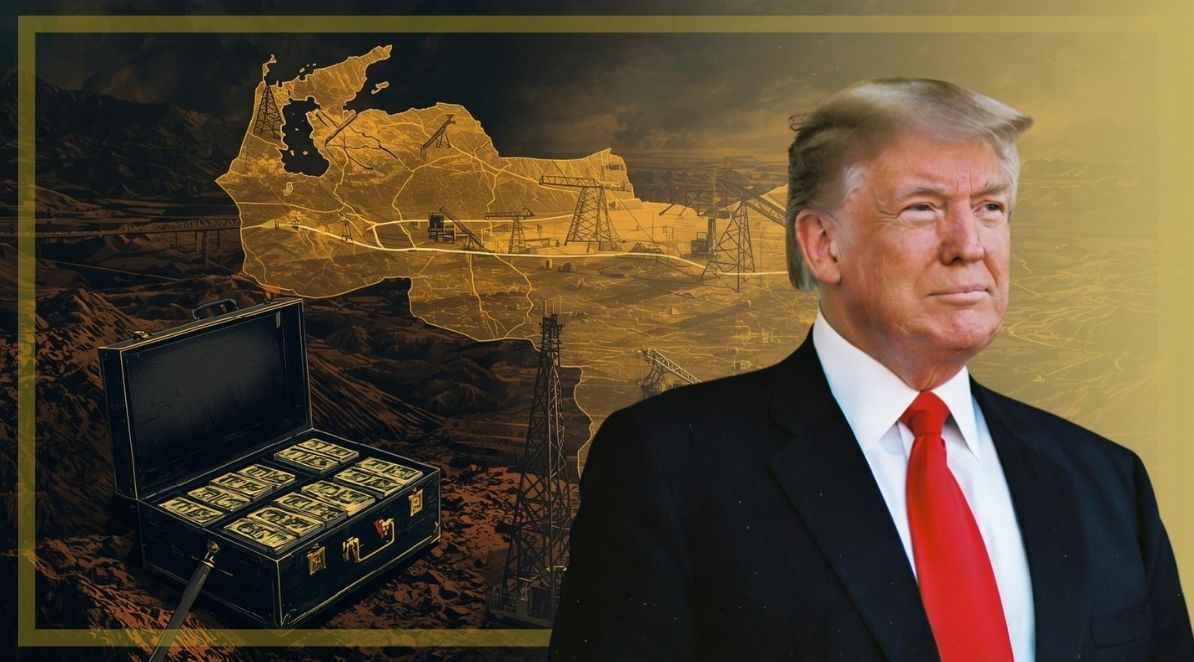
President Donald Trump now controls the largest oil reserves on Earth. Observers claim this will rebalance the global order.
Controlling Venezuela’s roughly 303 billion barrels of oil, worth an estimated $17-plus trillion in potential value, gives the United States unprecedented leverage to influence global energy supply, reinforce the petrodollar system, and reshape strategic alliances at the expense of rivals.
However, sources say that the regime of Nicholas Maduro has failed to develop oil fields, and extraction will be much more problematic than Trump administration boosters assume.
On Air Force One, Trump said, “We need total access—we need access to the oil and to other things in their country.” When asked what happens to the oil reserves, he said, “We’re gonna run everything.”
Q: What do you need over the next two weeks from Delcy Rodríguez?
— Aaron Rupar (@atrupar) January 5, 2026
TRUMP: Total access. We need total access. We need access to the oil and other things pic.twitter.com/uHQ8Z27JB6
At another point, he declared, “We’re going to be taking out a tremendous amount of wealth out of the ground.”
Spheres of Influence & the Monroe Doctrine
Trump’s Deputy Chief of Staff Stephen Miller told CNN’s Jake Tapper, “The United States; this is sort of foundational; the United States is using its military to secure our interests unapologetically in our hemisphere. We’re a superpower and under President Trump, we are going to conduct ourselves as a superpower. It is absurd that we would allow a nation in our own backyard to become the supplier of resources to our adversaries, but not to us, to hoard weapons from our adversaries, to be able to be positioned as an asset against the United States, rather than on behalf of the United States. The Monroe Doctrine and the Trump doctrine is all about securing the national interest of America for for years. We sent our soldiers to die in deserts in the Middle East to try to build them parliaments to try to build them democracies, to try to give them more oil to try to give them more resources the future of the free world, Jake, depends on America being able to assert ourselves and our interests without apology.”
Trump’s vision of the world and of history is closely aligned with Vladimir Putin: Might makes right, and countries can invade their neighbors to plunder their resources. Each superpower has its sphere of influence; China controls East Asia and the Pacific. Russia controls Europe, as well as the Caucasus. The U.S. holds sway in the Americas. Europe presumably controls Africa, or maybe nothing at all. And Russia swaps Venezuela for Ukraine.
History can be twisted to fit the goals of the local hegemonic power, meaning that Taiwan is a “renegade province,” Ukraine is “not a country,” and Venezuela stole oil from the United States.
Venezuela’s Extra Heavy Crude
There’s a reason that with the world’s largest oil wealth, Venezuela doesn’t rank in the top 15 in oil production. The domestic oil infrastructure has languished for decades due to mismanagement, waste, embezzlement, and general incompetence.
After nationalizing the oil sector, the government didn’t maintain long-term agreements to ensure production and technology transfer necessary to develop reserves and sustain existing production.
After firing 18,000 striking oil workers in 2002, Venezuela’s state oil company, the PDVSA, has lacked the expertise and human capital to develop the nation’s vast oil wealth.
Venezuela exported about 749,000 barrels per day last year, totaling less than 1% of global supply, according to data and analytics company Kpler. Production topped out at 3.5 million barrels per day in the 1990s.
Rather than reinvesting in production capacity, oil revenues were used to finance former President Hugo Chavez’s social programs. leaving the country backward and badly crippled, depending on loans from Russia and other partners.
Venezuela’s oil is tar-like, extra-heavy crude, more difficult and expensive to extract. Much of it is just reserves that would require wells to be drilled. However, once the oil is out of the ground, Southern U.S. states have refineries ideally suited to refine Venezuela’s oil.
Investor Michael Burry wrote in a Monday blog post on Substact, “Realize that many Gulf Coast refineries were purpose-built for Venezuelan heavy crude. So they have been running with suboptimal feedstock for years. This will, in time, produce better margins across jet fuel, asphalt, and diesel … I have owned Valero since 2020, and I am more resolved to holding it even longer after this weekend.”
He went on, “Venezuelan pipelines and refineries are old and in disrepair. This work will go to U.S. contractors. Chevron is already there. Exxon and others have been litigating claims for decades and may see some justice relatively soon, if the US literally begins to run Venezuela as some have suggested.”
Who Pays?
Still, ramping up production to even close to the volume the country exported in the 90s would require over a cool hundred billion in investment. The venture would require about $110 billion in order to increase output to about 2 million barrels per day by the early 2030s.
According to Trump, U.S. oil companies knew about the raid to kidnap Maduro (yes, the correct word is “kidnap,” for those of you at the BBC) before Congress because Trump talked to them “before and after” the raid. Trump later walked that back, saying conversations with the oil companies had been purely hypothetical, along the lines of “What if we did it?”
Regardless, according to Trump, the oil executives are excited about the prospects.
A White House spokesperson told Reuters, “All of our oil companies are ready and willing to make big investments in Venezuela that will rebuild their oil infrastructure, which was destroyed by the illegitimate Maduro regime.”
Unnamed oil company sources told Reuters, “Nobody in those three companies has had conversations with the White House about operating in Venezuela, pre-removal or post-removal to this point.”
In the end, Venezuela’s oil is less a conquered treasure than a stalled, capital-intensive reconstruction project that exposes the gap between imperial rhetoric and the hard realities of geology, infrastructure, and time.
Author: Tim Tolka, Senior Reporter
#Crypto #Blockchain #DigitalAssets #DeFi
The editorial team at #DisruptionBanking has taken all precautions to ensure that no persons or organizations have been adversely affected or offered any sort of financial advice in this article. This article is most definitely not financial advice.
See also:
From Market Crash to Crypto Boom: Venezuela’s Digital Currency Revolution