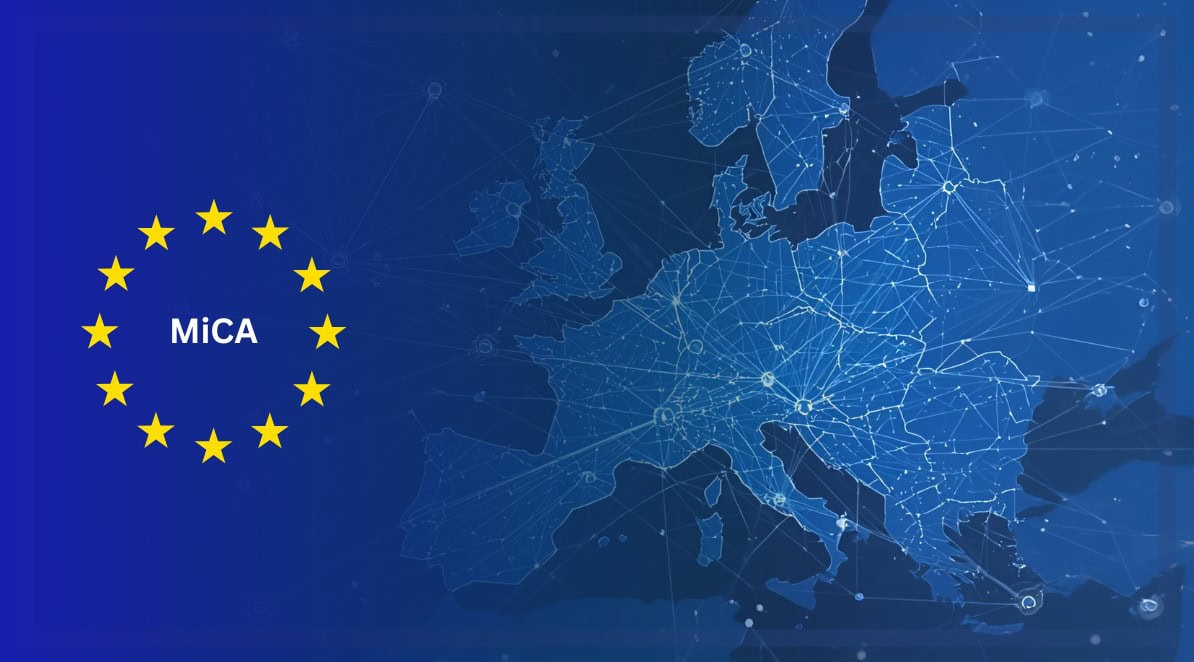
The EU’s Markets in Crypto-Assets (MiCA) regulation is Europe’s first comprehensive crypto law. It was adopted in 2023 and became fully effective by the end of 2024. MiCA brings all major crypto assets under one EU rulebook. It forces fiat-pegged tokens (“stablecoins”) to maintain 1:1 reserves, allowing instant redemption at face value. This meets strict disclosure and consumer-protection standards. Crypto exchanges, wallets, and other service providers must be licensed by an EU regulator and follow anti-fraud, anti-money laundering (AML), and operational-resilience rules.
Crucially, one EU licence grants a passport to operate across all 27 member states, replacing the old patchwork of national rules. In short, MiCA aims to unite Europe’s crypto market, boost trust, and head off risks to the financial system.
Today, DisruptionBanking delves into what MiCA does, and how important its rollout has been. This gives a clear view of how Europe’s big crypto rulebook is reshaping the market in real time.
How MiCA Changes Things for Everyday Users
MiCA covers virtually all crypto tokens not already regulated by existing finance laws. It came into force in June 2023, but key areas of the new law were phased in later. By mid-2024, rules on stablecoins took effect, and by December 30, 2024, all major crypto firms had to be licensed to operate in the EU. After these deadlines, any token or service not meeting the new standards risked being cut off from European markets.
For example, Coinbase announced it would stop offering any stablecoin to European users if its issuer did not comply with MiCA by December 30, 2024. In practice, regulators published guidance and interim registers to help firms adapt. But the message was clear: non-compliant tokens and unlicensed platforms could not serve EU investors after 2024.
This week, MiCA, the EU’s comprehensive crypto laws went into effect, representing a massive step forward for the digital asset industry.
— Circle (@circle) July 2, 2024
The US has a massive opportunity to act now to get stablecoin legislation right, instead of being left behind by other major markets. pic.twitter.com/AiNcNZEgWv
The Real Impact on Your Crypto Apps and Wallets
Stablecoins sit at the center of MiCA. The law splits them into e-money tokens (fiat-backed, like a euro-pegged coin) and asset-referenced tokens (backed by baskets of assets). Both must get regulatory approval, keep strict reserves, and publish regular updates on what backs their coins. In practice, that shuts the door on algorithmic or fractional models in Europe. Every token needs real assets behind it, and users must be able to redeem at face value.
Crypto-asset service providers like exchanges, brokers, custodians, and wallets, face similar pressure. They need a MiCA license and must prove they can protect customers. That includes separating client funds from company money, handling complaints properly, and avoiding manipulative marketing. They’re also bound by insider-trading and market-abuse rules. Once approved in one EU state, a firm can operate across the entire bloc. Before MiCA, they had to chase approvals country by country.
Why Europe Believes MiCA Makes Crypto Safer
MiCA’s goal is simple: protect users and steady the market. It draws clear lines, so people know which crypto services are allowed. In theory, that cuts down on scams and sudden market fluctuations. EU officials also see MiCA as a way to protect monetary sovereignty. The European Central Bank has warned that large private stablecoins could undermine financial stability. And Christine Lagarde told lawmakers that unregulated global coins pose real risks. That’s why the EU is pushing ahead with a digital euro and backing a bank-led euro stablecoin project, Qivalis, under tight rules.
Industry voices argue that MiCA finally gives crypto firms legal certainty. Many held back because the rules were vague; now they see a route to scale. A MiCA license signals credibility. That’s why USDC and other major stablecoins rushed for EU approval ahead of the deadlines. Supporters think this clarity will pull in institutional money. So far pension funds and banks have been cautious, but a regulated framework lowers the barrier.
EU officials defend the law’s strength. The European Commission calls MiCA a “robust and proportionate framework.” And the EU banking watchdog says the current rules already guard against stablecoin runs. Full reserves, mandatory audits, and strict governance are meant to let solid projects thrive and push weak ones out.
Where MiCA Still Falls Short
MiCA has gaps. It barely touches newer sectors like DeFi, since the law focuses on tokens and licensed intermediaries, not peer-to-peer protocols. Lawmakers floated a “MiCA II” to cover these blind spots, but by mid-2025, the idea was dropped in favor of enforcing what’s already on the books. Critics worry the current rules are costly for small teams. A compliant whitepaper, legal work, and stronger controls can run into hundreds of thousands of euros, a heavy cost for startups. Supporters argue that it’s the price of a safer market, and that Europe learned the hard way after years of crypto problems.
Enforcement is another problem. Each EU country is policing MiCA differently, and regulators in France, Italy, and Austria have warned that this creates loopholes. Stablecoins are the pressure point. Global issuer USDC can mint tokens outside Europe that still flow into the EU. The ECB and the EU’s systemic risk board warn that this “multi-issuance” setup could trigger runs if EU holders rush to redeem through the EU entity and drain its reserves. Brussels says guidance is coming, but the pressure from central bankers hints more safeguards may be added on top of MiCA.
Top MiCA Winners in 2025
There are some companies that have done very well since MiCA was implemented.
These include Circle with its USDC and now EURC. The EURC White Paper highlights the priority set on MiCA compliance. In the meantime, Circle lists over €287 million of EURC in circulation. This constitutes more than half the entire Euro stablecoin market.
Coinbase went as far as delisting some stablecoins in order to be MiCA compliant. The firm also stated its intent to offer Circle’s MiCA compliant EURC as early as October 2024.
Another winner has been Société Générale. The leading European bank integrated the EUR CoinVertible (EURCV) MiCA-compliant stablecoin on Solana’s network. It used the Société Générale-FORGE (or SGForge) business line to roll out the token. SGForge lists almost €65 million EURCV in circulation today.
The Biggest MiCA Losers
Losers include Tether which has not been given approval for a Euro stablecoin. The firm has been vocal about its opinion on MiCA which it considers ‘onerous’. Poland is an exception in the European Union, the country is yet to approve MiCA which the President has vetoed. This has left the crypto industry in Poland in limbo, which may continue for some time.
What MiCA Means for Crypto’s Future
MiCA is now live, and the next year will show whether it actually works. Regulators are issuing standards, reviewing license applications, and starting real enforcement. Some firms have been approved, many haven’t.
Outside Europe, everyone is watching. The UK, Singapore, Hong Kong, and the US, which passed the GENIUS Act in 2025, are planning or have implemented similar rules around reserves, issuers, and controls. Experts note that on core points the US and EU rules now look similar, which reduces the risk of loopholes for cross-border crypto activity.
For investors, MiCA ends the free-for-all in Europe’s digital assets market. Fewer tokens will be allowed, but those that remain will face real oversight. It raises the bar for startups, yet it also makes Europe a defined, regulated market instead of a grey zone. The real test is whether the EU can tighten gaps like DeFi without stifling innovation. For now, Europe has made its move. The rest of the world is paying attention.
Author: Ayanfe Fakunle
The editorial team at #DisruptionBanking has taken all precautions to ensure that no persons or organizations have been adversely affected or offered any sort of financial advice in this article. This article is most definitely not financial advice.
#MiCA #Europe #Regulation #DigitalAssets #Stablecoin #Crypto