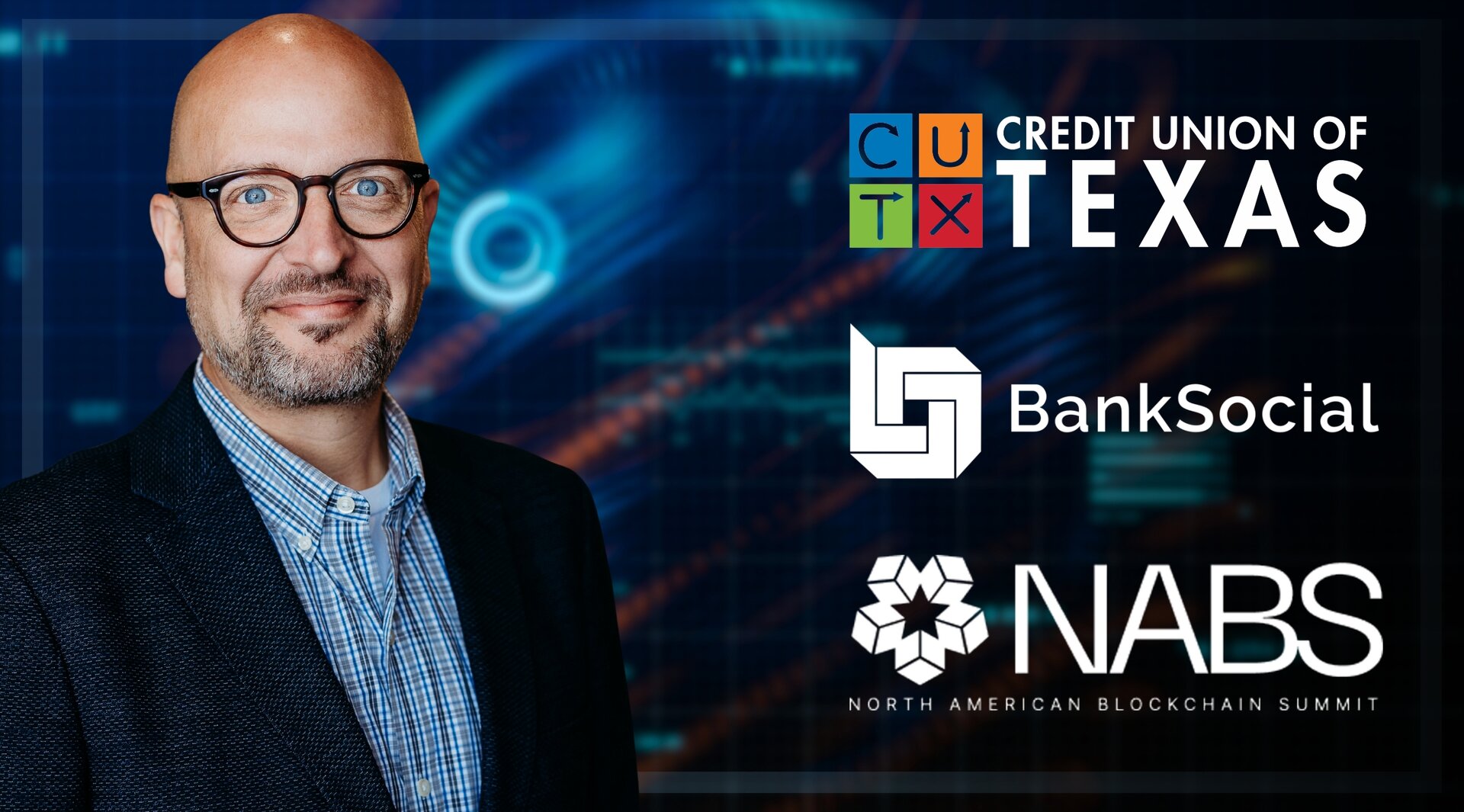
Texas has a significant role in the world today. It’s not by accident that the team at DisruptionBanking travel to the Lone Star State so frequently. It’s because it’s where it is all happening. It’s also where the Credit Union of Texas and BankSocial recently agreed on a partnership enabling more consumers in Texas the ability to interact with crypto.
In March 2023 our team attended the Future Digital Finance event in Austin, Texas. It was the first time that we became aware of the amount of credit unions operating in the U.S. What was also important to note were the similarities between how credit unions are owned by their members and the way decentralized autonomous organizations (DAOs) work.
Importantly, John Wingate, CEO of BankSocial, has taken this a step further. He has been active in bringing distributed ledger technology to credit unions. Credit unions whose members are increasingly interested in cryptocurrencies. Members who want to work with a credit union because of its membership appeal. They don’t work with the big financial institutions; they want to be members. They don’t want to be another piece of data in the system that is useful to corporate shareholders.
How Decentralized Finance Makes a Difference
John attended the very first summit organized by the Texas Blockchain Council back in November 2022. He’s been an important advocate of the community ever since.
Decentralized finance (DeFi) is a particularly important area for John. The returns that are available to people from collaborating with DeFi are often generous compared to the interest rates offered on savings by traditional financial institutions like credit unions. He believes that people are not accessing the higher DeFi yields because the environment they operate in is very new. People who interact with DeFi often must be very technically minded which can further hinder the barrier to entry. It’s complicated and it can also seem risky.
Where credit unions come in is that they are trustworthy. Much like the DeFi ecosystem, they are decentralized by nature, but there is a more trusting community focus.
How Credit Unions are Embracing Blockchain
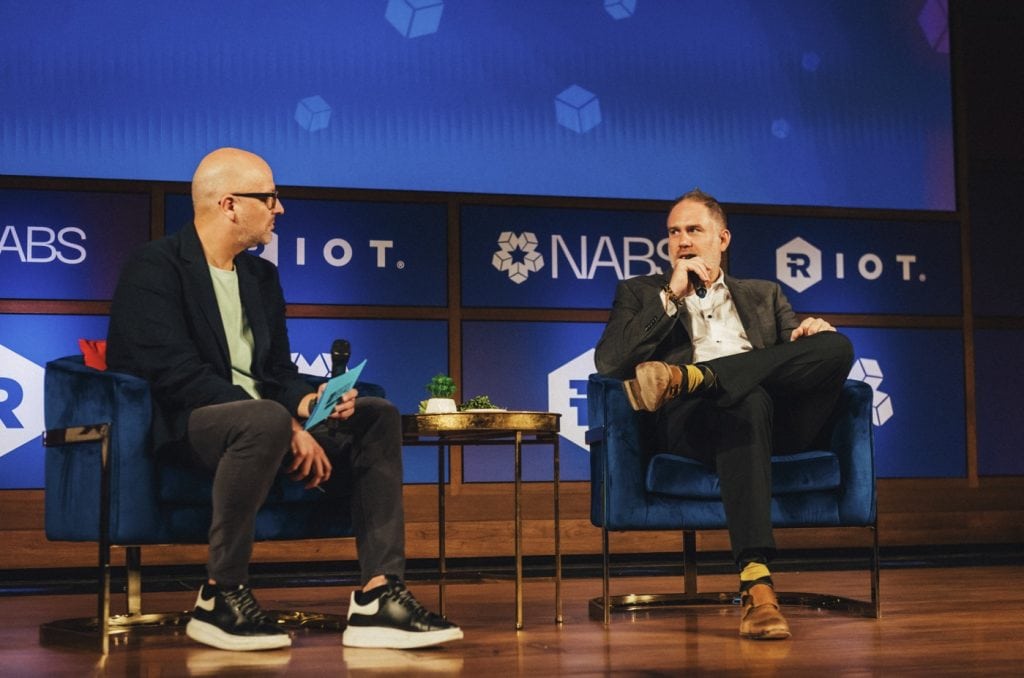
John sat down with Eddie Army, Chief Marketing Officer of the Credit Union of Texas (CUTX) at the recent North American Blockchain Summit (NABS25) organized by the Texas Blockchain Council. He wanted to discuss exactly these similarities. More importantly, he wanted to discuss the myths that exist about credit unions. He wanted to discuss the next phase of the partnership that the two companies announced this month. Finally, he wanted to talk about credit union members and their understanding of crypto. The so-called ‘myths’ that are widely held but rarely discussed.
The partnership between CUTX and BankSocial means that CUTX is one of the first credit unions to offer its members the ability to seamlessly buy, sell and manage their own digital assets, like Bitcoin, Ethereum, XRP, and others. Education is built in, and members get a self-custody wallet to populate. It is an important partnership for both companies.
Although many of our readers and the wider blockchain community will understand these sentiments and trends, consumers may not. Myths still exist, as well as doubts and uncertainty. Eddie and John tried to address them.
Myth: Crypto is Just Speculation
John started by emphasizing how he doesn’t believe that speculation is up for debate any longer. Institutional investors have embraced cryptocurrencies, not to mention millions of retail investors.
What John has observed, both himself, and through interactions with credit unions is that crypto is really about ownership. It’s also about eliminating the middlemen who create friction who make ownership overly cumbersome and often expensive. John shared how he sees the removal of friction as one of the goals of credit unions.
“To eliminate a cost and pass that benefit on to the member,” John highlighted. “This is the primary goal for credit unions.”
Myth: Credit Unions are Too Slow
The discussions continued with the topic of how credit unions may be perceived as being slow. John highlighted one of the initiatives that the National Credit Union Administration (NCUA) has undertaken. The NCUA is an independent federal agency that insures deposits at federally insured credit unions, protects the members who own credit unions, and charters and regulates federal credit unions.
John shared how the NCUA back in May 2022 issued guidance to credit unions exploring blockchain. He pointed out how the NCUA was the first regulator in the U.S. who looked at blockchain in a positive light. John shared how credit unions have a history of innovation, precisely because they listen to the members who own them. Take Tri-Cities Credit Union in Washington, which beat billion-dollar institutions to the punch by introducing mobile banking and remote deposits in the early 2010s. This was in response to members’ demands for on-the-go access. This agility continues today, as seen in the partnership between CUTX and BankSocial.
This is particularly important, as the partnership between CUTX and BankSocial is months ahead of anything the big banks in the U.S. have done with blockchain so far. A partnership that is very much still at the initial stage of its evolution.
“We actually see that credit unions are moving forward at light speed,” John explained. “They are the best institutions to be partnered with.”
Myth: Members don’t care about Blockchain
Eddie explained how members want lower fees, faster transfers and transparency. However, he also shared how members may not correlate these needs with the benefits of using blockchain technology.
John elaborated by sharing how members want to move money without being overcharged. They also buy digital assets. When they travel outside of the U.S., they want to have lower fees and the ability to quickly and easily transfer currency and even buy stablecoins when required. How, for members of CUTX this is now becoming a reality.
Myth: Only Banks and Fintechs can afford to adopt Blockchain Technology
John sees technology as a commodity. Whereas it could take a few working days to implement a payment system into your company’s website, it can take minutes to add a plugin that can handle crypto payments. This difference in speed makes blockchain a viable and valuable alternative to traditional payments.
He pointed to how digital banking apps were replacing physical cards. In turn lowering the cost of banking.
“Because technology is now a commodity and we can move at a speed we couldn’t move at 5 or 10 years ago,” John explained. “Add to this how the cost of AI has diminished, and deployments have come down in orders of magnitude. It means that now we can move at speed. Speed that puts institutions like credit unions first.”
Myth: Blockchain will replace Traditional Banking
John wasn’t happy with the word ‘replace’. He sees it more of an evolution of traditional banking than its replacement.
John highlighted how the same fintech providers and crypto organizations who were suggesting that banking as we know it was coming to an end till recently have changed tact. Since the Genius Act provided much needed clarity, many of these organizations are now themselves trying to become banks.
“Traditional banking is going to evolve heavily,” John shared. “Blockchain can help evolve the mechanisms of traditional banking that made money movement expensive.”
To move $1 safely can take up to 20 vendors, John pointed out. Many of these vendors are siloed and this lack of efficiency all adds to the costs of moving money. What John hopes to see is what he likes to call ‘co-operative capitalism’. He believes that this will completely disrupt traditional banking vendors who facilitate money movement, safety, security, and more.
BankSocial Digital Wallets available to CUTX Members
As the discussion concluded, Eddie came back to the partnership between the two companies. He was keen to highlight how CUTX members can now access BankSocial digital wallets allowing them to buy and sell digital assets. Other services are being planned. Eddie believes that this move by CUTX is just a start, and that it is also precisely how CUTX can most effectively serve its members.
John added how much he had learnt from cooperative financial institutions and community outcomes. He would encourage everybody to familiarize themselves with what cooperative capitalism means, especially in relation to digital banking.
John sees a future where consumers will interact with AI within their digital banking apps. A world where they will chat with their AI about when to buy bitcoin or Apple stock. Where AI will discuss this move with the consumer and give solutions for best outcomes in money management and investment.
In the future, John hopes, we are going to find a radically different world that is empowered and driven forward by innovative institutions that focus on communities.
Eddie encouraged delegates to download the CUTX app to experience the innovation that has been undertaken so far. To glimpse the future of digital banking together.
Author: Andy Samu
The editorial team at #DisruptionBanking has taken all precautions to ensure that no persons or organizations have been adversely affected or offered any sort of financial advice in this article. This article is most definitely not financial advice.
See Also:
Credit Union of Texas and BankSocial® Bring Self Custody Crypto to Members | Disruption Banking
Future Digital Finance Focus On Customer Experience | Disruption Banking
Why Credit Unions Should Consider BankSocial® and its Hedera Solution | Disruption Banking